Visitors to Guernsey (or Jersey, for that matter) early in the 21st century, can have little idea of just how ideal life in the island would have been in 1939. Essentially unsullied by war or strife since 1066, the tight-knit community – descendants of Norse invaders, Frankish settlers, the Norman Conquerors, British settlers and English, French or Irish smugglers – were a self-sufficient enclave. They lived and prospered in an idyllic paradise of fertile farmland and clean spring water, with a climate blessed with good weather due to the breezes and tides of the gulf-stream. It was an orderly, lawful, well governed and God-fearing society…the earliest church missionary being St Sampson, a French priest from Brittany who arrived prior to the Normans.
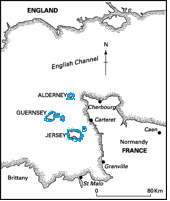 In the 1930’s, with plenty of everything the land and sea could produce and provide, these conservative and quietly reserved, multilingual folk resided in solid granite houses, many of which had survived since the 11th century. Their island home – the surrounding waters of which had foiled many an attempted unlawful landing by virtue of their hidden, rocky, submarine outcrops and reefs – had one added security in that it was obviously too small a target for invasion at such a high risk. (The disproportionately large number of recorded shipwrecks on its reefs and shores bear mute witness to the hazards). From the days of the wars with Spanish and French armadas to the recently-past Great War, things had remained much the same. No one had bothered with them and the declaration of another war held no real threat to the status quo…or so it seemed.
Irene continues: And so war had come to Europe again. As we gradually entered into this realisation, we began to get to grips with new demands and situations. First of all it was blackout restrictions. Though irksome, we were told how vitally important they were, needing to be attended to immediately. When looking up at the height of the windows in the main auditorium and Sunday school hall, plus those of the flat, perched high at the rear of the building, as well as the turret on the highest point of the roof, the mind boggled. Just how could all this be done? Gilbert gathered a group of the church men to discuss and plan how best to tackle the job.
In no time a great scene of activity began to take place as huge wooden frames, with black building paper stretched and fastened onto them, began to appear. These shutters were made to fit inside the windows of the auditorium and hall. They were constructed in such a way that they could be removed for morning services and daytime activities, in order to save on electricity, which had to be a major financial consideration.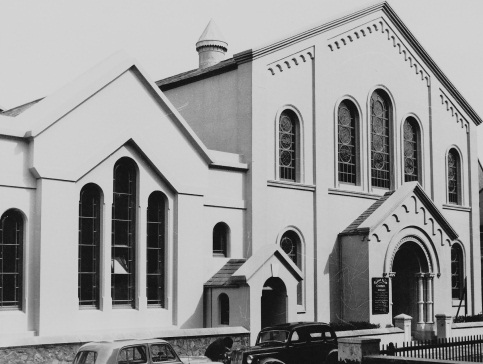
The little windows of the ‘turret’ were painted with black enamel whilst black curtains adorned the flat. After several attempts and modifications, not one ray of light could be seen from any window in the complex. [The ‘turret’ was later renovated and windows removed – as per photo.]
All households were just as busy ensuring that the many demands for security and safety were carried out and, even though time-consuming and costly, everyone did their best. Each family assisted others with the task and the ever-inventive Gilbert joined in with great enthusiasm. Invention was certainly a necessity with some of the widows in those tall Guernsey houses.
The ‘Guernsey Press’ newspaper began to run regular reminders, that blackout instructions had to be followed to the letter of the law and that fines would be collected by the authorities. This matter was obviously considered, by the powers-that-be, to be of the highest importance.
Next, we all received our gasmasks. Then it was ration books – the authorities realising that our dependence upon shipping supply-lines from England may be somewhat affected in days to come, so economy now would be a wise preparation. There were pamphlets to read, newspaper warnings to heed and radio broadcasts to listen to, as we were instructed in all manner of things relating to wartime living, but gradually, after the first uneventful months of the war dragged by, we began to refer to the situation as the ‘phoney war’. Life just seemed to go on in its usual comfortable way.
Gilbert and I really loved the island and its wonderful people. The Royal Enfield was doing great service and was truly a real asset. As we visited our people, we discovered the many beautiful places tucked away here and there. The first time we saw the little Les Vauxbelet Chapel we were simply charmed by this exquisite work which stood, for the entire world to see.
By repute it is the smallest chapel in the world, the handiwork of a Catholic priest who built is from pieces of broken pottery, glass, gemstones and shells. When anyone would have a breakage of china it would be saved until they were passing through St Andrew, when it could be left in a box outside this miniature building. The collected pieces would be sorted according to colour and size and, in time, be moulded into a portion of the ceiling, wall, floor or pathway, in turn becoming part of this place of worship. (The spiritual significance of this has continued to speak volumes to me over many years as I have thought of the broken lives who are placed in the hands of The Creator and…above all…how those same lives broken by sin and shame can be cleansed and moulded into something beautiful that brings praise and worship to the Lord Jesus Christ.)
The bays always held great joy for us…sheltered coves on the south coast, accessible by easily-traversed, steep paths down the heavily wooded cliffs. As one descended these tracks, glimpses of the blue sea appearing between the high gorse bushes and thick stands of pines are breathtaking. Such unspoiled beauty makes it hard to find words to express the depth of exhilaration that fills me when in memory I walk those places again.
Such were our first months in Guernsey. War was all around us but here tranquillity and freedom could still be found. Our days were busy in the work of The Kingdom and we were so very happy.
This sense of security that had taken hold of most islanders…and us…lasted until the spring of 1940.
Autumn passed and soon winter months brought some cold days and in December a little snow fell. Along with our young people, we both went carol singing. Oh, it was SO cold! I remember stamping my feet and rubbing my hands as we all stood in a circle singing the much-loved carol ‘O Come All Ye Faithful’. The evening’s highlight was our visit to the home of the Governor General and his wife where, after singing in the mansion porch-way, we were invited inside to enjoy hot cocoa and mince pies. It was all very exciting. It was such a lovely way to think of the truth of the Saviour’s birth – that wee babe who came that we might know our Heavenly Father’s love for all mankind. It was also a very special time for me personally, as I had just discovered that by the following July I should be cradling a baby of my own and that was such a wonderful secret to hold in my heart.
Our Christmas celebrations took place much as usual. Rationing curtailed some of the luxuries but it was amazing how one hardly realised there was a war on. The New Year followed quietly. On the war front nothing much seemed to be happening. The sense of ‘oh-so-false’ security prevailed well into spring, until the surprise attacks on Holland, Belgium and Luxemburg gave a jar to our complacency.
Suddenly there was much going on in halls and offices of The States of Guernsey. Defence measures came under closer inspection. Security was tightened. A review of imports and exports was conducted when, in the third week of May some of the cargo ships did not arrive on time…or at all. Cargo destined for England was often left harbour-side at the White Rock due to lack of space on the reduced number of vessels. Tomatoes, flowers and early potatoes were affected by this, causing a downturn in the island’s trade earnings.
Sometime at the end of May, two fishing vessels came into the harbour packed with men, women and children fleeing from France. They were given hospitality, refuelled and eventually continued on their way. This was a sobering sight for us. Soon other small sailing vessels of various kinds followed. In most cases the passengers were in great distress. Their condition was due to the harrowing escapes most of them had made, followed by their long and dangerous voyage which was nerve-rackingly slow, as a result of the extremely calm weather which had hindered their crafts’ progress in waters prowled by German E-Boats. These too were re-provisioned to enable them to continue on their way. Where…or if…they eventually landed was never known to us…possibly England or Ireland.
Hearing news of the use of airborne troops being dropped into the European lowlands became disturbing but still the feeling ‘it can’t happen here’ persisted. No one seriously considered that this comparatively insignificant fragment of the British Isles would be of any importance to the Nazi cause, not even thinking of the pride that possession would be in the German mind at having just set foot on the doorstep of our great nation.
Dunkirk and its great evacuation came with alarming swiftness and the German breakthrough in France is all a matter of well-known history. Now the Channel Isles alone stood between the continent of Europe and England.
Saturday June 8th, 1940, the Lieutenant-Governor of Jersey became concerned that the Germans would likely attack their Island, being the closest to the coast, if Germany inflicted a total defeat upon France. He hesitantly sent a message to the Foreign Office in London expressing his opinion. His fears were heightened at dawn when he awoke to a great pall of smoke arising on the horizon, from the French mainland, so dense it darkened the noonday sun. The French were apparently burning their oil storage tanks to prevent them falling into the hands of the advancing German troops. The Channel Islands became continually engulfed in twilight-shrouded smog with a thick aroma of burning fuel. The first signs of ill-ease appeared amongst the islands’ population.
It was a lovely Monday evening in June when Gilbert and I strolled on The White Rock, the quayside we loved so much. There we saw a large troopship being boarded by Royal Air Force personnel. We stood and watched. A young girl I knew…and had seen displaying a lovely diamond engagement ring on her finger after a short, whirlwind courtship with a young RAF officer…stood nearby weeping bitterly. (I have since wondered if she ever met up with her RAF officer-fiancé again. They had been quite a handsome couple. )
I clearly recall saying to Gilbert, “It looks as if they are taking all the RAF men away, I wonder why?”
Gilbert replied with a casual shrug, “Oh, they’ll probably fly in some fresh ones tomorrow.”
Turning away we made our way through the High Street and Smith Street before climbing up the hill past Elizabeth College and into Union Street, on our way home to enjoy a good night’s sleep.
Tuesday evening found us in the church’s weekly prayer meeting in the Sunday school hall. On walking around the church buildings after the gathering, to make sure everything was locked up for the night, Gilbert paused to say goodnight to the soldier who was on ‘sentry-go’ at the corner of the street. (This was a precautionary measure now being taken in certain locations near public buildings and places).
“You don’t look very soldierly tonight,” he remarked humorously, noticing that the soldier’s rifle was being held upside down.
“No sir” was the reply, “You won’t yet have heard, but the Islands are to be evacuated tomorrow. Key personnel have been flown out today”.
What a shock! I can’t remember exactly what happened after Gilbert had returned to give me this news except for many telephone calls and a sleepless night!
The previous Sunday June 16th, the British War Cabinet had sat in special session in White Hall. Following Dunkirk, other British troops from further along the French coast had retreated to Jersey from St Malo, along with two RAF Hurricane Fighter squadrons and had set up basic fortifications. Amongst other matters, an important decision had to be made: “What do we do about the Channel Islands?”
The Chiefs of Staff put forward a recommendation to the War Cabinet that the Islands be demilitarised. It was decided that, in the interests of the civilian population, the Islands should not be defended.
(Apparently the only dissenter to this cabinet decision was Winston Churchill, who believed the Royal Navy would be able to protect the Islands. He believed it to be most un-British to give them up without a fight, in light of the vital role they played in England’s history. Besides, it was “British soil” and he couldn’t see any reason to cede it to the “Hun”. He was outvoted.)
 enemy on the Island - WWII
Pingback: 04. Storm clouds gather | enemy on the Island - WWII