(Author’s note: For a great number of their married years, Irene kept a excellent diary of events. I have relied upon many of her written memories for a great deal of information about their early life together, especially their experiences in the Channel Isles. In this segment of the book I will quote [in italics] directly from her notes. In order to place Irene’s writings in true perspective with the times to which they relate, I have inserted historic, geographic and general information which will, I believe, be an aid to the reader.)
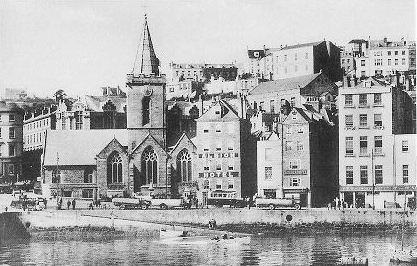
On May 1st 1939, Gilbert and Irene set sail on the ferry from Southampton bound for St Peter Port, Guernsey.
I took a deep breath of sheer delight. How lovely it all looked, how very ‘olde worlde’! Holding the ship’s rail I gazed around. Quaint granite houses perched high on the hill overlooking the township and harbour. In the foreground stood the fine, old Town Church, with its impressive spire. To my right, as I looked back out to sea, was Castle Cornet – an impressive-looking, historic fortress, set on its own small island; connected to the main harbour wall by a long jetty. Small craft were bobbing in the waters of the inner harbour, Oh, it was all so delightful. I was charmed!
Gathering up our luggage, we stood, waiting our turn to disembark. We gazed at the sea of faces that were the people, awaiting arriving friends. Finally it was our turn to come down the gangway. My heart – and I guess Gilbert’s too – was beating very quickly. Who would meet us? What would be our first impressions…or theirs? Then, out of the crowd stepped Reverend Pritchard, the outgoing pastor, a familiar face, known to us from church conferences. We felt relieved and warmed by his friendly smile. “Hello there,” he said cheerfully, “Meet our church secretary, Mister Batiste and his daughter, Enid.”
The warmth of their handshake and embrace told us immediately we were amongst friends. This delightful Guernsey-man with such a warm, radiant smile and eyes that twinkled with good humour, won our hearts from the first moment. His daughter, friendly and gracious, greeted us such sincerity that any fears I might have had were dispersed. Soon we met others from the church, charming folk whose speech often lapsed into their native Guernsey ‘patios’ (colloquial French), as they talked to each other – I wondered what and if they were saying about us, I must admit – but they also were so friendly, ready to receive us and we felt immediately at home.
With an established history of settlement predating that of mainland England, Guernsey is bursting with history. Archaeologists have unearthed relics and remains which confirm the presence of what they declare to be a six-to-eight thousand year old Neanderthal encampment on the western coast and ‘adjoining’ Lihou Island (connected to the main island by a natural, low-tide causeway). In subsequent years occupants have included migrants of Gallic and Frankish origin (the former from the region known today as Brittany) who established settlements …only to be threatened by invading parties of Vikings, who left traces of a community on the northern end of the island.
Probably the Island’s most notable role in history is the important and vital part that it played in the Norman Conquest of Britain…“1066 and all that”. Situated in the English Channel, not far from the French coast, the Channel Islands were part of the Duchy of Normandy and became the offshore fortress and launching point for the invasion by William, Duke of Normandy and his troops. Being closest to England, Guernsey became William’s headquarters and there is, quite naturally, a tremendous pride amongst the descendants of the ‘Conquerors’ about this important role, that their home island played.
Even to this day a medieval language, in the form of the local ‘patios’, is spoken amongst the older families who will tell you, with a gleam in their eyes, that it is, “the variety of French spoken by William, himself.”
The Channel Islands hold unique status within the United Kingdom. They have their own currencies, tax systems and houses of parliament – known as “The States” – one house in Jersey, administering that island’s affairs, the other in Guernsey, which has extended responsibility for Alderney, Herm, Jethou and Sark. Although officially in the Bailiwick of Guernsey, The Isle of Sark still operates under a feudal charter in the care of a ‘lord’ who resided in the famous ‘Signeurie’ – former home of late Dame of Sark. The isle is most famous for its total abolition of motor vehicles (except tractors).
“The States” are presided over by a Bailiff, whose role could be equated to that of Prime Minister, Speaker-of-the-House and Chief Justice all-rolled-into-one. Perhaps as an expression of the Island’s stance as ‘Conquerors of England’, the Bailiff’s chair in the States chamber is placed seven inches above that of the Lieutenant-Governor, the representative of the British Crown.
The Bailiff is, in short, the most important person in the Island, followed then by His Majesty’s Procurer (often referred to as The Attorney-General) and then the Jurats, who are members of the Royal Court as well as the States. (Sadly, despite its fascinating and unique history, there is pressure in the 21st century for this ancient and very efficient governmental form to be abolished in favour of a more liberal, modern model).
A visit to the Castle Cornet, which is now a museum of Guernsey history, reveals some interesting facts about the unique stance Guernsey takes with regard to Great Britain and its attitude to its relationship with the British Monarchy. Tradition locally, for instance, holds that Britain is a conquered territory of the Duchy of Normandy and, as such, the Monarch de Jour who sits on the British Royal Throne – which a continuation of the throne of King William I – is recognised and toasted on official occasions as “Our Duke”. To further emphasise the point, it is often heard said (albeit, usually in jest) that “Guernsey doesn’t belong to England…England belongs to Guernsey” or perhaps, “Ah yes, England…our oldest possession”
The island is nine miles long, and five miles wide, at its most extreme points. It is reputed to have over 500 miles of roads and lanes (possible, due to the hilly nature of the island) and yet still manages to preserve a portion of rural and natural parkland. The coastline on the south and lower west of the island is formed by spectacularly sheer cliffs, which shelter intermittent, small, sandy bays. These havens are accessible by pedestrian walking paths, steep laneways suitable for limited vehicular traffic or passenger ferry boats, which make the short trip from the St Peter Port harbour and are an enjoyable journey for holiday-makers. The remainder of the coastline comprises sandy beaches which, due to the large tidal rise and fall, stretch out great distances at the ebb. It is in all, a place of great beauty, historical fascination and exceedingly quaint. Formerly best known for its agricultural and horticultural excellence in tomatoes, daffodils and famous Guernsey cows, it is now more renowned as a tourist and tax haven.
In 1939 however, things were much quieter and more conservative, but no less striking.
Irene’s notes continue…Pastor Pritchard and the Batistes drove us from the White Rock (as the quayside area is known) up St Julian’s Avenue, along New Street and into Union Street where the church stood. Here we stopped. As the others went inside, I stood and gazed up at the buildings. The thick Guernsey granite walls of the whole complex gave a feeling of stability. Previously a Congregational Church, this building had been bought quite recently by the Elim Church. I thought it was also quite impressive; however I must admit I was most surprised that we had stopped first at the church building. I remember thinking that it was strange that we should be brought on a sightseeing visit of the buildings as soon as we arrived. I was just longing for a cup of tea and a chance to see where our new home was located!
Leading us through the large Sunday School hall that was attached to this quite fine looking church, we were both amazed to see Pastor Pritchard go to a small door and then hear him call out “Coming up, dear.” He proceeded to lead us up a narrow flight of stairs to a small room where his wife, who greeted us warmly, had breakfast prepared. We really enjoyed the meal as we were so hungry, having not eaten due to our excitement… and not wanting to get seasick. After we had finished eating, he said, “We have only about an hour with you as we are leaving to go back to England on that boat. We just wanted to put your into the picture.”
‘Put you in the picture?’ I thought, ‘…What picture?’
Getting up from the table we were taken to see a small kitchen, bathroom and toilet. Right next door was a living room. After climbing another set of creaky stairs we found two bedrooms, separated by another little room – that, for some strange reason, always reminded me in later days, of a little ‘ark’ – which eventually became Gilbert’s study. Through a small coloured-glass window, which looked out into the Sunday school hall below, it was possible to see anyone who was coming to our downstairs door…if you happened to be in there at the time, of course. The whole set-up was almost like something out of a Charles Dickens story.
Apparently, in the past, a caretaker had lived on the property but, due to the difficulty of finding accommodation nearby, Pastor Pritchard and his wife had taken over this portion of the building – disused since the change of ownership – and turned it into an apartment (or ‘flat’) for their use. Of this, and a few other facts he passed on, we had no prior knowledge.
Soon the Pritchards left in the car with the Batistes to catch the boat for their return to England. We stood and looked at each other in amazement, bursting finally into laughter for, amongst many other things, we had realised that there was not one inch of garden or ground anywhere. The church buildings occupied the whole site. Where could we sit to enjoy the sun? Would we have to go out to a park in order to get some fresh air? What’s more, how would we dry the washing? Our predecessors were older and longer established. They had used paid-laundry facilities – we were young; our salary and savings infinitesimal. I was perplexed…Gilbert seemed unperturbed. Not for long was I to be concerned though, as plans were already formulating in the mind of that man of mine. “Don’t worry,” he said with a grin, “I’ll fix a rope and pulley onto the roof of the schoolroom and run it to one of the bedroom windows and we can put the washing out that way without a problem.” (Windy days WERE to be a problem, however. Towels and sheets became detached from the line in the gusts which blew in from the storms in the English Channel, and fell onto the schoolroom roof, leaving permanent marks resistant to every form of soap known to man. Gilbert had also to put his life on the line, not only to set the line up but also to retrieve the items of stray laundry whenever they fell).
With all the zest of life we learned to laugh, love and turn the disappointments and disadvantages into adventures, knowing that the Lord was firmly in control of all circumstances. We rejoiced in His love and care.
There was no time to sit and be miserable anyway. Most importantly, there was the first Sunday service to prepare for, then (over the next week or so) a congregation to meet and get to know, in addition to readjusting our new abode to our own liking. As with most young ministers of the day, we really had to watch our budget. We had strong legs and healthy bodies and so we walked almost everywhere around the town. There were however, some of our congregation who lived on the other side of the island and needed to be visited in their homes and, although Guernsey is a relatively small place, the cost of bus fares were so high that something else had to be done.
“What about a motorbike, Dear?” Gilbert enquired excitedly one afternoon, about ten days after our arrival.
‘What sort of question was that?’ I mused to myself.
Hurriedly he explained, “One of the young fellows in the church is selling his and has offered it to me for six pounds ten shillings. What do you think?” Now, even that amount was a challenge for our bank account. But finally, after much discussion and prayer, the decision was made and we became the proud owners of a Royal Enfield 2-stroke which could be parked in a corner of the Sunday school hall, out of the weather – there being nowhere else to park.

Oh the sheer joy and delight of the trips we made. Off we went to visit all and sundry in high glee, travelling through the lovely water lanes and around the bays, past greenhouses filled with tomatoes and fields where Guernsey cows grazed. The sight and scent of acres of jonquils and daffodils, the stately homes with their manicured, classic gardens and the bite of the salt spray that blew in off the sea, all made pastoral calls so much more refreshing. They were truly wonderful, halcyon days in the ministry, even if some of the congregation were more than a little surprised to see a minister’s wife on the back of a motorbike…after all, it was 1939.
Those first happy months were filled with excitement. The church activities were many, as a vital and keen young peoples’ group, busy women’s fellowship, energetic Sunday school and well-attended Sunday services kept us on the go. The singing of the melodic voices in that Guernsey congregation, with its orchestra in accompaniment, was a joy indeed.
Barely four months had passed since the day of our arrival in May when, returning from the service on the morning of September 3rd the dreadful news broke upon the world that Great Britain and her allies were at war with Germany. Like everyone else, our hearts were filled with horror at the thought of the suffering, separations and unhappiness across Europe that would surely come, as the day became shrouded with deep forebodings for mankind everywhere. Yet, strangely enough, even as the truth began to dawn, we…like so many who lived in the Channel Islands…felt that little could happen to us. The islands were so small…too small…who would bother about them? In the First World War they had remained safe. Produce had been able to be sent to England and the necessities of life had arrived safely in return. Surely it would be the same again. It was as if we expected to be mere onlookers, spectators to a great drama.
As we all became caught up in the thought “it can’t happen here”, we little knew what awaited us…..
There is great truth in the words of the hymn, which says:
“God holds the key of all unknowns
And I am glad
If other hands should hold the key
Or if He entrusted it to me
I might be sad.”
 enemy on the Island - WWII
Pingback: 03. Guernsey…the big event. | enemy on the Island - WWII