At that time most of the civilian population of approximately 46000 people had little idea that lorry after lorry, loaded with munitions and equipment, had been driven to the docks following the decision by Great Britain to declare the Channel Islands a demilitarised zone. The military were being returned to England in an endeavour to preserve the Islands and Islanders. Strict secrecy was so important. At first it actually appeared as if we were being deserted but that, of course, was not the case at all.
Wednesday morning we went into the town to wait for the morning newspaper. The whole place was packed! News had spread rapidly far and wide. Country folk had driven in; townsfolk had flocked down, all waiting to see in print if what they had heard was truth or only rumour. Gilbert and I waited in the shop doorway of ‘Boots, The Chemists’ only to be increasingly squeezed up as more and more people jammed the intersection of the High Street and Smith Street.
Overnight, the States had met in an emergency session. They worked out the complicated plans for a coordinated evacuation as well as a contingency plan in the event that not enough vessels were available to accommodate everyone who wanted to leave. With great deliberation, not wanting to cause mass panic, it was to be announce a “voluntary evacuation” whilst taking into account the concern that many more than expected could decide to go. If such a situation should arise, and then only, it was decided that the “women and children first” rule-of-the-sea should be applied.
Once the papers were available they were quickly snapped up. All around one could hear gasps of amazement and expressions of dismay. Tears coursed down the cheeks of many as cries of fear and distress came from the lips of others. Panic took hold as readers were confronted by the headlines which screamed:
Island Evacuation
Whole Bailiwick to Be Demilitarised
Children to Be Sent to Mainland Today
Mothers May Accompany Children under School Age
The newspaper’s choice of emotive wording in the report, indicating that the Islands were to be left undefended carried the most unfortunate undertone of “women and children first” (that was to have been as a last-resort-only qualification), which became the cause of considerable panic and so much unnecessary heartache. (The result of the decisions made, based upon what was read between the lines would mean that many families would be torn apart geographically and emotionally…for the full five years. Some were able to devise ways and means to be reunited in England after a shorter period of time – but all of these factors were unknown at that time to those forced into having to make such a hasty decision, of course).
Further alarm was caused by the sounds of war which could now be clearly heard across the Channel waters from the French coast. The boom of heavy artillery fire, air-raid bombs and demolition explosions carried over the short distance to the Islands. The imagined terrors of bombings, invasion, and much-feared Nazi rule…with its reported atrocities…flooded the minds of parents caught in the straits of indecision – to send the children or not to send the children, that was the question.
By Wednesday midday, a letter had been personally delivered to the Lieutenant Governor from London:
To: Home Office 19th June, 1940
Sir,
I am directed by the Secretary Of State to say that, in the event of your recall, it is desired by His Majesty’s Government that the Bailiff should discharge the duties of Lieutenant-Governor, which would be confined to civil duties, and that he should stay at his post and administer the government of the Island to the best of his abilities in the interests of the inhabitants, whether or not he is in a position to receive instructions from His Majesty’s Government.
The Crown Officers should also remain at their posts.
I am, Sir,
Your obedient servant,
A. Maxwell.
Later, when the evening paper came out, there were more specific details given. It was to be a voluntary evacuation, not compulsory – as many had thought when reading the earlier press. Meeting places for schoolchildren and teachers were detailed; practical advice as to what children should take with them; information outlining facts relating to the ships that England was sending to pick the children up; details of the reception centres that were being set up to cater for the children on arrival; and so on.
White Hall [London] had hurriedly scheduled three cargo vessels which should arrive at the White Rock to pick up the school children at 6 a.m. on Thursday morning. School teachers were all briefed and meetings of the parents were called to explain the situation to them. Plans for transport and the children’s subsequent care in homes and schools on the mainland were fully outlined. After the meetings teachers reported back with the numbers of children whose parents had indicated they would give permission for them to leave.
The plans that had been formulated by the authorities over the previous two days, and the whole task was undertaken with great efficiency, despite one or two small hitches.
It was an incredibly sad night, especially for those living in St Peter Port township near the harbour as, in the early hours of the morning, the lanes echoed with little footsteps and hushed children’s voices as the school groups marched to the harbour. Unfortunately the first ship, HMS ‘Antwerp’, which was to transport the initial group of children, was running nearly two hours late and two thousand children had to huddle close together in the pre-dawn chill, without any shelter.
When it finally docked, there was some disagreement between the office of the Sea Transport’s Load Master and the local authorities, as the L.M. wanted to on-load military equipment and troops first. A phone call was made to Major Sherwill, who jumped immediately out of bed, climbed straight into his car, and headed directly to the quayside to intervene. Fortunately, common sense prevailed and before long the first dispatch of children, teachers and some mothers was completed.
Almost immediately a steady succession of other school groups began to arrive at the docks, as more vessels arrived; then another group; then another; and so it continued for over 3 hours. At one point, the teaching staff of Elizabeth College marched out of the college grounds…at the head of what appeared to be a triumphant parade…leading the entire student body, en masse, to the wharf. By mid-morning Friday, those children, whose parents had so decided, had gone!
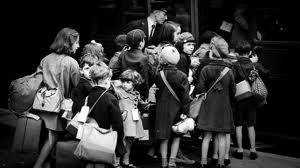 It was estimated that 5000 children were transported safely from the Island in 31 hours. An amazing effort, but many were the sad scenes in those hours. Men holding their children as if they could never let go; tears flowing freely as parents took children to the boats; some panicking and rushing back home with them to reconsider then rushing them back to the boat once more…sometimes several times; anguish registering on faces, reflecting the turmoil within. They were days that one would never wish to see again.
A noticeable quiet seemed to settle upon the whole Island. Ambrose Sherwill noted in his personal diary…“ No children play in the streets and mothers mourn the loss of their children and will not be comforted.”
Irene continues in her memoirs: After the children and mothers with pre-schoolers had left, a Red Cross ship came to take any aged, infirmed and hospital patients who wanted to leave. Expectant mothers were also advised to leave as authorities had realised that there could be many difficulties and complications which could arise if and when supplies scarce, causing babies to become undernourished or worse. The entire situation was so fluid that any and every eventuality had to be considered.
It was at this time that I personally came to realise the truth of that Bible text from Romans, chapter 8 verse 28, “And we know that all things work together for good to them who love God and are called according to His purpose”. The wonderful hope of an early-July baby had been dashed. I had experienced the pangs of late-term miscarriage and my broken heart had cried, “Why, Lord?”…but now I could see clearly the love in the planning of my Heavenly Father. Naturally Gilbert would have chosen for me to have left the Island for the baby’s sake and my own. The Psalmist declares “As for God, His way is perfect” and I really do believe that to be true. There was another purpose too, I think. Because I had known that experience of such a loss, I could more readily relate to (and provide more comfort for) others when, as days passed and their hearts were breaking at the absence of their children. I now knew a little about their anguish and could feel more deeply than if I had not known ‘empty arms’
Irene lost her much longed-for daughter who, had she lived, would have borne the name Elizabeth.
Next to be given the opportunity to sail were young men of military age. Due to the fact that the Channel Isles are self-governing (although totally loyal to the crown), these men had not come under UK conscription but had stayed to assist the agricultural and cattle programs that would assist in food supplies to the mainland. It was now considered far better to leave and fight rather than stay where the situation would likely mean their deportation to somewhere in Europe. And so the lists continued as category after category departed and soon we were left with a decision of our own, when other boats were delegated for any who wished to leave of their own volition.
As far as Gilbert was concerned, for him there was no choice to make. He told a fellow minister, in my hearing, “I have been called to shepherd my people. While one member of my congregation remains, I shall stay also.” He went on to quote from St John’s gospel, “It is the hireling who flees because he is a hireling, but the good shepherd stays with his sheep.” He had no doubt whatsoever, “I MUST stay.” I have always loved to recall that and thank God for his loyalty.
It wasn’t quite the same for me though. My father had been trying to telephone us all day but the lines were jammed with so many callers. Eventually, at about 2am, he got through. “You must come home. You know what could happen if the Germans come.” Having served in the First World War and witnessed the atrocities, his insistence was most intense. I wanted to assure him – but couldn’t. I didn’t know what to do!
Gilbert gave me small comfort in this, really, except to gently encourage me to seek to be sure for myself. It wasn’t easy because we had heard that priests and pastors had been put into concentration camps in the wake of the German advance through France (and even in Germany itself). Who could know what they might do when they arrived and found Englishmen who were ministers…would they suffer the same fate? If so, the anxiety for them would be not only for their congregations but for their wives also! Deep in my heart I knew one thing, I wanted to do what God wanted me to do – He Who had changed my life so dramatically at my conversion; Who had led me in so many ways from that day to this; the One whom I loved and for Whom I wanted so much to do His will…direction seemed so unclear as I prayed but could see no light.
Truly I was a woman in every sense during those next few days! One day I would go, pack and get ready…only to change my mind the next. This happened time after time, sometimes within hours. Then someone telephoned me. “My sister and I will be going on the boat. Why not join us? We can travel together to London so that you can meet your parents.”
Was this my answer, I wondered?
Once again I packed, put on my navy suit and hat (I’ve every reason to remember them well – I wore them for almost all of the next five years!!) and stood at the top of the stairs.
Turning to Gilbert, I asked again (as I had so many times), “Do you want me to go?”
“You must do what you feel is right,” he answered.
I went down the stairs to the little dining room and just stood there. Then I saw a little ‘promise box’ on the window ledge (it wasn’t actually ours, it had belonged to the previous Pastor who had left it behind). Opening the lid, I picked up the little tweezers attached to the lid by a small, silken cord and took out one of the small scrolls. I read it. “The Lord will guide you continually, make fat your bones and satisfy your soul in drought…” (Isaiah 58:11). In that instant of time, I knew what God wanted me to do!
One of the major concerns of which we had been warned, was the probability of food shortages and water scarcity and here was the promise of guidance, food and water. What was more (after taking my Bible and reading through the whole of verse 11 and verse 12), it was also clear I could be a blessing and help to other people. It burned like a fire in my heart! I turned to Gilbert who had come down into the room. “I’m not going!” I burst out, “listen to this.”
Reading him the words, I was completely filled with assurance and can honestly write that, in all the following five years, I never once said that I wished I had gone. Reading God’s Word had shown me His will. His peace filled my heart completely.
That issue being now settled, I immediately joined Gilbert in visiting our people of the church. Until now my mind had been preoccupied with my own problem, so much so that, although Gilbert had already been visiting folk everywhere, my selfishness had prevented me from joining him. (I’m not proud of that. How easy it is to be so involved with ‘me & mine’ that others are forgotten). We found that about half of our congregation had evacuated – a proportion consistent with the island population at large.
Statistics showed that by this time almost 50% of the population of Guernsey had evacuated (an estimated 23,000 remaining), whilst on Jersey less than 25% had made the decision to go. This was obviously a reflection of the differing attitudes with which the administration of each of the two main islands had viewed the whole evacuation process.
[Conversely, on the Isle of Sark, The Dame calmly called all of the islanders together in the church hall and bluntly informed them that she fully intended to stay. She had experienced some previous dealings with Germans, could speak and write their language and believed there would be neither trouble nor atrocities if everyone just went about their daily lives and business without any fuss or ado. It was apparently a major tenet of her faith that ‘one does not abandon one’s land for any invader’. “However,” she said, “I can’t promise it will be easy. We might get hungry but, as you know, there are plenty of rabbits, and fish too”…words which would later come back to mock her when all guns with which to shoot the rabbits were confiscated by the invaders and the fishing waters were sewn with sea-mines. Of the stoic ‘Sarkees’, only a handful evacuated but Alderney was to be totally evacuated …complete with almost the entire stock of pigs and cattle].
Our Sunday school, which had been large, had only two children remaining. Like the town, where the streets were so quite, it was almost as if we had known the visit of the Pied Piper. Still, many people were undecided even yet as the last of the boats arrived to take evacuees. Panic still prevailed in some homes and certain situations. A local shoe shop owner put his entire stock of footwear on the pavement for folk to take freely and locked the doors on his empty premises; a man sold his car for one pound to a passer-by just before boarding the ship; drivers filled their cars with petrol without charge when the garage proprietors decided they did not want the Germans to have any of it if they arrived…IF they arrived! WOULD they? Who knew? How could ANY of us know? The waiting game was trying and nerve-racking!
In what was to be the last week of freedom, things appeared outwardly to settle down – although in many households that was not quite the case. As the last few boats came and went, settled minds suddenly became unsettled again, as panic reared its ugly head. Before dawn, sudden and irrational decisions were inexplicably made, as bags were hurriedly packed, breakfasts gulped down and entire families piled into the car to dash to the White Rock for what may (or may not) have been the last sailing for England. Often beds were left unmade, breakfast dishes on the table, cats, dogs and birds left uncared for – such was the distress of some. Later, their friends who had opted to stay found their way into the dwellings to clear up. Some cared for pets, as long as it was possible (sadly, many had to be put down), whilst others picked up abandoned cars from streets around the quayside at White Rock, to return them to the departed families’ garages.
Just prior to the evacuation order, Gilbert had sold our motorbike and had been able to pick up a little Austin 7 for the princely sum-total of just eighteen pounds. How proud of it we were, as it stood in the street outside the church schoolroom. We lovingly cleaned and polished it – had it been a Rolls Royce, it could not have received more care! We then found that a man had an unused garage about 5 minutes walk away from the church which we rented for two shillings and sixpence a week – what affluence!
Immediately, the Austin 7 truly proved its worth, as we were called upon for visitation to calm, assure, advice and pray with our people as best we could… at all hours of the day or night.
 enemy on the Island - WWII
Pingback: 05. Evacuation…or not | enemy on the Island - WWII