09. Beg Swap or Borrow

09 Beg Swap or Borrow

Soap, soap, soap; what will you swap for soap?”…

“Has anyone a gas mantle? Swap for whatever”…

“Will swap good pair brown shoes, size 4, for warm skirt”…

“Man’s grey suit and braces, for sweet-corn or whatever permissible”…

…and so, on and on –  the daily papers’ “swap columns” made interesting reading and just sometimes we found it possible to comply with some very odd needs. 1941 was turning out to be a very strange year indeed. I once traded some new curtain material for sugar beet syrup (and then at the end of the occupation totally regretted it when I tried to replace those curtains at a reasonable price!). It is certainly unusual what necessity will force us to do.

The “Exchange Mart” advertisements in the Islands’ newspapers were a vital part of community life and engendered a real spirit of cooperation. It was good to be able to help a fellow-islander out. Besides, in a ‘help and be helped’ environment, one never knew when they would be the one in need. The phrase “whatever permissible…” was added because the trading in or bartering of certain restricted or rations goods and food-stuffs (especially) was strictly ‘verboten’.  

In time, it came to bear the cheeky, hidden sentiment … “whatever is NOT permissible.”  Likewise … “for what..?” and … “or what?” were used to heighten the hint of rebellion.

The ‘personal’ ads were also a site for revolution against the system, revealing another tendency for civil disobedience. For instance, a seemingly innocent message like:  “Ernest Albiges offers reward for lost or stolen black sow with brown marking on flank…” which could well be used as a notice that a beast had been ‘removed’ from an officially inventoried herd, slaughtered and the meat was available for the black market. The advertised notice would be used to support the ‘official report’ that the farmer was required to submit to the German Authorities, advising of the ‘loss of’ a stolen or strayed animal.

Between the Essential Commodities Committee and the German administration, the control of foodstuffs and livestock needed to be well controlled in order to maintain a steady supply of the basics of life…as much, apparently, for the troops as anyone. With the perception that the ‘occupiers’ were getting a far better deal than the ‘occupied’, the black market was alive and well. Farmers became especially adept at simple deceptions upon which the rather droll administration were slow to pick up as root crops with too much soil still clinging to them were helped to boost the weight of each sack at the weighbridge and tomato boxes contained an over-generous supply of tissue paper padding.

It was rumoured that on one occasion, a plain, ‘pink’ pig…the most common colour…was found to have died [genuinely] of a disease, which required a quick burial in order to prevent an outbreak. One of the authorities’ veterinary officers was called to inspect the animal and supervise its burial and authorise a stock inventory change. After the vet’s departure, the animal was dug up, washed thoroughly and taken to a neighbouring farmer’s where one from his herd was slaughtered. The diseased pig lay out in its place, having been suitably daubed with some dark vegetable dye to resemble a natural colour patch on its flank, ready for a vet’s inspection. After inspecting it, he certified the death and officially amended that farmer’s stock inventory. The slaughtered animal’s meat was put on the black market. The diseased beast was the re-washed, re-marked and laid out yet again, on its other side. It was reputed that the same animal was certified dead on no less than four farms! (In difficult times, the odd ‘urban myth’ can help lift flagging spirits no end!) 

During these days when the dreariness was taking its toll, our church’s weekly ‘Women’s Bright Hour’ (which I had initiated), really took off. Each Tuesday gathering was planned so that we could have different speakers. Looking back, I wonder how we found so many who were willing to take part but it was like an oasis in a desert for the many women whose life had been so drastically changed by the circumstances which had overtaken us all. The rows of bicycles, propped up against the outside walls of the church increased each week as more and more ladies attended. (Later, as cycles became the target of theft, due to their increased importance as transportation so the attached schoolroom became a safe ‘garage’.) We sang the hymns which gave us comfort and inspiration. Experiences of how we were coping were shared, useful tips and hints on innovation and economising were exchanged and the truths of God’s Word were shared in a practical manner that applied to our particular situation. The Lord Jesus Christ met with us indeed and the awareness of the presence of God’s Holy Spirit was precious, as we shared our faith and received much blessing. Likewise our Sunday morning services became a real powerhouse of blessing. The pews were full as Gilbert preached and taught with real authority, opening God’s word and applying its truths so accurately and honestly. Sunday morning Communion services brought us into a fresh understanding of our oneness in The Kingdom of God and we left our times together feeling we could face any emergency or contingency in the strength of The Lord, Who was truly our friend and saviour, strong shelter and refuge in every time of danger and difficulty. Events like these and others in the life of church and community, forged friendships of real depth and lasting quality. (At the time of rewriting my diary, many of those friends are now in God’s presence but their memory is of immeasurable value.)

Gilbert’s maturity as a Christian leader and pastor in the church and community was growing by leaps and bounds, as was his credibility and acceptance. They say it is pressure that turns coal into diamond. It was for ‘such a time as this’, it seemed, that he had been being prepared to meet the needs of so many people and God was giving him the physical and emotional strength to do just that, along with a measure of wisdom beyond his years .

Christmas drew near once again. There were few delicacies to brighten the occasion, unless one had still a few tins of fruit or jellies stored away from earlier days. Friends gave and shared what they had in the true spirit of the season as familiar carols were sung, the beautiful Christmas story repeated from pulpits throughout the Islands, and all rejoiced in the unchangeable truth – God loved the world so much that he sent His only Son, born in a land under military occupation, that whoever on earth believes in Him should not perish but have everlasting life. Decorations were hung in homes, shops and churches and on everyone’s lips were yuletide greetings, often with the hopeful postscript, “…and perhaps the war will be over before next Christmas.”

08. A Little Bit of Sunshine

08. A Little Bit of Sunshine

The day he arrived was a red-letter day. With a pale fawn coat, a white patch on his chest (that looked a little like the white triangle of a shirt that appeared between the lapels of a suit jacket), Laddie was a spaniel of a ‘not much looked-into’ line of pedigree, to which the description “a cross between a hearth- rug and door-mat” would be a generous compliment. He was cuddly and lovable with a very long tail which added to his ‘different’ appearance…but we adored him. We managed to feed him on scraps and offal, obtainable at that time for the feeding of animals, and dog biscuits. As time went by and the biscuits ran out of stock and offal became restricted, it became more difficult.

One of the most devastating factors of the occupation for the civilian population was the monotony. Time moved slowly…oh, so slowly. Tiresome routines and restrictions upon all manner of things, those that were taken for granted in the normal, replaced well-ordered rounds of everyday living in pre-occupation Guernsey. There were curfews, limitations, new laws and orders. It was a constant flow of orders, orders and more orders, many of which contradicted each other within 24 hours.  Above all there was the scarcity and blandness of available food. The staple diet contracted until, in the last months of the occupation, it consisted of turnips, carrots and parsnips, washed down with acorn coffee, the afore-mentioned blackberry-tea or other inventive substitutes (added to the menu as the isolation progressed).

At first, the abattoirs (where they butchered the meat destined for the menus of the German Authorities’ dining tables) saved the blood and intestines of slaughtered animals for pet food. However, with dwindling food stocks, more offal was made available for human consumption. The blood, when combined with breadcrumbs, suet or coarse-ground grain could be used to make black pudding. Intestines could be either rendered down to a heavy, yellow fat (ideal for frying black pudding), or cooked as a highly sought-after delicacy, known to the connoisseurs of the community as ‘pipes and tripes’.

Cambridge Park was handy to our house and ideal for Laddie’s walks on the lead so, Gilbert and I made this welcome diversion a part of our daily routine. It was an outing beneficial to all three of us. We had a kennel near the back door and Laddie was a cute and well-behaved puppy.

And then one morning, the kennel was empty!

We called and called but no Laddie. So, bicycles out, we set off in search of him, but with no joy. Later in the day I was told by a friend that they heard he had been seen on the back of a lorry with some German soldiers, on the other side of the island, his white ‘shirt-front’ and distinctive tail giving his identity away. Sadly, I thought my pet was gone forever. Certainly the soldiers were not going to return him…but as the days passed, I continued my calling and searching…just in case.

Early one morning, upon opening the back door, I was greeted with the unexpected sight of a log tail protruding from the kennel. With a cry of absolute delight, I called Gilbert, who came quickly to see what the fuss was all about. Thin, bedraggled, and exhausted, there lay our Laddie. He must have run for miles following his instinct to return to his home and he lay sleeping the whole day…just where he had flopped… with his tail in that same position…totally worn out.

 Next morning it was like he’d never been away. Gilbert went and got some scraps of horse meat, which we had gleaned from the slaughterhouse, and he gobbled it down. Then, tail wagging, running in small circles, barking and bounding around the garden in anticipation of a walk, he delighted us once again with his exuberance for life. What a faithful friend! 

Sometime later, when we had little or nothing of sustenance to feed him, we were forced to make the difficult decision to take him on his last walk to the vet. We never had another dog since Laddie. He was an ‘occupation treasure’ who helped fill our days with interest… a’ little ray of sunshine’, lent to brighten our way for a while.

07. Life Under the Jackboot

When in town, in those first occupation days, one felt as though it was all like a bad dream. Hundreds of grey-green uniformed men were everywhere. Shops were crowded as the soldiers who, finding good stocks of just about everything (at first), spent their ‘Occupation Reich marks’ with great gusto. Always they had to be served first and we watched with some annoyance as all kinds of clothing – ladies’, children’s, baby’s – were bought up and packed into enormous parcels and carried away to be posted to families in Germany. All too soon the shelves were emptied with no replacement stocks, as all communication with, and transport between, England and France (usual suppliers for the islands) had now ceased. To see a burly soldier holding up lingerie and dresses against one of his companions whom he considered to be the same size as the Fraulein for whom they were intended, was really quite hilarious, even though one dare not show it. (It made for a good laugh when shared with friends in private, cheering us up a little as we made the best of a bad situation.).

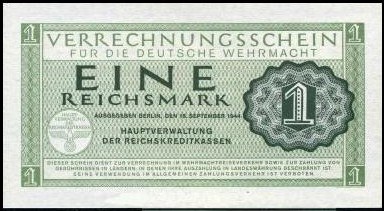
We were issued with ration books for the necessities, and a few small luxuries, of life but the coupons disappeared so quickly as so many had to be surrendered for a single items Along with rations came the necessity to queue for everything on the list, some of which were available in one place and others in another. Entire days could be spent in queues. It was also obvious that our buying power would soon be nil. Guernsey currency (the islands had – and still has – its own printed and minted Guernsey Pounds, Shillings and Pence) was soon exchanged for the special occupation currency introduced in each country they invaded…‘Occupation Reichsmarks’ …comprising German marks and pfennigs[1]. We found it hard to think of it as real money, somehow. It reminded me of washers and bottle tops.

The newspapers carried updated information relating to rationing and price-fixing of every believable commodity needed for daily living, every day.

Prohibitions on the sale of candles, burning of bonfires after dusk, photography within a mile radius of the airport, the custom of ‘treating’ in restaurants, keeping more than one month’s reserve of food in your cupboard, the private sale of tomatoes and potatoes, etc., etc., were reported upon in each edition, many of which were rescinded or modified within days. Such erratic – usually ‘knee-jerk-reaction’ – declarations, continued throughout the entire occupation, often becoming the source of mirth to the local population and making the German administration look decidedly silly, to say the least! [2]

Reichmark


German Occupation Money

Summer days changed to autumn, leaves turned red, orange then russet brown. Days grew colder and shorter. Always we hoped that the war would soon be over – perhaps even by Christmas! Hope is a wonderful stimulant. What a blessing that the future is veiled from us…and that, for the child of God, our trust is in His ability to keep us in the hollow of His hand.

Every now and then, rumour ran rife and excitement ran high as we heard of commando raids on the island when some Guernsey-men who had enlisted in the British forces, were sent by Royal Navy submarines to land on the island for various reasons. They made observations in order to try to ascertain the strength of the occupying force, its defences and the conditions under which the civilian population was now living.

Two elderly ladies, Mrs Le Mesurier and Mrs Michael, were transported to France for sheltering members of the British Forces who undertook one of several undercover commando raids to Guernsey.

British aircraft flew overhead on one occasion, dropping information of eight men who had escaped from Guernsey in a 20 foot boat. They left under cover of darkness, rowing half a mile offshore before starting the boat’s engine. Later the engine stalled but they worked to repair it and arrived in England safely. News such as this was most heartening and gave us fresh conversation to relieve the monotony of the situation. Needless to say, the Germans were not amused by these events and were seen, rather comically, dashing about the countryside picking up any leaflets they could find, threatening punishment for anyone caught with the offending papers. In the newspapers there were also threats of reprisals if further commando raids occurred and deportation to Germany for anyone caught harbouring any military personnel involved in the incursions.

Our radios were a great source of encouragement at this time. To hear the news first-hand from the BBC, along with the familiar programs was a great morale booster, but on November 14th all radios were suddenly confiscated. Local postmen were conscripted, by order of the Commandant’s Office, to collect them. The fine for disobedience of this order was RM 30,000…a real deterrent to everyone…but many took the risk and news received from the BBC was circulated under a blanket of secrecy.

 here were also fines imposed for a myriad of petty offences including – illegal milking of a cow [5/-]; not observing curfew hours [£1]; not ensuring blackout screens are light-proof; charging too much for merchandise; sketching, drawing or painting out-doors [5/-]; moving a pig without a permit [10/-]; riding an un-registered bicycle or insisting on riding a bicycle on the left-hand side of the road [2/6] (now that the Germans had changed it to the ‘right’), and so on and on, ad infinitum.

The first fine levied by the Germans was one pound for a gentleman defying the curfew as he ‘weaved’ his way home after dark, apparently.

The subject of bicycle registration had become an obsession with the authorities and provided the troops an opportunity to stop anyone as they rode along at whim to check for valid permits.

A humorous story arose, though, which concerned one of the members who attended the Elim Church who decided that, if he was going to have to have a permit, his would be number 666. He went to the registration office and stood near the door to question each person as they came out to see with what number they had been issued. As people were in no hurry to obey the registration order, the numbers were far too low to have reached the desired goal that day, he went home. The following day was not much better.

The third day he returned and again questioned those exiting the office. Things looked better so he positioned himself near the back of the queue in order to count off the intervening numbers until he could be sure that he would secure his preferred ‘mark of the beast’. It took almost all day to get close to the right number.

Finally, satisfied the numbers were into the 650’s so he joined the queue.

Unfortunately for him, the permits were printed in blocks of 30’s. When they reached 660, it seems the next block was picked up out of sequence and he walked out clutching the number 696!

Greatly upset by his misfortune. He never did speak of it, afterwards, but his story was often repeated amongst his friends and acquaintances and he was the recipient of much ‘leg-pulling’ in later days.

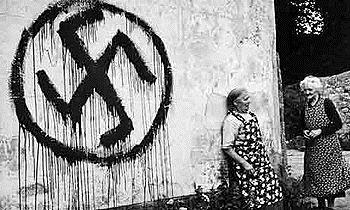
Swastika


A blood-red swastika, graffiti

It should be noted that the behaviour of the German troops themselves was, and continued in the main to be, almost irreproachable. One of the early fears amongst the population, as they anticipated invasion, was for the womenfolk. There was only one reported rape case in the earliest days, which was most unsavoury. It involved a very drunken soldier and a defenceless, elderly woman. The military authorities conducted a swift and thorough Court of Inquiry resulting in the soldier being convicted, deported to a military base in France and shot.[3]

On more than one occasion, HM Procurer Ambrose Sherwill referred to the situation as “A Model Occupation” and although criticised for an apparent ‘conciliatory tone’ towards the invaders, did in fact tell the truth when he said the Island’s Civilian Administration were…“being treated with every consideration and with the greatest courtesy by the German military authorities…” He went on to say, “The conduct of the German troops is exemplary…I am proud of the way my fellow-islanders have behaved and grateful for the correct and kindly attitude towards them of the German soldiers. We have always been, and remain, intensely loyal subjects of His Majesty; this has been made clear to, and is respected by, the German Commandant and his staff…”

Like most of the Islands’ civilian administrators, Sherwill believed that their survival depended on keeping relations with the Germans on a good footing. That is by no means to say by ‘complete capitulation’, as there were many clashes of wills and wits which had potential for danger…at least one of which resulted in Sherwill being ‘retired’ from his post, then deported and imprisoned in France for complicity in a commando raid which went wrong.

Post-war accusations that the Islanders fraternised with the invaders are completely erroneous. Sherwill’s replacement as HM Procurer, Rev John Leale, summed it up when responding to a challenge that he had caved in to German demands on a certain issue stated, “To tell you the truth, I’m not feeling very heroic [over the particular matter]…but in the long run I have no doubt whatsoever that our rights and interests as British people are best safeguarded by sticking to International Law through thick and thin…we follow the example of those who take partners for life…in espousing the Hague Convention ‘for better, for worse’…”

Christmas Day came and with it a notice from the authorities that they would return all radio sets. The same postmen, who had been instructed to collect them ( with the aid of many willing, extra volunteers), spent Christmas and Boxing Days returning radios. How we appreciated their work and how much we celebrated the unexpected turn of events. The joy of hearing the BBC news again was overwhelming. Naturally, our church activities at this time of the year kept us very busy but our first occupation Christmas turned out to be better than anticipated.

It was about 6 months after the Nazis had arrived and for many people the yearning to hear news of their children and other family members who had evacuated became almost intolerable. A few Red Cross messages had trickled through in October but nothing on a large scale. It wasn’t until January ’41 when formally typed cards, containing no more than 25 words, arrived in quantities sufficient to justify opening an office in town where, when notified, we could go to read and reply to them. The word restriction including the address, it was so difficult to decide how to use the opportunity. Only personal news could be included and how much more than this we longed to convey. They took so long in transit – 4 to 5 months at least – that the news was pretty well stale but we truly appreciated anything which came from those we loved and longed to see.

More and more German troops were arriving and the need for accommodation was becoming pressing. Houses left vacant by the evacuees were being taken over, in addition to soldiers being placed in billets with civilians.

Gilbert and I were now living back in town, having been asked by a friend if we would take charge of her niece’s home. It was a delightfully situated two-storey house standing in a cul-de-sac of eight dwellings – ‘The Close’ – which featured a stone fountain and circular pond in the courtyard, as its centre-piece. We just loved the area, so quiet yet so near to the church and town. The owner was an RAF officer who, along with his wife, little son and mother-in-law, had evacuated leaving the property in the care of the wife’s aunt and uncle. Vacant, it could clearly have been taken over any day by the German Authorities and with that threat; it was obviously a better choice to have civilians occupying it than troops. (There was also the matter of concern for the contents of the family’s jewellery shop which had been stored away in secrecy in one room of the house…and one knew only too well what would happen to those, should they fall into the wrong hands.) So, accepting the gesture of trust, it was our privilege to take responsibility and care for the home and its precious contents for the remainder of the five years during which we lived in it, with the help and friendship of Joan and Ivor Lloyd as our dear neighbours…how much gratitude we owed to them for their kindnesses in so many ways.

We had just moved to The Close when one day there came a knock at the door. Upon opening it, I was handed a requisition for a pillow and mattress for the use of one of the soldiers. Most people were required to surrender bedding of some description. Fortunately there was one of each spare in the house which we could hand over.

Towards the end of 1940 food-stocks had begun to dwindle seriously. The effect upon Guernsey was more severe than Jersey, as Guernsey’s climate and lay of land lent itself more to the growing of tomatoes under glass, whereas Jersey’s land had always been more suitable for crops such as potatoes and some grain types. Experiments in variation were relatively successful but a volume sufficient to feed the swelling population of troops was a problem. Eventually, a shipping service between the occupied French mainland and the islands was established. It was then approved that Guernsey and Jersey could send a purchasing commission to Granville, France, in order to try to negotiate the purchase and supply of the necessities of life.

From Guernsey, the man chosen for the job had the ability to get on well with both Germans and French; was fluent in French and many regional dialects to boot; had a background in dealings with French businessmen and therefore familiar in their business methods; was very energetic; canny and shrewd in dealing with all manner of merchandise. Raymond Falla was already Guernsey’s Chief Agricultural Officer; a tall, dark, imposing and most charming man of the highest calibre. In late August Falla joined Jean-Louis Jouault of Jersey, on a buying trip all over occupied France, tracking down whatever supplies they could lay their hands on. With seven thousand pounds’ worth of RMs in a battered suitcase they conducted business with government, commercial and even black-market sources, with amazing success…all things considered. A quandary arose when it became obvious that the French themselves were short of many of the commodities on the Islands’ shopping list so a certain degree of bribery, hard bargaining and some old-fashioned ‘con-man-ship’ was needed to skilfully and cunningly persuade the suppliers to part with their stocks.

The goods obtained proved, in the end, to be only a stop-gap, prolonging the inevitable but the efforts of these two men added greatly to the morale of the occupied civilians. What’s more, the merchandise was, by and large, of insufficient quality to attract German military personnel to buy them out…the way they had done in the early months. The French-made products were certainly not up to ‘Made in England’ standard of the goods still in stock on the forces’ arrival.

Despite these buying trips to France being repeated over a period of many months, success in securing purchases diminished as supplies on the continent also dried up.

“Shortages” became the subject of every street corner conversation and it was not until years later that it was humorously stated that Guernsey had two commodities of which there was never a shortage: fresh sea-air…and toilet paper!

Due to the huge supplies of tissue paper held in store for the tomato packing and export industry [in a variety of bright colours to identify the grades of fruit], enterprising farmers cut up and packaged the sheets for sale, after the tomato export market died. Guernsey housewives had the rare distinction of being probably the only ones in all German-occupied territories to be able to purchase toilet paper to match their décor. Supplies lasted the duration of the occupation!

When stocks of merchandise in the Islands’ shops finally ran out, many shopkeepers elected to continue trading as ‘swap shops’ or ‘barter markets’ where any sorts of articles could be swapped for others at an agreed value…a pram for a pillow, a frying pan for a pair of warm gloves…a pair of almost new high-heels for two good novels…etc., etc. However, due to restrictions on the movement of certain restricted goods or items [including tobacco, alcohol and certain foodstuffs]; some business was transacted ‘under the counter’.

Food, after the months went by, became scarce and the constant topic of conversation, as one stood in the queues for rationed goods, circled around how everyone was coping. Each week the ‘Star’ and ‘Evening Press’ issued revised orders regarding rations. As the shops ran out of more and more commodities, we realised we would have to make do as best we could. Siege conditions are far from easy when essentials begin to get so short.

Cattle-feed became scarce…hungry cattle do not produce much milk… so milk had to be rationed. Half a pint of skim milk per person was a far cry from the famed ‘rich, full-cream Guernsey milk’ that had always been so abundant and enjoyed so much by all.

Chicken-feed ran short…unfed chickens produce few or no eggs…and so the list went on. It was clear that things weren’t going to get easier as the days continued.

Other restrictions became irksome, too. The use of gas was curtailed, certain hours of use being forbidden. To further enforce this order, the main gas line was shut off twice daily. Those who exceeded their quota within the allowed hours would find themselves deprived of gas supply completely.

Everyone now began to take extreme care of anything and everything they could get hold of, or had already in store. Salt, soap, meat, bread, sugar…and so the list went on…gradually became scarce and we quickly had to learn to substitute or do without. Everyone was gradually becoming nicely ‘slimmed down’ [without the need of diet books to give us the know-how]. My washing no longer had that ‘brighter, whiter look’ as I hung it on the line – but then, neither did Mrs Le Cheminant’s next door – so, not needing to compete it didn’t seem to matter quite so much!

 Average weekly rations, at this time, were 4oz butter, 2oz cooking fat, 4oz sugar, and 4oz of flour or oatmeal, macaroni or dried beans. Every now and then we felt like children at a party when a special issue of sardines, tinned tuna fish or even local cheese (kept in storage by the essential commodities committee) were made available as morale–boosters.

Experiments made, out of necessity, revealed that there were many substitutes were available for one thing or another. For instance, when tea became completely unobtainable, I (along with a group of our church ladies) cycled out to L’ancresse Common to pick blackberry leaves in a large bag. I took them home and baked them very slowly in the oven as instructed. The dried leaves came out of the oven considerably less in quantity than the big bagful that went in! I then chopped the leaves finely and put them in a jar for future use. About enough for two pots of tea! Once made, the ‘tea’ wasn’t very appetising…it was green and tasted smoky. All kinds of suggestions were made to improve the final product – “Just add ,baked grated carrot and you won’t notice the difference from real tea”…“Let it stand longer”…“Pour it sooner”… or the ultimate “It’s purely psychological, my dear” …what a joke! However, we persevered and in due course parsnip leaf, rose leaves and petals, carrot tops, and dried dandelions, in variations and mixtures, went on trial as ‘the pause that refreshes’ and – with imagination – we drank and we survived.

More and more the daily newspapers became a life-line to sanity as they entertained, informed and warned readers of all they needed to know for every-day occupation life. They carried reports, hints and suggestions on ‘acceptable alternatives and substitutions’ for some of the accepted norms of life:

“Tobacco substitute…try mixing tobacco 50/50 with dried and chopped vine leaves…”

“Bakers have been instructed to add potato mash at a proportion if one ninth to flour for the   bread ration…” (Later fine pollard was added in lieu of potato mash)

“Acorns, currently in plentiful supply in Saumarez Park, are an excellent coffee substitute if   roasted, dried and grated…”

 “Growers of table grapes have been successfully experimenting with sun-drying the fruit for sultanas to increase storage life…”

“Due to an end of season glut of tomatoes, an expert from France is visiting the Island to instruct growers in methods of sun-drying the fruit for longer preservation…”

“Over-ripe table grapes have been successfully made into vinegar and ‘Sarnia Wine’…”

“Supplement your meat diet with pickled or boiled limpets

…”

Our church services continued, meaning much to those who needed encouragement and the joy of good fellowship. Sometimes German soldiers came in for short visits and we supposed they were possibly there for reasons other than worship – perhaps monitoring Gilbert’s sermons – but it did not seem so as we continued in freedom. The only group to be deprived of gathering were the Salvation Army Corps; closed down by the authorities and their buildings used as troop canteens. Apparently the uniforms and titles used by the Salvationists (Major, Captain, Officer, Soldier, etc) were a problem to the German Authorities… ‘Only one army in the Island at a time’, so to speak! Many Salvationists came and worshiped with us as a result of the closures, in addition to Methodists, Anglicans and Congregationalists, many of whom joined us after cars and motorcycles were confiscated and transport became a problem. Denominational barriers became a thing of the past as our shared troubles and trials broke down such differences. The motto ‘All one in Christ Jesus’ became a reality. How precious such experiences can be!

………………………………………………………….

[1] (On July 9th, when first introduced, the Reichs mark [RM] was fixed at a rate of RM8.00 to the pound…by September 2nd the rate altered to RM2.00 to the pound!!)

[2] (After the war, it was explained by former Occupation Troop members, that many of the orders were sent directly from the German High Command in Berlin to the French HQ in Paris, under whose jurisdiction the Channel Isles fell. The majority of these orders were intended for mainland France. However, as is often the case when promotion-seeking egos become involved in any organisation, bureaucratic little, lower-ranking officers forwarded them to the Commandant’s office, en Toto, where other little bureaucrats printed and released them directly to the press, prior to being read by their superiors. The frequent contradictions and withdrawals that followed their issuance made most of the orders a joke.)

[3] [There was only one other publicly reported incidence of rape in the entire occupation of the islands…which did not actually involve enlisted men but rather some conscripted German civilian harbour officials…in Jersey. It would be unlikely that any army in the world, occupying enemy territory, would be able to boast a record equal to this.]

06. Invasion and Occupation

On Thursday June 27th, 1940, we were on the crowded High Street when a plane flew over, very low and at great speed. As folk looked up, expecting it to be an RAF aircraft, they were struck with horror as they recognised Luftwaffe markings.

New questions arose: “How long now? What next?” Thursday passed, no more planes sighted over St Peter Port, although several high altitude reconnaissance flights passed over the north and east of the island. Fears were temporarily allayed.

 Friday 28th June, 1940 – a day never to be forgotten by so many – dawned fine and calm.

The morning paper, ‘Guernsey Star’, gave notice of a speech to be made in Smith St, from the balcony of the ‘Press’ building, late in the afternoon and so it was that a vast crowd gathered as His Majesty’s Procurer, Major Ambrose Sherwill, spoke through a loudspeaker to the assembly. Gilbert and I found ourselves standing next to two of our church members, Mr and Mrs George Langmead, for what was basically a ‘pep’ talk designed to encourage, calm and give the population a general ‘chins-up’. Amongst other things, we were urged to be resourceful, grow all the food we could and…if the Germans did come at all… it might not be all that bad.

Certainly he did not (indeed, could not) tell us anything about the uncertainties of the future.

The speech over, the crowd slowly dispersed, the low hum of conversation rose and fell like the murmuring of the sea. The four of us climbed the hill at a leisurely pace, reached the church and sat on the low wall near the entrance to talk over what we had heard. It was almost 7pm, twilight on a typical warm Guernsey summer evening, upon which the darkness would not settle until almost nine.

Suddenly it happened!

First the low drone of aircraft coming in across the sea from the east…almost indistinguishable. As they approached the harbour the planes fanned out, roared up into the sky, then dived over the docks and township, their engines screaming.

War had come! Machine guns rattled, bombs whistled, concussion blasts shook the air.

We dashed into the church to take cover, scrambling under the heavy pews for extra protection.

The continuing explosions were intense. The smell of cordite filled the air.

About ten interminable minutes later…with a sense of nerve-rattling uncertainty, dread and the knowledge that there were no guns to defend us and nothing we could do…we emerged, still shaking, to see the pall of dust and smoke rising above the township. The drone of Luftwaffe engines had faded away into the distance and other nervous citizens, like us, emerged from the temporary shelter they had sought in doorways or behind walls.

Lorries had been lined up on the wharf ready to send boxes of tomatoes to England on the few cargo ships which had continued to run after the evacuation was completed. The mail boat, ‘Isle of Sark’, which also operated a regular service to mainland, was in port. Cattle, pigs and other livestock from Alderney had just been unloaded, waiting to be trucked to farms at the northern end of the island.

As the bombs rained down and machine-gun bullets hammered into the trucks, petrol tanks burst into flame, spreading sheets of fire across the dock. Tragically, some drivers – who had dived under the vehicles for shelter – burned to death. The Alderney livestock broke loose and stampeded amongst the piles of smashed tomato-crates, many of them breaking legs. Shrapnel showered waterfront buildings, shattering windows and wounding or killing occupants and bystanders. Blood from humans and animals, laced with tomato flesh and juice collected in thick, surreal pools on the White Rock. Elsewhere on the island other aircraft had machine-gunned buildings and vehicles, firing on farm workers in a field. One even returned and strafed an ambulance carrying wounded to hospital, killing one of the wounded patients and severely wounding an attendant (Mr Joseph Way, who later died of his injuries). The Guernsey lifeboat, despite its obvious identification, was also strafed whilst operating offshore, killing one crew member. Since the island was demilitarised there was no defence, other than from the ‘Isle of Sark’, recently fitted with light anti-aircraft guns, which managed to return several rounds of fire. In Jersey, St Hellier harbour was subject to a less fierce (but no less frightening) attack, when it was bombed at the same hour. Civilians were fired upon as they ran for cover. The final toll, released the next morning was reported as: 29 deaths in Guernsey, 9 in Jersey with many more badly wounded.

St John Ambulance volunteer, Donald Board…who was later to become a member of the Eldad Elim church, with a memorable role in the choir…was despatched poste-haste to assist with the crippled ambulance and render first aid to the driver. [When interviewed, his recollections of the devastation at the scene were still quite graphic to his mind, even in the new millennium, 65 years later.]
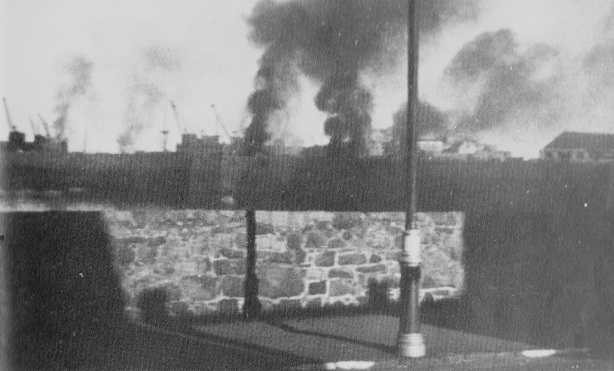
Air Raid Aftermath


Aftermath of the Harbour Bombing

Ironically, the ‘Guernsey Press’ that evening (which had hit the streets at 5pm), had reported that certain British ‘military experts’ had declared, “There need be no fear of the Germans taking any advantage of the British decision to demilitarise the Channel Islands…” Many people, including some of the injured and dead, would have held that newspaper in their hands whilst listening to the Procurer’s speech.

[The islanders, in shock at the bombing, were furious at the unprovoked attack. There were outbursts of bitterness – which the Germans were later to counter when they refuted the accusations. They described their actions as ‘legitimate acts of war’, claiming to have mistaken the line of tomato-lorries as military vehicles carrying loads of munitions. Nonetheless, the machine-gunning of the lifeboat, ambulance and citizens was totally indefensible. The population knew they were demilitarised and fully expected the Germans to know the same.

The Germans countered that they had absolutely no intelligence reports relating to the Islands’ military or non-military status, having no informants ‘on the ground’. They claimed to have been proceeding with an already proposed plan which was given its final approval on Thursday June 20th …eight days before the attack…assuming the Islands to be defended.

The question still remained…what of the reconnaissance flight the previous day, clearly indicating no evidence of military occupation or anti-aircraft activity and yet they had continued with their ‘blitzkrieg’ – lightning raid – just the same?

They insisted, nonetheless, they had not received any communication advising details of demilitarisation.

On the other side of the ledger, as it was later revealed, the British Government was somehow trying to get “the best of both worlds” by demilitarising the islands but remaining silent on the issue, hoping the enemy would be too preoccupied to notice. It was a case of “trying to be too smart by half”, as the saying goes.

Also unaware of the British position and horrified at the attack, Ambrose Sherwill made an urgent telephone call to London immediately after the raid, in response to which the BBC announced news of the demilitarisation on the 9 p.m. news. Reuters News Agency also released a communiqué. The latter was apparently the means by which the German forces finally heard ‘officially’ of the situation in the Isles…at least that it what they later claimed.

Naturally, once all the facts were later known, many Islanders expressed added bitterness at London’s heartless abandonment of them. The event became cynically known in Guernsey as “The Battle of Tomatoes”]
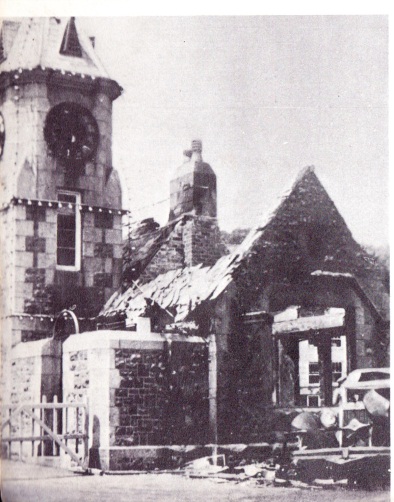
Bomb damage


 Bomb damage to St Peter Port Clock-

Tower, at the White Rock weighbridge

Bidding the Langmeads a hasty farewell, as they left hurriedly for their home, we made our way up to the flat. Quickly Gilbert contacted Arthur Jackson (Pastor of the De Lancey Elim Church) and together they went down to The White Rock to see the damage and offer any help they could provide.

The sight of the burnt-out lorries was horrifying, especially more so when they learned that some people who were farewelling friends on the ‘Isle Of Sark’, had sought shelter with the lorry drivers beneath the vehicles. People they talked with…many who just wandered aimlessly around the docks area in shock…were terrified that the raiders would return, perhaps after nightfall.

Hearts all over the Island were heavy and sad.

Our new church secretary and his wife lived out in the beautiful parish of Castel, towards the centre of the island. Their property, with its greenhouses and flower gardens, bordered the magnificent Saumarez Park. Their immediate concern was for us, staying in the town so close to the harbour…particularly in the flat above a large building which may be a target…so they phoned us, insisting that we go to stay with them for the time being. As Pastor Jackson lived adjacent to St Sampson’s Harbour…another potential target area, further up the east coast of the Island…they suggested he also join us.

(Arthur and his wife, small daughter and baby boy had arrived in Guernsey not long after Gilbert & Irene’s own arrival. When the evacuation was announced, he sent his wife and children to England, staying himself “for a little while” until he felt it was right for him to leave. His situation was now decided for him by circumstances beyond his control and the folk in his congregation were glad to have him with them.

The Pastor of the third Elim Church at Vazon, on the west coast, was Rev John Woodhead. After much prayer, John had taken his wife and two daughters on one of the boats back to England, intending to return alone and continue his ministry. He was due on the next, return-sailing of the mail-boat “Isle of Sark” however, due to the actions that followed in the next two days, was prevented from so doing.

So there was the Elim work with three churches and now only two Pastors. The ‘future plan’ that had been recently set out for the introduction of lay-preachers to assist in these growing assemblies, was now an imperative.

The situation being as it had now become, it made sense to have both Pastors living in close proximity. To have cooperation at this time, when things were becoming uncertain, was vitally important and it was obvious that each needed the other, in a location where the night curfew would not affect their ability to meet, plan and pray together).

By Saturday night all three of us were installed in ‘Manor View’ with Mr and Mrs Peter LeTissier and their son Ronald. After the traumatic shock of the previous evening, and now finding myself amidst a lovely stand of tall pine trees and surrounded by beautiful gardens, the fresh air made me feel very sleepy. The countryside was so lovely. Hydrangeas, at their very best, formed thick hedges around the charming old homestead. The new bungalow was delightful and we made a happy family all together. In such a delightful spot it was too easy to ignore or forget the dark clouds gathering on our horizon.

Sunday morning, June 30th found us in a morning service filled to capacity. Many people who rarely attended church were in the congregation that morning. Other denominations reported the same. The atmosphere was tense but assurance and calm became very evident as we sang hymns, read God’s Word and shared Communion together. Then, as we prepared to conclude the service, the air-raid siren sounded a warning! Folk looked at each other fearfully as Gilbert suggested that, as best possible, we should move over near the thick granite walls.

Some stood pressed to the wall whilst others sat on the pews or squatted on the floor and children curled up under the pews. We sang hymns and choruses as we waited. No sound of aircraft overhead. After a while it was obvious that some felt they would take the risk and make their ways home. With a prayer for protection, Gilbert gave the benediction. Everyone left silently.

Nothing happened…the ‘all-clear’ never sounded!

Not long after noon, a single German plane touched down at the airport. Head of the Guernsey Police, Inspector Schulper, had been given a sealed letter from the States addressed to “The Officer Commanding, German Forces, Guernsey”…to be handed to the first enemy personnel ashore whenever, wherever, however they arrived. The letter stated that the island had “no armed forces of any description”.

Upon receiving news of this arrival he made his way, poste-haste, to the airport – only to find it deserted. One observer had seen the aircraft land and taxi to the tarmac. Leaving the engine running, a lone pilot had cautiously approached the terminal building and, finding it empty, walked inside, revolver in hand. Just then three British fighter planes passed low, overhead. This apparently startled the pilot, who dashed out of the building (leaving his revolver on the counter), scrambled into his plane and took off in great haste. Whether or not he made it back to his base is unknown.

A short while later (after some tricky manoeuvring, required to scare 50 Alderney cattle to one end of the runway), four German Transport planes arrived. Inspector Schulper made his way, once more, to the airport and handed his letter to Captain Liebe-Pieteritz who earned to distinction of being the first German officer to receive the surrender of British soil.

On hearing the aircraft overhead, Major Sherwill rang the Home Office in London, from his own office, to say “Goodbye”until the war’s end.

Also hearing the low-flying aircraft were Gilbert and Peter Le Tissier who were sitting at Manor View, enjoying a late Sunday lunch with their wives. Looking up and recognising them to be German transport planes, both of them had the same sudden, awful thought. In a cupboard upstairs at the Eldad church there were thousands of leaflets refuting Adolf Hitler’s claim to world supremacy. Quickly they dashed there and loaded their cars to capacity before speeding off, each to one of the other two churches to collect any copies which had been left there. They then made their way quickly to a place where they knew there was a furnace in which they could rapidly dispose of these documents. The contents of the literature would certainly have been viewed as subversive by the German Forces if discovered. The entire afternoon was spent setting fire to the bundles of propaganda, many of which were so tightly wrapped that they refused to burn quickly. With the aid of some petrol the job was finally finished. They returned to Manor View, reeking of smoke…‘mission accomplished’.

The German landing party, meanwhile, asked to be driven to a location suitable for the establishment of a headquarters. The Inspector called for several police cars as well as commandeering a taxi to take them to the Royal Hotel. After requisitioning the hotel, a Luftwaffe Officer [probably Capt. Liebe-Pieteritz], in the company of a Guernsey Policeman, visited Major Sherwill at Havelet House requesting him to accompany them to their newly established HQ at the Royal. The Bailiff, Victor Carey was also collected and brought to the hotel as the first, rather frightening but almost comical, [1]signs of foreign authority became apparent.

We went to the evening church service under the freedom of British Rule and came home under the Nazi Regime.

I had gone with the Le Tissiers to Eldad, whilst Gilbert had driven out to our Vazon church to fill the empty pulpit. Again, there were well-attended services in churches everywhere. People were in need of hope and comfort. This wasn’t a dream, it was real!
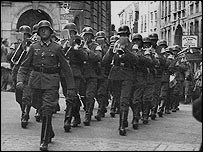
Germans March in St Peter Port


German Forces March on British Soil

St Peter Port’s High Street

On the way home, Gilbert had passed German troops everywhere, especially in the area near the airport, where more aircraft had landed. As he slowed to pass one point where several officers were talking to a squad of men, he was chilled to see the heel clicking, stiff-armed salute of the soldiers and hear them shout “Heil Hitler!”

Monday July 1st. The swastika flew from the Royal Hotel. For many, the knowledge that we had indeed been occupied had yet to dawn upon them, being tucked away in their quiet little rural cottages and homesteads, but the phone-lines were soon running hot as a special free copy of the ‘Star’ was delivered to homes or distributed on the streets. Soon the truth struck home.

That morning, in bold print, the front page of the ‘Star’ (and later, the evening’s ‘Press’) bore the first German Orders to be issued on British soil, under huge banner headlines:

ORDERS OF THE COMMANDANT OF THE GERMAN FORCES

IN OCCUPATION OF

THE ISLAND OF GUERNSEY

  1.  All inhabitants must be indoors by 11pm and must not leave their homes before 6am
  2. We will respect the population in Guernsey, but, SHOULD ANYONE ATTEMPT TO CAUSE THE LEAST TROUBLE SERIOUS MEASURES WILL BE TAKEN AND THE TOWN WILL BE BOMBED!
  3. All orders given by the military authority are to be strictly obeyed
  4. All spirits must be locked up immediately and no spirits may be supplied, obtained or consumed henceforth. This prohibition does not apply to stocks in private houses
  5. No person shall enter the aerodrome
  6. All rifles, airguns, pistols, revolvers, daggers, sporting guns and all other weapons whatsoever, except souvenirs, must, together with all ammunition, be delivered to the Royal Hotel by 12 noon today, July 1
  7. All British sailors, airmen and soldiers on leave in the island must report to the police station
  8. No boat or vessel of any description, including any fishing boat, shall leave the harbours without an order from the military authority
  9. The sale of motor spirit is prohibited, except in exceptional circumstances. The use of cars is forbidden
  10. The black-out regulations already in force must be observed as before
  11. Banks and shops will open as usual

 (Included in the same issue were the funeral notices for victims of Friday’s air-raid, carefully worded in a manner so as to not give offence to the Germans).

Order number 9 was to be particularly noted for us. Poor little Austin 7! Soon it was put up on blocks and we were never to ride in it again! [2]

As we were now living about 3 miles from the church and all bus services were to cease, we were back to the need of transport. Choices were confined to walking or riding bicycles. But…where would one get a bicycle? Overnight they had become premium items.

Even so, Gilbert managed to get a second-hand bike for himself. He then found one for me…almost brand new. It had been bought on a hire-purchase arrangement by someone who had since evacuated and the shop had reclaimed it but, for a small amount, we could pay the debt out. The only problem was…I had never ridden a cycle in my life! Out of sheer necessity, it was now my turn to learn…and FAST! After a wobbly start I was off and away. I loved it! The wind in my face, the joyful exhilaration and the exercise – everything had its compensation and, for me, no less than this new experience.

We rode everywhere. Regulations prohibited riding two abreast – common sense in a place with so many narrow lanes as part of its roadway network – so in single file, bicycle after bicycle was to be seen moving around the island, as if in ‘caravans’. It was a great way to mix and meet with new people, especially when a steep hill was encountered and all had to dismount and walk up together.

……………………………………………………………….

[1] (The escorting soldiers on motorbikes, driving ahead of the vehicles at high speed, had surprised and terrorized on- coming drivers who met them coming down the narrow streets…on the ‘wrong’ side of the road…!)

[2] [Eventually it was requisitioned by the Germans and sent off to France for enemy use there.]