| 15. Enemy Encounters, Heroes and Starvation |
It was about this time that Gilbert had an unusual encounter with the enemy. The Sunday morning service had not long commenced when, during the singing of a hymn, the door opened and a German officer walked in and stood in the back row. He picked up a hymn book and sang along. He sat through most of the service, apparently taking everything in and even took notes throughout the sermon. During the singing of the last hymn he looked at his watch and slipped quietly out of the door. Gilbert and the elders felt a little uneasy about his presence. Who was this man? Perhaps an official observer from the administration ensuring that nothing subversive was being said in the services. Was he a curious passer-by? Perhaps he was a churchgoing soldier just enjoying the service or just killing time on his way to an appointment? And would he come back again?
Next week it was the same routine. He slipped in late and left before the benediction.
Determined to find out, the following week the service was ended a little earlier so that Gilbert and the church elders could meet him at the door.
The officer’s name was Herman Lauster – a Christian soldier, posted to a coastal watch-post, who had been transferred to Guernsey in the recent troop changes. As they introduced themselves to each other, Gilbert immediately felt at ease with this man who wore the uniform of the ‘enemy’ and pleasantly surprised to find that he spoke good English – with a noticeable American accent. Herman was duly invited home to the manse for lunch, where he shared his story with Gilbert and Irene.
Herman had been a farmer who had left Germany in 1926, as a young man, to seek his fortune in America – “The Land of Opportunity” – accompanied by his fiancé. Driven by a fanatical desire to succeed and get rich, he had worked tirelessly on the land for a share-cropper near Baltimore, eventually amassing enough to buy his own farm. As he prospered he purchased a general store and then several shops. It was in Maryland that he had an encounter with God which changed his life and he entered the ministry with the Church of God – a Pentecostal sister-church to Elim in the USA.
After a few years of pastoral ministry, he felt the call to missionary endeavour, first to Colombia, in South America for a short term, then to the land-of-his-fathers, Germany. He felt a burning desire to evangelise and commence the foundation of the Church of God in Germany.
He arrived there in December, 1936. His forthright proclamation of the truth and open denouncement of Adolf Hitler and the Nazi regime, as he went about planting congregations in various parts of that country over the next few years, brought him immediately into conflict with the pervading attitudes of the leadership and greater proportion of the population. It eventually earned him the wrath of the Gestapo (Nazi secret police). Finally he was arrested and sent to a concentration camp at Welzheim, from which prisoners were frequently sent to the ovens at Dachau. He was imprisoned at Welzheim for seven months. The treatment Herman received at the hands of his own countrymen had been horrendous, but such was the fanaticism of the Hitler-movement that he received verbal abuse, psychological manipulation, beatings and a sentence to hard labour, which left him emaciated and almost cost him his life.
An incredible set of circumstances (triggered by a concerted season of prayer and fasting by the local congregations he had established, as well as hundreds of Church of God members in the USA), saw Herman ‘mysteriously’ released on orders signed by ‘sources unknown’. However, he soon found himself called up, uniformed and transferred as a non-combatant to Guernsey to bolster the extra troops needed for the Occupation Force, as the seasoned combat troops were shipped off to other war fronts.
He explained to Gilbert that on the previous couple of Sundays he had been on his way to duty and could not stay to introduce himself, but he was to become a regular in the services until the end of the occupation.
Despite the terrible treatment he had received, Herman was a shining and enthusiastic witness amongst his comrades and over the course of time, he led many of them to faith in Christ, often bringing two or three with him at a time to join in the Eldad fellowship. (Several of these men were later to become ‘pillars’ of the Church of God in Germany in later years.)
Due to the hours of duty, it was not always possible for him to be in church on Sundays so he sometimes met with members of the church on weekdays, regularly leading prayer meetings and Bible studies.
Other churches also heard about the ‘German Preacher’ and invited him, on occasion, to ‘share the Word’ in their services.
During the reminder of the occupation, Herman spent many of his off-duty hours with Gilbert at the church vestry, in deep discussion and debate on all matters regarding God’s work and the ministry. Together they encouraged each other with their prayer times and fellowship. It was good for these two Pentecostal Pastors to spend time together.
Years later, in an article which appeared in the Guernsey Press, Gilbert was quoted as saying of this unusual association, “It was a joy to us to see, in such a real way, all barriers broken and all distinctions disappear at the foot of the cross…the hours we spent in prayer and fellowship still bring happy memories”. Gilbert always held Herman in the highest esteem, considering him to be something of a ‘Daniel’, serving God despite being forced to labour under an evil regime.
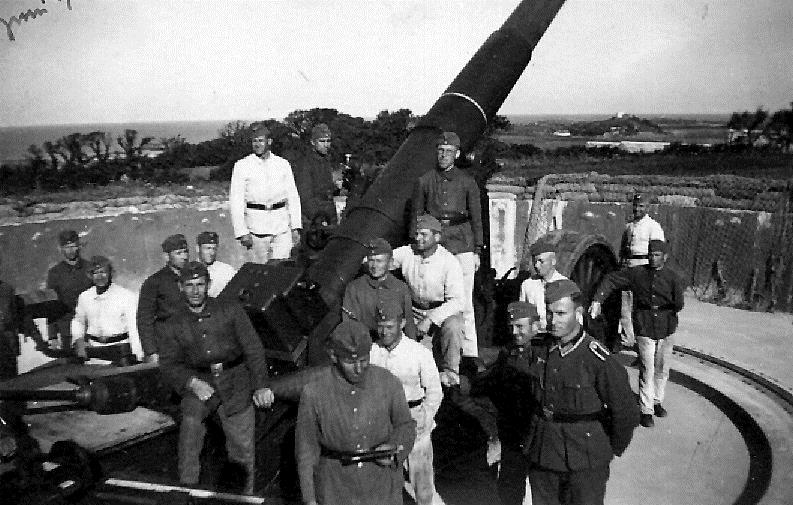
Herman Lauster is seated at centre in his white uniform, amongst his Flak Gun troops.
He told Gilbert one day that, as the situation in Europe rapidly deteriorated, he would go up onto the deck of the watch-post each morning and, looking out to the horizon, he’d pray “Lord, send the Americans!”
He also related a vision God had given to him of an end to the conflict, in which he saw one of his own German army commanders standing aimlessly atop his observation post, along with 22 of his fellow-soldiers. The officer declared that the war had been a farce and fatally lost.
[Editor’s note: read Epilogue for more on Herman Lauster, at the book’s end]
After D-day the situation turned steadily worse. Being now cut off from the Continent, there were no more rations for the troops, neither was there any further opportunity for civilian trade with the French. From then on we were limited to what could be produced on the Island. Although we were in enemy occupied territory, we were not considered “prisoners of war” and thus not entitled to any assistance from the Red Cross.
A brave man, Captain Fred Noyon changed all that.
Fred Noyon was a retired sea captain who had spent some time as a Channel pilot, working out of St Sampson’s. He had now settled down to the life of a fisherman, a canny man with an intimate knowledge of the waters of the Channel and English coast. Afraid of very little after his many years of experience at sea, he considered he had probably ‘seen it all’.
One day in mid November he was approached by certain concerned persons, to see if he would be willing to take the risk of going to England in person to present documentary evidence to the Churchill government, which gave a clear and total picture of the dire situation now existing in the Channel Isles. Some few months earlier, two reports had been smuggled out, one in October by uncertain means a second in early November, with an escapee who made it out through France but had not been able to present the papers in person.
(It appeared that the Royal Navy now had a total blockade on the sea-lanes from all ports that would provide any avenue for the Germans to get supplies to the Channel Isles. Aerial reconnaissance photographs taken by RAF flight crews, en route to raids over Europe, indicated a head-count of cattle…almost all dairy cows, not beef cattle…that all things must have been well as the beasts were not being slaughtered in great numbers. It was a rather simplistic method of intelligence gathering and, tragically, far from the true facts.)
Captain Noyon would be recognised as a plausible and reliable character through whom to pass the information on to the ‘senior service’ (navy) as he had been ‘one of theirs’ (albeit a merchant seaman) almost all his working life.
Noyon gave the matter some consideration and decided that he would give it his best effort, on the basis that:
- there were very few others as qualified or experienced as himself
- as a widower, with no children in the Island, he had no family whom the Germans could punish after he had gone
- he was frustrated with the situation as it was, unable to freely go fishing in his beloved boat, ‘Littlewood’
Besides, he loved a challenge. He agreed to go, along with his mate, Bill Enticott.
The plan was quite simple. He would apply for the usual day fishing license and put to sea out of St Sampson’s, do some fishing along the northeast coast, then turn back south with the stated object of testing his engine pumps whilst sailing into St Peter Port to have repair work on them.
Having loaded all the right gear to match the tale, The German Harbourmaster, when he went to inspect the boat, accepted the story. Unbeknown to the HM, under the nets were an extra stock of eight cans of fuel obtained on the black-market, bartered for an undocumented portion of his fish catch.
The ‘Littlewood’ sailed from St Sampson’s and into the next bay to the north. There Noyon and Enticott laid a very old net (in bad enough repair to abandon) and then carried on slowly northward, appearing to be looking for schools of long-nose fish. Late in the afternoon, passing showers and drizzle set in, hiding them from sight of the shore. Perfect. They changed course out into the Channel. At dusk they raised the vessel’s sail to catch the westerly that had sprung up. Not long before midnight they were challenged by an American sub-chaser. They were taken to Cherbourg…not England as hoped… where they were able, none-the-less, to hand over the documents to high-ranking British authorities, capable of making sure the information got ultimately into the right hands. In addition to the documentation, they were able to give accurate details of defences, gun emplacement locations and force strengths. The foresighted Enticott had, during the time when fishing had been embargoed, volunteered to drive supply trucks for the Germans and used the opportunity to make meticulous notes of where everything and everyone was positioned.
This was the fullest information so far received. Its accuracy and clarity confirmed the previous information received from other sources, at least one of which had passed on through German hands and could have been considered suspect.
On November 5th, contact was authorised with the Red Cross, using the German radio frequency via the local Guernsey transmitter. The following message was sent:
To the Secretary General, Guernsey,
International Red Cross, 5th November, 1944
Geneva
Conditions rapidly deteriorating here STOP will soon become impossible STOP we urge immediate visit of Red Cross representative STOP
All rations drastically reduced STOP.
- Bread finishes 15th December.
- Sugar finishes 6th January.
- Ration of separated milk will be reduced to one third pint per head by end of year.
- Soap and cleansers – stocks exhausted.
- Vegetables generally inadequate to supply civilian population through winter. German consumption heavy…
- Clothing and footwear stocks almost exhausted.
- Fuel for gas and electricity finish at end of year.
- Coal stocks exhausted. Wood fuel quite inadequate.
- Many essential medical supplies already finished
Victor Carey
Bailiff of Guernsey
A similar message was sent from the Bailiff of Jersey.
Victor Carey noted in his diary, “…starvation stares us in the face and I can see no way out of it.” The reality was that almost no one in Guernsey was not malnourished and going hungrier by the day. Some got up in the morning, ate what little was available for breakfast and left for work. Returning home at midday they went to bed as there was nothing left to eat and no energy left for work or activity of any kind.
For a minister with a parish as large as Gilbert’s now was, it was imperative that he and Irene stay well. Unknowingly, one of their ‘alternative dietary substitutes’ was also helping to keep them well. From time to time, the “Press” would announce that certain beaches are open for carrageen harvesting and both Gilbert and Irene would join in, as much for the chance to get down to the water’s edge as for the seaweed-moss they were able to collect. Serving suggestions for this bright green algae included: – sun-drying it until crisp to enable them to be finely chopped and used as a green-tea substitute; after washing in fresh water, to be used in a salad; boiled in a small amount of fresh water then drained and served as a cooked vegetable…the water, when left to cool, would set like aspic due to high content of natural gelatine. The amazing fact is that, like many others, Gilbert and Irene ate the carrageen only because it was edible and, despite its rather bland taste, went some way to filling an empty stomach. In reality, it is a medicine all of its own, containing minerals and vitamins conducive to good health. It’s most common commercial use is still in cough and cold medicines.
Other good, healthy food, not normally found on their table in better times, included limpets, chestnuts, turnip, parsnip, stinging nettle, dandelion and more. On one occasion they managed on parsnips alone for over three weeks…causing them both to have recurring dreams of roast lamb and Yorkshire pudding with vegetables and gravy. [The family never had parsnips on their dinner plates in subsequent years].
 enemy on the Island - WWII