| 14. Resourcefulness and Risk |
Days for us were very busy. Shortages in essential commodities were growing more acute. Even the smallest thing that could be used some time was conserved, not even a twig was left lying on the ground. If a gale blew and trees were damaged in any way, a host of people would arrive with prams, wheelbarrows, handcarts or anything upon which they carry a branch, stick, twig and even the leaves and soon every trace of wood was collected. Winters can be cold in Guernsey and the lack of essential food and clothing called for every effort to be made to subsist during that time. Electricity, coal and wood were now causing anxiety as supplies ran low. The use of gas was restricted to certain hours and its use outside that time ‘verboten’. As the situation worsened, its non-use was enforced by cutting it off at the source twice a day. During the permitted hours, gas-fires were not to be used for room heating. Hot water taps were sealed up and it was more than one dared to break the seals. The use of electric lights between 11pm and 7am was also forbidden, but most people were unaffected as all they wanted to do was find warmth under their blankets and sleep at that hour, so it was not too inconvenient. Later the shortage became so acute that only 4 units of electricity were allowed per household. I became very astute at giving Michael his last bottle and changing his nappy in the dark – it really is amazing what you find you can do when it is imperative.
It was especially during these winter months that the crystal set became most appreciated. Gilbert would take the tiny box from its hiding place, disconnect the ear-piece from the phone and attach it to the terminals and then set the ‘whisker’ onto the BBC. Reception in the house was such that the ear-piece blared out loudly, almost to distortion point. Afraid that a neighbour or, worse, a passing German soldier on patrol, may hear the noise, Gilbert would put the earpiece under two pillows and underneath the warm sheets and blankets he and Irene would enjoy the variety of news, music and comedy of the ‘BBC Home Service’ transmissions…sometimes having to stuff the blankets into their mouths to stop from laughing out-loud at the fun and humour which brightened up their evenings. After all, they would not want the enemy to think they were having too good a time, enough to be laughing so loud, and thus impose even more restrictions on the community!
It gave them another source of good humour with which to face, and cope with, the realities and difficulties of their everyday life. Times were, certainly getting tougher.
It was at this time that, after discussion with some of the men of the church, Gilbert made a ‘hay box’ – a rather primitive aid to cooking. He used a plywood tea-chest and, after obtaining some hay from one of the farmers who attended one of our churches, packed the hay tightly into the box – leaving an indented shape into which two of my saucepans would fit snugly. Then I made a cushion, stuffed with more hay that would compress down tightly on the saucepans when the contents were boiling, and the lid was tightly closed. Gilbert would stand at the ready whilst I would hurriedly drop the peeled and cut vegetables into the pots which were swiftly placed into the space provided in the box. Immediately, the cushion was pressed into place and the wooden lid shut down and that was that…for about 12 hours… when the vegetables would be cooked through! We laugh about it now, but we didn’t always laugh then!!
Later when there was no gas or electricity to heat the water, Gilbert converted a four-litre paint tin into a twig-burner. He made a little platform with four little feet for the burner to stand on. In the side of the tin, he cut several little holes through which we could insert the twigs which I collected whenever I took Michael out in his pram. Once again, we could use the ‘hay-box’ after our twig –burner had brought the water to the boil. The holes in the burner also provided a small amount of light when used at night.
“Improvisation” was the theme of every day. When it was cold, we wore as many clothes as we could and one winter, Gilbert would spend his mornings at his studies wearing his winter dressing gown over his suit.
In order to fortify the islands to satisfy Herr Hitler’s dream of the ‘unangreifbare Festung’ (impregnable fortress) it was necessary for the Germans to import foreign workers through Organisation Todt (O.T.) to do the work. According to estimated figures, 17,500 O.T. workers…made up of unemployed Frenchmen, Spanish Republicans, Dutchmen, Czechs, Poles, Russian prisoners from the Eastern Front, Belgians, Algerians, Moroccans and other sundry forced-labourers, had arrived in the islands by February 1942. Many more continued to arrive in years to come due to the high attrition rate. No matter what their origins, all were treated with equal cruelty by their overseers and guards. The uniforms that had been issued to them were generally tattered. They wore improvised footwear comprising pieces of cloth, wire or string wrapped around strips of old tires and bound to their bruised and blackened feet. Each carried their own improvised eating receptacle…usually an old jam-tin or pot. They were fed from soup trucks, which would visit their work-sites in the quarries or at fortification construction sites and were frequently so starved they would storm the trucks and fight over the dregs.
Usually they were crammed into abandoned, derelict or badly damaged, furniture-less houses and left to sleep on bare wooden or flagstone floors. Frequently beaten or worked to death at their workplace, their bodies often left atop piles of rock. It is commonly believed that many were even thrown into the cement mixers, to be poured into the walls or foundations of a gun fort or block-house. The greatest concentrations of O.T. workers were located on Alderney, where the fortifications were the heaviest in the islands group. The full truth about the numbers who met their fate there will probably never be known.
The many foreign workers the Germans had brought into the Island were seldom seen but occasionally one or two wandered away from their camps, thin, emaciated and emotionally wrecked. One day Gilbert answered a knock at the front door to find a young man, unshaven, painfully thin and looking very ill. He stood there, a pathetic figure, his eyes deeply sunken with dark rings around them, unable to speak very much English. With his filthy and bruised hands, he opened his tattered overcoat to reveal his only other clothing…brown paper, tied with string. What we could see of his body was skeletal, also bruised. Haltingly he asked Gilbert if he could help him in any way. We both knew of the official order prohibiting civilians from providing food, clothing or shelter to the forced labour workers, but his case had so touched our hearts we did not consider the consequences of our actions. Clothing was now impossible to buy, and Gilbert had only two suits, one suitable for his work, the other not quite so good but still a suitable alternative. As the Apostle Paul put it, “…the love of God constrains us…” and ‘my dear man’ felt compelled to give his second suit to this impoverished young man. So, after also packing up a parcel of underclothes and shirt, he presented it, to the evident joy of the stranger.
The morning passed and then there was another knock at the door…a heavy, strong knock! There stood a Nazi S.S. man. “Didt you giff zis man zese clothes?” he demanded, indicating the young stranger we had seen earlier in the day, cowering behind him. My heart was in my mouth as Gilbert stated firmly, “I did,” wondering just what the outcome would be. The German had apparently been convinced the items had been stolen. He stood there in thought for a moment, opened his mouth as if to speak but paused…closed his mouth…hesitated…then turned instead to the young man, gave him back the parcel and waved him on his way. He stood for a thoughtful moment longer then spun on his heel and headed off down the close, marching briskly past the shuffling foreigner. We looked at each other in silence.
It was if the unseen hand of God had passed between that S.S. man and us, leaving him dumbfounded and quite confused. Truly, we sensed our Heavenly Father’s presence at that moment!
During the next year things dragged by slowly, little of consequence happened. Gilbert was constantly on the go with church activities and visitation of the now-expanded congregation, with so many of other denominations having joined us. With transportation severely limited and his only personal form of mobilisation being his bicycle, making his rounds took so much longer.
On occasion, when Phyllis was free to stay with Michael for a full day, I would cycle along – especially when there were sick folk or problems that required a lady’s attention. Despite the dreary, depressive pace of life, due to occupation circumstances and the negative effect they had on many of the population, we were kept so busy in our ministry that we felt we didn’t have the time to let it get us down. Gilbert frequently commented what a privilege it was to be so caught up in God’s work at this time and how blessed we both felt at having been called to this task.
It is a sad indication of the boredom of life for the community when the ‘highlight’ of each evening, about 6pm, was the arrival of a German reconnaissance aircraft that flew right around the island. The noise of its engines was so loud and distinctive it became known as “Moaning Minnie”, and it became a daily reminder of the presence of our occupying forces.
It also became the subject of many wise-cracks and in-house jokes, e.g. ‘Why isn’t a Guernsey man intimidated by his wife’s complaining? …because moaning Minnie has made him immune to loud, whining noises!’
One evening Gilbert had left early for the mid-week Bible study and I was alone in the house with Michael. Overhead, there came the sounds of aeroplane engines and machinegun fire, followed closely by anti-aircraft fire. This wasn’t our “Minnie”, it was too menacing. Quickly I ran up to the bedroom and took Michael downstairs to the kitchen. Standing under the alcove by the gas stove, I rocked him in my arms as the noise continued, singing: “Keep on believing, Jesus is near…Keep on believing, there’s nothing to fear…Keep on believing, this is the way…To faith in the night as well as the day.” Falling asleep in my arms this trusting little child knew no fear and the words of that song gave me that same confidence, realising I was in my loving Heavenly Father’s care. The planes flew off into the distance, peace returned and the experience lives on, remaining real to me as the years have passed.
[This was probably one of many ‘dog-fights’ between RAF Spitfires and Hurricanes and Luftwaffe ME109 and Fockwulf fighter aircraft which took place over the Channel Isles, especially during the ‘Battle of Britain’, with spent bullets and cannon-shells frequently falling on the countryside below. When taking place at quite low altitude, these battles could be frighteningly noisy events].
Gilbert was often away during the day times as more and more requests came for him to call on the aged of the congregation who were finding it increasingly difficult to get to Sunday services. A reduced diet was leaving many of them very weak and frail and with horse-drawn ‘bus’ services being at a premium during the week, the animals were usually rested on the Sabbath.
His usual practise was to take his Communion Case. This little 6x8x3inches black leather-covered box with a hinged top had a moulded interior fitting, into which a small silver goblet and plate, a little box of bread, a miniature bottle of wine, and an even smaller bottle of anointing oil could rest during transportation. This case fitted inside his briefcase alongside his Bible. The briefcase had a wide flap-top which he would open and lay over the cross-bar of his bicycle and then buckle it up so that it hung from the bar, just above and between the pedals. Thus, it was out of the way, yet always within his reach as he went to share Communion, read, or to pass on encouragement from the Scriptures and pray for the sick after anointing them with oil.
He must have covered hundreds – if not thousands – of miles on that bicycle with its ‘custom-made’ tyres. That, along with God’s sustaining power, helped him to remain fit for his ministry…despite the enforced-diet he and all the Islanders were required to endure.
During one of these visitation excursions, he was cycling along the coastal road on the western side of the island. It was a lovely sunny day and the water, out to his left, was a smooth as glass as he looked out across whilst he rode. As he approached a spot where a German observation post had been erected atop one of the many historic Martello Towers that dot the coast a regular intervals (tall, round, thick granite leftovers of 11th century military activities), his attention was drawn to three small black specs low on the horizon. At first, he took them to be three large sea birds but on a second glance realised they were aircraft approaching at high speed. Looking up at the watch post, he could see the soldiers leaning on the rail, apparently unperturbed by the approaching aircraft. Then he saw flashes of light from the wings of the middle one. Instantly he realised this was an Allied attack. Hopping off his bike, he picked it up and dashed to a storm-water ditch beside the road and got down into it. Each of the planes strafed the tower in turn, climbed, banked steeply and turning a full 180 degrees, dove down back to almost sea level and fled back out to seas as fast as they had come. The whole event took less than a minute. They must have flown in below radar height, too low for ‘ack-ack’ fire. The machine-gun on the tower did not return fire at all.
After a short time, satisfied that the aircraft had left and would not return, he lifted himself and his bike from the ditch and pedalled off poste-haste, keeping a watchful eye to seaward.
Leaving Irene or Phyllis alone in the house was concern enough but the Germans had taken to surprise-raids on homes where they suspected clandestine radios or crystal-sets may be hidden. Whilst they had a hiding place behind a loose brick inside a disused chimney in one of the bedrooms and another in the attic, he did not want anyone to have to face a search which may have uncovered the set in his absence. [As it was, there were at least two Military-police raids on the house but on neither occasion was the crystal set in the building.
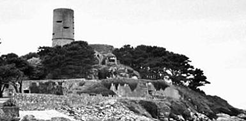
The German tower built atop a “Martello” tower, which Gilbert witnessed being strafed by an RAF aircraft.
Living in such proximity to General Heine and several other German officers who also had their accommodation in The Close, they were probably considered to be least at risk to the temptation to commit such an offence and no further inspections were made]. Prepared to take full, personal responsibility if found out, Gilbert carried the set with him as he went about his ministerial duties.
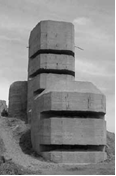
A German Coastal Observation tower; rangefinder for the heavy “Mirus Battery” guns.
He had hollowed out part of the padding in the moulded section of his communion box into which his little crystal set would fit snugly. Despite being stopped at checkpoints periodically as he criss-crossed the island, he was seldom searched as he always wore his blue minister’s arm-band. Any officer that did commence a search got no further than opening the briefcase. Upon seeing the Bible and the Communion Box, the search was concluded.
It was on this little crystal set that Gilbert and Irene heard the news in June, 1944 of the Allied landings at Normandy on D-Day.
June 1944 saw hundreds of British aircraft flying high above, crossing the Islands enroute to France. D-Day had come. Once landed, the Allied troops set up a powerful B.E.F. radio station and Gilbert and I were able to pick up their transmissions on our crystal set. What an exciting time as we listened to all the news and action. Of course, we all thought our deliverance was at hand. Little were we to know that our most difficult months lay ahead, and we were in for quite a long wait.
Our German invaders were now “cut off” from the Continent and we had become a ‘Siege within a siege’.
As early as 1942, as the war became more difficult for the Germans who were facing new threats on multiple fronts, many more of the experienced and senior soldiers of the occupying force had been recalled to France, the rank and file were replaced by men who were less driven or fanatical. *
In some cases, the replacements were quite disenchanted with the whole concept of Herr Hitler’s great dream of the ‘Thousand Year Reich’. In fact, amongst the new arrivals were men transferred directly from detention and internment camps, those who had incurred the wrath of ‘the little corporal’ himself, including conscientious objectors, opposition politicians, ministers of religion, and other ‘intellectuals’ who had voiced their own opinions about what was happening to their country under the Nazi regime. They were drafted to non-combatant duties such as civil administration, coastal surveillance, and medical support.
[*Not so with the senior officer replacements amongst whom came many with strong, radical Nazi views and ideals. They were a rather incongruous combination – extremist officers leading largely disinterested troops].
 enemy on the Island - WWII