| 12. Covert Operations |
Whilst the deportees enjoyed listening to radio in their camps in Germany, the population of the Channel Islands sat in ‘communication-darkness’, their radios having been confiscated a few weeks earlier. Undeterred, a few amateur ‘technicians’ got to work, creating crystal sets for themselves. Gilbert was, of course, right up there with the best of them. Naturally, this was kept a personal secret, to avoid being reported and convicted for a crime against the Reich, which attracted a serious penalty.
Even Irene was unaware of Gilbert’s covert activities when he disappeared to the church buildings for hours at a time. Unbeknown to her, and anyone else in the church at that time, he had dismantled portions of the Hammond electric organ, of which the church had taken delivery just prior to the occupation’s commencement, and had removed a great deal of the electric wiring as well as several electrical contacts from the instrument. No one in the congregation would have been any the wiser because the organ was not able to be played, due to the Germans’ imposition of power restrictions, whereby the power was shut off to all but their military facilities, due to fuel shortages. A piano was being used in its place.
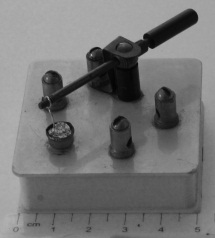
After a visit to the rubbish tip, en route to call on one of the church flock who lived in the vicinity, he returned with just the very thing he needed…a small, white ‘Bakelite’ box, 5 cms square by 1.5 cms deep, to hold dentifrice. [‘Dentifrice’ is a solid block of coarse ‘soap’…not unlike sand-soap, only finer…for use as a tooth cleaner. The tooth brush is moistened and the bristles rubbed on the block until it foams. This is used instead of toothpaste as it did not dry out and lasted longer.] These little boxes were standard issue to German soldiers.
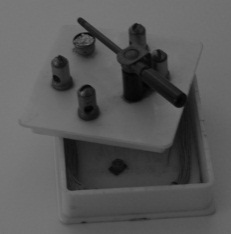
Through the lid, six holes were drilled to allow contact points to be fixed. On top of the lid, four screw-contacts were fixed above four of the holes, whilst a tiny brass cup (to hold the crystal) was fitted above the fifth and a small pivot arm with a ‘whisker wire’ above the sixth.
Unfortunately, Gilbert had no crystal but, after racking his brain, he remembered a school science project from which he had learned the chemical method of creating one using sulphur powder. It just so-happened that he knew someone who could supply him with a teaspoon-full of the needed ingredient – none other than the chemist! Upon obtaining it, Gilbert headed for the little kitchen in the old church flat. He put the sulphur powder into a glass tube he had salvaged from the dump, sealed the ends and held the tube over the gas flame, slowly increasing the flame’s intensity until the powder fused into the desired crystalline form. The next job was to carefully file the crystal so as to fit it snugly into the cup.
Up in the attic, Gilbert set to work. Having joined all the organ wire together to form one, very long, endless strand, he began to form it into a circle about 10 feet in diameter. Having laid that circle on the attic floor, he continued to coil the wire, loop after loop, on top of the original circle.
This was apparently an easy method by which to determine the BBC signal’s actual wave-length, a matter of trial and error, as the number of strands and size of the loop are adjusted. Attaching the end of the loop to the set, he could listen out for the signal by moving the ‘whisker’ to different spots on the crystal.
Gilbert’s Ingenious Crystal Set – note the Wave-length Loop Inside the ‘Bakelite’ Box

But…to actually hear the signal he needed an earphone, of course. Where would one find such a thing?
The answer lay right there in front of him…there it was in his study…the telephone receiver! Dismantling the church’s phone, he removed the little ear-piece from the handset and attached the wires to the screw-contacts on the box-top.
With the wavelength established and signal reception clear, Gilbert set about miniaturising the loop, in exact proportion, to enable it to be installed on the inside of the box.
Success! And a ‘mini’ crystal-set, able to be easily concealed, was created. Already there was talk of surprise inspections of houses for radios or other listening devices by the Nazi ‘SS’ men, so one had to be especially careful, in case they turned up at your door unexpectedly.
Later, having a good supply of the necessary materials, Gilbert went into ‘business’ making these little marvels for trusted friends, instructing them in the art of the dismantling and attaching telephone earpieces.
One of the recipients was a man who kept his set hidden in his doghouse…but no ordinary doghouse! Mr Wilfred Durman lived on a farm where he kept three large Great Danes. They were his prized possessions and, as they were so large, had a doghouse the size of a large garden shed, with a wire-fenced compound surrounding it, to enable then to have space to walk around.
At precisely 5:55pm, each evening, Mr Durman would go out to the doghouse “…to feed the animals in the enclosure…” Whilst they were eating, he would go into the building, shut the door and take out his crystal set to listen to the 6pm BBC news. As dog feed became scarcer, and the dogs became hungrier, he was completely safe in his hideaway, as no self-respecting German soldier was going to come near two fierce canines the size of small ponies, with empty stomachs and bad attitudes.
 enemy on the Island - WWII