19. The Aftermath.

19. The Aftermath.

Liberated! – What a lovely, sweet-sounding word it was…and what a glorious reality. The Occupation had lasted four years, ten months and seven days.

The celebrations amongst the civilian population went on for days, from house to house, in the streets and parks…almost any place where people could gather, no longer bound by the oppressor’s rules against congregating (outside of church). For the administration, however, it was a matter of getting the Islands back into full operational mode as quickly as possible.

Banks and businesses would need to be opened, with supplies of every imaginable sort needing to be brought in. Rules and regulations instituted by the Island authorities during emergency would need to be rescinded so normal law and order could be restored. The States (or as many members as were present at that time in the Island) met in extended session with representatives and advisers of the British Government (who had been hurriedly flown in to assist) to attend to the essentials of restoring civilian rule. The British Government had already prepared financial and practical aid programs, the implementation of which required the creation of countless departments and committees to oversee their operation. These and numerous other “instruments of bureaucracy”, for which the British government of the day were well renowned, were rushed into place with amazing speed and efficiency to enable the population to get their lives back in order with the minimum of fuss.

There was, it seems, a certain amount of political expediency in this flush of activity, as it was clearly perceived by the observers from England that many Islanders considered that their Isles had been abandoned and then forgotten by Britain for the duration of the occupation.

(There were, obviously, far too many implications to the dilemmas facing the British Government during the conflict, in respect to the Islands, to delve into in this book. Suffice to say, they posed a situation without parallel in the Empire’s history.

The Islands and the people’s welfare had been raised regularly in parliament over the past five years, especially by Winston Churchill and Lord Portsea but, in view of the ‘bigger picture’, they presented a true conundrum. In hindsight, things could have been done better on their part…but isn’t that always the way?)

Three factors in particular did seem to raise their heads though:

1. Why didn’t the government use the services of the BBC to send messages to the population?

2. Why were Red Cross parcels not sent earlier instead of arriving so late in the piece?

3. Why had they not sent medical and other    essential supplies?

In brief, the answers were:

1. The degree to which the Germans would be monitoring the airwaves was uncertain. The British authorities did not want to put the islanders in further danger by having the enemy purport that intelligence information was being sent to an underground resistance movement, resulting in possible reprisals.

2. The Channel Islands population did not fit the classic P.O.W. criteria, as allowed for in the Geneva Convention. It was also feared that the enemy would confiscate the food supplies to supplement their own. Further, it was also a fact that aerial surveillance observations indicated that the crops and stock of the Islands were faring very well therefore food must be in good supply.

3. Vitamin D for children, insulin for diabetics and other medical essentials were sent in limited supply along with the Red Cross parcels but, once again, there was a fear of the enemy purloining anything more for themselves. 

One of the first services to be restored was the Post Office, in conjunction with the Red Cross and how busy they were from the first day of restored business. Both Gilbert and Irene thought to get off quick letters to their parents, informing them of their current situation and state of health.

A pastor’s job in the rapidly changing social environment of the aftermath of a trauma such as the Guernsey people had survived was without precedent in the life of a denomination as comparatively young as the Elim Church. What sort of training could have been provided to prepare and enable a minister-in-training to face such an unthought-of situation as this?

The whole of the occupation was difficult enough in itself…albeit with the blessed ‘up-side’ of the sense of inter-dependency and unity generated amongst the population thus creating an ideal environment for ministers and their ministry…but on the other hand, liberation proved to be the antithesis of that expressed need. Now, here was Gilbert – one lone Elim minister for three good-sized churches – in a social environment becoming embittered at what was being heard and found out, as many rumours and truths of the past five years unfolded. Doubtless the ‘traditional’ churches (C of E, R.C., Methodist, etc), which had survived through centuries of wars, were able to impart some measure of expectation of what had become to them part of their culture of ministry but to a young revivalist denomination this was all new.

Despite the outward elation of liberation and without the unifying factor of a common enemy the community retreated to their own hurts and fears as accusations about collaborators, fraternisers, privateers and even traitors surfaced. Young ladies who had been only too willing to grant ‘favours’ to the German troops became particular targets of anger, labelled “Jerry-bags” (sometimes even having their heads shaved) and ostracised. Those Islanders who had evacuated also came in for criticism, as news flooded in from the mainland of how well they had been received and cared for, living very well in comparison to those who had stayed behind. The terms “cowards” and “runaways” were heard in conversation.  This issue became even more sensitive when returned evacuees, upon being told “You turned and ran like rabbits,” retorted with, “Yes, we went off to help win the war whilst you were here, all cozy with the enemy!”

The post-occupation problem seemed, at its depth, to stem form fear of the unknown of the brave new world outside to which they would have to adapt…a world that had, by and large, moved on without them as they had remained in a little ‘time-warp’ not of their own making. The once-confident and self-sufficient society of well-to-do farmers, entrepreneurial holiday hosts and business bankers now felt like the poor country-cousins. Adaptation was not going to be easy and to be told so, under pressure from Westminster, did not make the pill any easier to swallow despite the massive injection of millions of pounds England was prepared to pour into the Islands to return them to viability.

[The Germans had forced the Islands’ Administrations to borrow heavily from British and foreign banks to pay for the occupation, to the tune of ten million pounds. As a post-war expression of sympathy for the Islanders – on the part of the British government, who exerted pressure on the banks – these debts were reduced and in some cases forgiven. As their contribution, Britain granted a total of seven and half million pounds, partly to liquidate ‘unforgiven’ portions of the loans, the remainder to restart the local economy.]

On the surface, the clean-up began. Of the 30,000-strong garrison, 27,000 were transported off to P.O.W. camps in Britain. 3,000 were required to stay behind and work with the British forces to identify and remove mine-fields (land and sea), decommission armaments, reconstruct damaged buildings, repair property, assist with road restoration (caused in part by movement of heavy military  machinery) and generally help clean up. Services slowly returned as power and water were once again turned on.

With the return of electric power, evening worship services and gatherings could resume on both Sundays and weeknights. Routine and normality began to return to church life and Gilbert was now busier than ever, still with three churches to oversee.

The need for personal visitation, prayer and counselling increased daily to a point where his resources were stretched to the absolute limit. Numbers in attendance had begun to drop off and much time was expended following up on the spiritual needs of those who were missing. Sadly it appeared that amongst the congregation that the high degree of dependency upon God, desire for close fellowship and hunger for prayer generated in the difficult occupation days had slackened with freedom’s arrival…but the shepherd felt compelled to ensure not one member of the flock was abandoned.

In the broad daylight of hindsight, every aspect of life was questioned, even the role of the church. Most of the flock stood firm but some, who had come in from other denominations, raised a few problems.

[In the general environment of suspicion there was even a hint of question about Gilbert’s fellowship and association with Herman Lauster but nothing ever came of it…and neither should it have.]

At this point in time, Gilbert needed two things…firstly, some replacement pastors to take over after the Vazon and Delancey churches; secondly, a break back home in England. On June 13th, he wrote to Rev W.G. Hathaway, making his requests known to the Elim HQ.

June 7th, King George VI and Queen Elizabeth made an official Royal Visit to Guernsey. [They had been scheduled to visit the previous day but were unable to do so due to bad weather, which prevented their aircraft from operating.]

During an open-air meeting, in reply to the Loyal Address from the Bailiff, the King said that he had been deeply concerned for his people in Guernsey and Sark all through the years of the German occupation but that he was greatly joyed that the Channel Isles, the oldest possession of the British crown, were once again enjoying freedom. The listening population were elated by their presence and the words of encouragement from their Monarch who, alongside his Queen, had walked amongst the bombed-out ruins of London during the Blitz. The empathy he felt with his people was clearly registered and they cheered him everywhere he went in the Island that day. Naturally, the crowds were delighted to have their King and Queen amongst them.

The news was not quite so good for Gilbert, though. The owners of the house in which they had been living were due to return to the Island, meaning that Irene, Michael and he would have to return to the apartment upstairs in the church.

The situation with relief pastors was not so good either. Elim HQ replied that they were in dire straits themselves, being short of men to serve all the churches in the mainland…particularly single men, who would have been more suitable for short-term relief. Most of the pre-war single pastors had married during the war years and due to the national call-up, there had been few new students enrolled. They would, however, like to have sent Rev Techner to relieve Gilbert for a holiday but were faced with the problem of obtaining a permit for him to travel to Guernsey.

With the situation in the Island as it now was, the authorities had found it necessary to restrict new entries to Guernsey, there being so many British troops and government advisers there – in addition to the numbers of evacuees wanting to return. Permits were being issued under very strict guidelines and qualification was most difficult. Despite the Anglican, Catholic, Methodist and even Salvation Army being allowed to have either visits or relief from members of their British headquarters, Elim could not obtain the necessary permission.

By the beginning of August, the family were resettled in cramped conditions in the little church flat once again, an active youngster making the location anything-but-ideal but, with perseverance and patience, they pressed on with their ministry in the hope of a break before Christmas.

Regardless of the heavy workload, Gilbert found time to write an article for the “Elim Evangel” which appeared in the September edition.

Correspondence between Gilbert and Elim HQ indicates that both ends became actively involved in harrying the powers-that-be for the necessary travel permits – both in and out – for Gilbert and the family, as well as Rev Techner…with Gilbert even expressing the hope that they would be in the mainland in time to join in a great celebration rally in London on September 1st, despite being able to obtain a travel permit [for travel as early as July 12th!] for themselves for their planned departure at the end of August, Rev Techner’s permit was still not granted.

Finally, however, with the paperwork ultimately settled, the exchange was transacted and the weary travellers arrived at Weymouth.

They stayed a few days in London at “Woodlands”, Elim Bible College in Clapham to enable them to join in special services of thanksgiving at the Clapham and Kensington churches. They were also able to visit Irene’s family in London, before making their way to the seaside. In the peace and quiet of Hove they could unwind at the home of Gilbert’s parents.

Needless to say, both families were shocked to see how thin and pale they were, although amazed at their general good health. Michael recalls that Irene felt almost ashamed at his physical condition and remembers seeing the stunned reaction from people whom they met and frequently hearing the comment “He looks like a Belsen child” [a reference to the much-displayed photographs of emaciated children liberated from the infamous Belsen concentration camp.] 

With much sleep, quiet rest and good food however, their bodies were fortified, whilst fellowship with church, family and friends lifted their spirits. Gilbert visited some of his colleagues from the early days of his ministry whilst Irene and Michael spent time with both sets of his doting grandparents, enjoying the rest and care. How they needed that break.

Returning to London, Gilbert spent time at Elim HQ, presenting a full report of the work in Guernsey during the past five years as well as catching up on changes and progress of the work on a national level.

A summation of the effectiveness of the work of Elim in the Island during the occupation was reflected in an article by Guernsey historian, Herbert Winterflood, in the Guernsey Press in January, 2003 in his series “Christianity under the Jackboot”, where he concluded his final episode with the closing statement… ‘It is obvious that the Elim Churches contributed a great deal of spiritual life to the island in those difficult days’… And so they had.

……………………………….

EPILOGUE: The latter years.

1952 saw the emigration of Gilbert and Irene’s family (now four in number) to New Zealand, to establish the Elim Churches.

Then, in 1965 after 13 years of pioneering work, Gilbert and Irene were invited to the UK for a preaching tour of Elim Churches, which provided them with an opportunity to revisit Guernsey.

As they were preparing their itinerary, news reached them of the death of Herman Lauster, with whom they had lost contact after moving to New Zealand.

His biography was being prepared by the Lauster family and an invitation was extended to Gilbert and Irene to visit their home in Germany, en route to England, to have some input in its writing.

Delighted to be able to contribute memories of their friend and as well as some insights into conditions of living during Herman’s time in Guernsey, they agreed to do a recorded interview as a resource for the writers. The welcome they received from the Lauster family, in the Black Forrest, was one of genuine warmth and sincerity.

It was here they learned more of what had happened:

  • When the end of the Occupation came, with the arrival of the British navy and troops, it happened for Herman just as he had seen in the vision.
  • Within days he was shipped off to Prisoner of War Camp 23, near the market town of Devizes in Wiltshire, England.
  • During his year of incarceration, he wasted no time in evangelizing the hundreds of disillusioned soldiers in the camp and it would be accurate to say that a revival broke out amongst the prisoners as he preached to, and prayed for, these spiritually broken and wounded men. [Some of the Nazis in the POW camp even made an attempt to take Herman’s life.]

Gilbert, once becoming aware of Herman’s whereabouts after he was taken prisoner, had actively tried to initiate efforts to have him released, through the government resources available to him in Guernsey.

  • At the same time as Gilbert had been trying to lobby for Herman’s release, the American branch of the Church of God pursued the same goal, utilising connections with the US Forces through their chaplains. Church leaders in Germany made similar appeals and on August 2nd, 1946 Herman was finally released.
  • After the end of the war, he returned to Germany to continue a successful, albeit strongly resisted, ministry which led to the establishment of many Churches of God assemblies across both Germany and neighbouring France and Switzerland. Helplessness and despair, for many, was turned to joy and hope wherever Herman preached.
  • Ultimately, he became the prime catalyst for the expansion of the work of the Church of God in Europe.
  • On Tuesday September 9th, 1964, whilst preaching at a convention (held, ironically, in Adolf Hitler’s former summer retreat town of Berchtesgaden), Herman passed away in the pulpit.

To this day, the Church of God holds Herman Lauster in high esteem as one of their ‘Missionary Heroes’ for his ministry in South America as well as Germany.

Herman had played a significant role in Gilbert and Irene’s lives during those dark days and they were delighted to have been able to contribute their memories of this fine servant of God.

Although Gilbert and Irene would spend the greatest part of their lives in New Zealand, Guernsey would always hold the dearest place in their hearts to the end. Whilst friendships made in New Zealand were indeed dear, somehow the Dunks felt ‘unrelated’ in the same sense as they did to the ‘Guernsey family’.

It has been said, ‘the truest friendships in life are forged in the fire of common adversity’ and so it was for Gilbert and Irene…and their boys…both of whom considered themselves as ‘born & bred Sarnians’ (Guernsey-men).

Gilbert and Irene have passed to their Heavenly reward, now. The legacy they left will only be known in eternity but in every endeavour of his life, his work can best be summed up as “Occupation: Pastor!”
18. Deliverance is at Hand.

18. Deliverance is at Hand.

It was almost a year after D-Day that war in Europe would end and apart from the obvious disadvantages of being cut off from their last supply-lines in France, the latter weeks of 1944 saw the commencement of one of the coldest winters on the Island’s records. With fuel and oil running low, there was no option but to commence clearing gardens of bushes and trees in order to heat homes. Despite orders prohibiting the cutting down of trees in public parks and domains, many large branches would disappear as the temperatures continued to drop. Bakeries, which were issued with special supplies of oil for their ovens to maintain the bread rations, were instructed to assist civilians. In order to preserve the trees from ending up fuelling the family stove, bakers were to accept the prepared cooking pots brought to the bakeries by local residents to be placed in the ovens, thus utilising the residual heat left after the day’s bake was finished.

Irene continued to glean twigs and small branches for their small improvised heaters and water boilers in order to keep Michael warm and his bottles and food at a satisfactory temperature. Every walk with the pram was a major search for any flammable item, as every other citizen had the same need. Things were looking grim as everyone was living off the little ‘fat’ they had on their bodies, as the proportion of locally-grown crops requisitioned by the German garrison increased and the amount of fresh produce decreased in the almost-freezing conditions.

It was on one of these walks that she passed a house that seemed, quite literally, to talk to her. She was surprised when from this semi-detached, three-storey villa, she heard, “I’m waiting for you”.  It was set on the corner of a lane near the top of a hill which had a magnificent view out over the harbour and across to neighbouring islands.

At first she thought she was hallucinating due to the hunger pangs she experienced from time to time but, each time she took that particular route on one of her walks with Michael, the house whispered the same message. In the interest of her own peace of mind, she determined to push it from her mind, not even mentioning it to Gilbert. Eventually, she made it a matter of prayer, committing it to her Heavenly Father and each time she went that way in future she responded in her heart, “My Father knows about it.”

As Michael grew and his clothes became too small, Irene and Gilbert would look for opportunities to ‘trade-up’. Where no suitable warm clothes were available, they were forced to unravel knitted items and roll the wool into balls. The wool of two items could be combined and re-knitted into one larger item. As the goat population diminished, the special goat’s milk he required (due to his allergy to cow’s milk) was unable to be obtained. The vegetable types he could eat were also becoming scarcer. Despite these set-backs, he remained in relatively good health. He was an active boy but his resistance was low due to his diet.

One day, about this time, Michael escaped through the open front door, climbed over the front gate and headed for the circular fish pond which formed the centre-piece of the round-about at the end of the cul-de-sac. The pond was full of green water-weed, which sustained two or three very lucky goldfish who had survived the Germans’ dinner plates. In no time Michael was soaked to the skin and coated with slimy green algae.

Suddenly realising that he was missing, I dashed from room to room, out into the back yard and finally to the front door – still ajar, in a frantic search. As I emerged from the house I heard an excited shriek from the pond and there saw the ‘little adventurer’, blue faced and shivering but totally absorbed in his task of communicating with its frighted, be-scaled occupants.

Through shivering, pale lips he stuttered, “I…I…I w-w-went to s-s-see the f-f-fishies” as I rushed him indoors to dry him down and wrap him in warm blankets, there being no hot water at the time. Thankfully he survived with little or no side-effects despite the coldness of the season.

Finally…a belated Christmas gift arrived on Wednesday December 27th, a rather battered-looking old Swedish vessel ‘Vega’ arrived with a cargo load of Red Cross relief aid.

These were only to be for the civilian population. Once again, we had to queue for hours. Each of us received an eleven pound [5kg] parcel of REAL FOOD. We were like children at a Christmas party…which I suppose it was…as we undid the cartons. Each was filled with all kinds of goodies…long forgotten delicacies – real tea, real coffee, real biscuits, chocolate, marmalades and jams, tinned meat, cheese, boiled sweets. They had been prepared and sent from the Canadian and New Zealand Red Cross Societies. [How grateful we are to those who gave to the Red Cross in those days. We say a big “Thankyou” to you all.]

It took real discipline to receive parcels like that and not consume them all in one sitting. In the church services there was a real air of thankfulness for this provision but, as their shepherd, Gilbert took time to remind his people to be careful and frugal with what they had received. It was the talking point of the entire population for many days and some people were seen with their precious carton under their arm, taking it everywhere so as to not have it stolen from them.

On the other hand, certain of the German Authorities [as noted in a previous chapter], were working on a scheme which would enable them to get their hands on the greater share of the civilian ration, despite the Hague Convention rules for occupying forces clearly forbidding such an action.

Amongst some divisions of the rank and file there were a few breaches of discipline as reports were given of some troops digging up civilian gardens, begging for food scraps, even vegetable peelings, at civilian doors. Others broke into houses to steal. All the cats and dogs in the Island also disappeared. As a general rule however, it was recognised that the level of discipline of the German troops as a whole was commendable…quite possibly second-to-none

There appears to have been just one ‘official’ report of a soldier stealing a Red Cross parcel despite the ‘rumour-mill’ circulating many others.

Conversely, there was one remarkable story of a soldier who, having assisted a housewife with a small job in the house where he was billeted, was offered a cigarette in thanks. When he saw the pack carried the brand name of the type brought by the ‘Vega’ he resolutely refused to accept it as it was from the Red Cross, General von Schmettow having specifically so ordered.  

Amongst the civilians, there were many who took pity on the troops as the rummaged through rubbish tins and compost heaps, whilst their officers were reported (by the islanders who cooked for them) to be eating quite well in their officers’ club. There were reports of civilians sharing their own meagre rations with them.

The ‘Vega” returned again each month (six times altogether) but with each subsequent visit the numbers of parcels were a little less and some people had to wait a little longer. About January, supplies of all the flour on the island ran out. There was no longer even a small bread ration. It was at this time that Gilbert and I lived on parsnips only, for three weeks. Anything left over from the parcels we kept for Michael. Milk rations were first reduced to be based upon whatever the troops leave in surplus each day…then they ceased altogether. Water was available for five hours each day but no gas, no electricity and no heating fuel. Even twigs and leaves from the trees were getting scarce…just bare, thick branches and tree trunks lined the parks and lanes. Wood from the packing cases that held the Red Cross parcels was put up for sale but stocks sold out in hours.

Then, we heard on our little crystal-set radio that the war in Europe was coming to an end. Our spirits lifted and we were filled with hope, only to be brought down to earth with news that the Commandant – Admiral Huffmeier, an ardent Nazi, had vowed that he would never surrender the Islands to the Allies.

When he took over the role of the deposed von Schmettow in February 1945, Huffmeier had stated quite categorically:

“I have only one aim: to hold out until final victory!

I believe in the mission of our Fuhrer and of our people.

I shall serve them with immutable loyalty; Heil to our beloved Fuhrer!”

A report in Deutsche Guernsey Zeitung, a paper produced principally for the troops, reported on one of the Admiral’s speeches to the garrison, as late as March 19th, 1945:

‘Vice-Admiral Huffmeier left no doubt in the minds of his audience that, with firm, unshakeable faith in the victory of our just cause, he is determined to hold as a pledge, to the very end, the Channel Islands which have been entrusted to him by the Fuhrer.

A settlement of accounts with the Anglo-American Force, arms in hand, is quite possible and perhaps not far ahead…

Those who kept within their hearts the ideal of National Socialism, in its original purity, will have the upper hand…’

With the Allies having already crossed well into Germany and the fall of the Reich imminent, this dangerously fanatical man was threatening to hold the world at ransom with the Islands’ civilian population as his hostage.

Gilbert called on his congregations to pray, as other ministers would also have done, that peace may be won at the cost of no lives.

Throughout the last week of April and the first week of May, everything continued as ‘normal’. The Red Cross released its seventh round of parcels on April 25th, with an additional ration of six ounces of flour, four and half ounces of butter and three ounces of meat – what a bonus.

Hearts were cheered one day then downcast the next as mixed news reports of our situation were discussed amongst the people. Each one drew their own conclusion. Gilbert and I endeavoured to keep our hearts set on knowing God’s will for helping our church folk.

May 1st brought news on the BBC of the death of Adolf Hitler and expectations soared again.

‘Vega’ arrived again on May 5th and two days later the eighth issue of parcels was completed. The following afternoon, Tuesday May 8th at 3pm, every ear listened to a (hidden, secret) crystal-set or radio as the British Prime Minister, Winston Churchill made a special BBC broadcast…

“…Hostilities end officially at one minute after midnight on Tuesday the eighth of May, but in the interests of saving life in the ‘cease-fire’, began yesterday to be sounded all along the front, and our dear Channel Islands are also to be freed today…”

Our Procurer declared that flags may be flown from 3 o’clock but that all celebrations should be held back until the arrival of the British Forces arrived… There was, however, an official Service of Thanksgiving held that evening in the St. Sampson’s Church. Many of our Elim congregations gathered together, unhindered by any curfew, for prayer meetings at Eldad, Vazon and Delancey. There was not much sleep for anyone that night.

The German garrison’s padre requested permission to conduct a thanksgiving service of their own, at the end of which he wrote a brief note in the Register of Church Services:

“I give my thanks for all the love of Christ which has come to us in this House of God during our stay in Guernsey. I pray that the Lord may lead the world towards the Eternal goal of His Heavenly Kingdom and establish Peace higher than all human understanding”

Meanwhile, Admiral Huffmeier spoke to a parade at the Regal Cinema, site of his usual mass-gatherings, at which he spouted his usual Nazi rhetoric. His last address was no disappointment…defiant and radical to the end. He instructed that if and when the British soldiers arrived, his soldiers should salute them in the streets, as was military custom… but with the Nazi salute!

In the morning, to our great joy, we awoke to see the Royal Navy destroyer ‘HMS Bulldog’, with its escorting vessels, on the horizon a few miles to the south-west of the Island. Our hearts leapt at the sight of them.

Unbeknown to most ashore, in the waters to the south-west of the Island, negotiations had been under way since early the previous afternoon.  At precisely 2pm on Tuesday, May 8th, a rather rusty old German minesweeper, hove-to a short distance from the HMS Bulldog, flying the swastika. A small rubber dingy was launched from the minesweeper. Three soldiers paddled in the front through the choppy waters whilst a tall, skinny, young naval officer sat in the stern. The officer was piped aboard in a traditional naval salute. As he arrived at the top of the gangway, briefcase tucked under his arm and soaking wet from his short journey, he had the audacity to snap to attention, click his heels and give the Nazi salute. He was swiftly escorted below to be met with an icy response. He was Lieutenant Commander Zimmerman, one of Admiral Huffmeier’s own clique of arrogant, radical, young Nazis. He declared he came bearing a paper which authorised him to receive the terms of armistice, to be taken to the Admiral.

Brigadier Snow informed him coolly that this was not a matter of armistice but of surrender – immediate, total surrender – and that he was to return to the Admiral with the necessary papers. An instruction was then issued for him to keep another rendezvous, in the company of the Admiral or an officer empowered to sign the surrender. Zimmerman acknowledged the arrangement but then, as he stood to his feet he declared, “I am instructed to inform you that your ships must withdraw from these waters otherwise Admiral Huffmeier will regard their presence as a breach of faith and a provocative act.”

Observers to this outburst observed he seemed to be trembling and had broken out in a sweat, perhaps in shock at his own boldness or bravado in making such a rash and undiplomatic threat. Brigadier Snow and his officers were taken aback and most certainly not amused.

The Brigadier is reputed to have snapped back, “You tell Admiral Huffmeier that if he opens fire on us, we’ll hang him tomorrow!”

 As a matter of precaution, ‘Bulldog’ and its escort destroyer ‘Beagle’ withdrew a safe distance to await a signal of advice that the surrender party was returning.

On his return to base there were apparently discussions involving General Heine, Major von Aufsess, Zimmerman and the Admiral, whereupon it was decided that General Heine should be empowered to sign the surrender. The Admiral was, by now, afraid of his own troops and did not want to risk going to the harbour to join the boat to the rendezvous as he feared for his life. Under orders from his superiors he agreed to make the surrender and not follow through with his previous threats to make a final stand which was to have culminated in the blowing up of all the arms and ammunition on the Island.

Von Aufsess’ diary notes, in which he gives a summary of the events of the day and the danger which was narrowly avoided, make interesting reading:

‘The actual surrender of the Island came as something of an anti-climax, although not, unfortunately, without its dramatic moments.

The Admiral, in a fit of silly pique and pride, first threatened to fire on the English ships when they arrived a few hours ahead of time. The ships withdrew, but he lost his one and only chance of negotiation and merely angered the victorious enemy.

To exacerbate things further, his envoy… the theatrical Zimmerman…greeted the [British] Commander with an up-flung arm and a ‘Hitler’ salute. One can only guess at the feelings of the astounded British Officer, but must assume…he was both offended and outraged. We felt the effects of this in the inimical manner in which we were subsequently treated. With one foolish gesture of defiance, all the goodwill earned by the troops in years of exemplary behaviour had been destroyed.

That the Admiral surrendered…was due to the orders he received directly from his supreme commander, Donitz…but his intention came perilously near to being put into effect…’

It is believed von Aufsess had a hand in guiding the surrender back on track without further ado.

It was after midnight when Heine finally came aboard ‘Bulldog’ bearing the rather feeble note from the Admiral that he had allowed the civilian population to fly flags and hold religious services and therefore expected his troops to react negatively. This, he reported, had happened and he was not in a position to come and meet the Brigadier personally for fear of retribution from his own men. He had, however, furnished Heine with full authority to sign the unconditional surrender.

In the early hours, in the company of Captain Reich, Major von Aufsess performed his last duty as an officer of the Occupation Force. In a very brief address in English, he made the formal return of the Island to the States of Guernsey with the single sentence: “The war is over; we herewith hand the islands back to you.”

The two sides faced each other and with wordless bows, the transaction was complete.

As von Aufsess and Reich took their leave from the building, the two policemen on duty at the door saluted the departing Germans politely.

Soon after dawn, the Islands were free!

We had heard earlier, on our radio that the war, for us, was all over which filled our hearts with such gratitude to the Lord and gave us such joy and excitement.

In the Close, where we lived, there was activity at General Heine’s house…many comings and goings. We and many others had seen him leave hurriedly and now we knew why. He had been aboard ‘HMS Bulldog’ signing surrender terms with the British in the early hours of morning. By the time he returned, the entire Close was decorated with streamers and Union Jacks flew from almost every window; things we had hidden for years in hope of this day. What excitement!!

Some of the men had wound red, white and blue streamers right around General Heine’s house, even across his front door. When he arrived back home he was under escort by two British sailors. He had come to collect a few of his things before going off to the prison. He stepped from his car, walked to his front door, unlocked it and then stooped down low enough so as to get under the streamers without breaking them. The crowd stood silently and watched as he re-emerged from under the streamers and returned to the vehicle. No one said a word. None uttered any abuse. I was proud to be British that day!

Then, there was a flurry of excitement when word was spread that British soldiers would soon be coming ashore. Gilbert stayed with Michael at the house whilst I hurried down with some of the neighbours to the quayside. It was packed. What a crowd. Such excitement and overflowing of rejoicing from everyone. It all seemed so unbelievable! We watched in awe as twenty five soldiers and an officer arrived, marched to the port flagpole, pulled down the Nazi flag and hoisted the Union Jack. With tears in every eye, the crowd cheered, laughed, yelled, whistled and then sang “God save Our King”. The soldiers were then mobbed as they were hugged, kissed, having their hands shaken over and over again.

Not long after, the first of many landing craft arrived and 300 troops marched up the quayside, throwing sweets to the excited children who lined the streets. Tears of joy as we were able to touch the uniforms of our men see the British shoulder flashes and welcome them as our liberators. For us, this day was one of unforgettable experiences – the clouds had rifted and the sunshine broken through for us all.

Brigadier Snow arrived in St Peter Port, after accepting the surrender in Jersey, to then accept the Admiral’s own surrender. Huffmeier explained that he could not hand over his sword (as is usual in naval tradition), because he had already destroyed it, in accordance with his orders from his High Command. After signing the papers, he was marched to the quay to be taken by launch to the ‘HMS Faulkner’.

One event of the day which has lived since with Gilbert, occurred at about 2 pm when he and our baker (who was also a Methodist lay preacher) arrived down to the docks just at the time when Admiral Huffmeier was being escorted to the boat. Again the crowds stood and watched in near silence. Between the tall British ‘Tommies’, the Admiral seemed a diminutive figure, marching in his full uniform with head bowed and  shoulders hunched…the hem of his long great-coat almost dragging on the ground. At that moment Mr Plummer placed his hand on Gilbert’s shoulder and quoted a verse from the Book of Psalms “This is the Lord’s doing, it is marvellous in our eyes.” [118 v23]

17. The Good, the Bad and the Ugly

The Good, the Bad and the Ugly

17. The Good, the Bad and the Ugly

To doubt that God works in mysterious ways is to admit no understanding of what His will is for those who have committed their lives to Him and become His children. It is an oft-quoted Bible verse which says “…what they had intended for evil, God turned to good,” and He, Who sees all things, was working behind the scenes for the hundreds of His children in the Channel Islands in those days…even as far as whom He would allow to have authority over them. 

Not only were there Christian men like Herman Lauster working for good in the occupying forces, but others (who would likely claim little or no faith in, or understanding of, God) who were used to aid and protect the civilian population. One such man, worthy of special mention, is Baron Hans Max zu und von Aufsess, a nobleman who had been raised in the mountains of Bavaria in a magnificent castle on an estate with hundreds of hectares of forest and farmland. He was well educated in all aspects of life, with an understanding of agriculture, timber and crops. His university training had earned him a degree in law, in which he had practised before the war. A creative artist and talented photographer, he was the ultimate diplomat and negotiator.

Major von Aufsess’ understanding of men and his ability to identify their strengths and weaknesses, along with his real sense of justice and compassion, enabled him to successfully act as the mediator between the military authorities and the Islands’ civilian governments and populations in his role as Head of The Civil Affairs Branch of Military Administration.

He was an avid diarist, recording the daily happenings…military and personal…throughout his time in both Jersey and Guernsey – a highly dangerous practise! If discovered, he could have been Court Marshalled, earning a possible conviction of treason with a maximum penalty of death by firing squad. [He did in fact, for a long period of time, hide the diary behind the wallpaper (as a precaution) in the old house he occupied].

His diary, finally published 40 years after the end of the war, in 1985, gives an amazing insight into the Occupation from an ‘occupiers’ point of view, as well as revealing some interesting observations and assessments of the men who held the fate of the Channel Isles in their hands.

[Author’s note: It is pertinent to include some of these details from Baron von Aufsess’ “Occupation Diary”. Although possibly considered a self-serving record, it does help to shed some amazing light ‘from the other side’ on the Germans’ perspective and helps to make clear the gravity of the situation for…and the fragile safety of…all the civilian population during those dreadful four years and ten months.]

In a four year window of time, when:

  • for most of the time the supply of every commodity needed for the survival of humanity was, at best, tenuous if not impossible;
  • the fickle fortunes of war proved the impossibility of effective forward-planning under all circumstances for BOTH invaders and invaded;
  • the German forces became “de facto prisoners of the British” for almost one quarter of the time (following D-Day);
  • The lack of precedents for a siege-within-a-siege provided many a conundrum, for which men endowed with the famed, biblical “Wisdom of Solomon” would have been more welcome amongst those charged with administration of the situation – both military and civilian.

The Channel Islands were, in fact, under the authority of a series of senior German officers who vied with, and often schemed to undermine, each other in their desire for power.

General Graf von Schmettow: the first Commander in Chief who held the post from September 1940 to February 1945. He achieved an early rapport with the highest levels of the civilian governments in both Guernsey and Jersey and was popular with most of the officers in his own administration. Some of the more ardent Nazis, however, accused him of being “too affable and conciliatory”.

Von Aufsess observed von Schmettow as…“personally likeable with warmth of human feeling and an affability, which is probably more appealing in view of his high rank. Behind his age and high honours one glimpses the youthful spirit, ready for any joke or escapade. He has a good memory and an instinctive feeling for what is right, spontaneously and impulsively, although on this account he is more open to influence and less able to weigh a problem as a whole”… he went on further to describe him as…“undoubtedly an outstanding personality, an as individual and leader of men; warm of heart, quick of understanding, also blessed with much wisdom”…

Despite having to obey orders from Berlin that adversely affected the population and the seemingly harsh, and the arbitrary decisions he himself had often to make, he appears to have been a true provision of God’s grace for the population, whether they realised it or not.

General von Schmettow was a career Army officer, and later in the Occupation came under much pressure from elements of the Navy who had been appointed to positions in the Islands…that old ‘Navy v. Army’ animosity. There were many junior officers who had risen quickly through the ranks of the Nazi party, amongst them who, not long after their arrival, spoke out against the ‘soft’ General to their own naval superiors. Admiral Kranke complained that he was reported to be “too magnanimous” (alluding to von Schmettow’s ‘lenient ruling over the civilian rations’) and chided him accordingly.

Lieutenant-Colonel von Helldorf: a very unpleasant, less-senior officer who held a vital position of importance within the General’s office, was one of the leaders in undermining von Schmettow’s authority and position. von Aufsess noted that he …“has a coolly, calculating mind… but is all for ill-considered and high-handed decisions…[he] juggles facts and figures…and plans with audacity in a rather arbitrary and lordly way when dealing with [sensitive] matters [relating to civilians].”… He was the initiator of a scheme to evacuate all civilians to England and fight it out with the Allies for the Islands. The plan to confiscate all civilian food and fuel stocks before the first Red Cross ships arrived was also his, a scheme which he forced all the way to the top only to have it refused…largely by the intervention of von Aufsess.  (It is quite ironic that he was later involved in a plot to assassinate von Schmettow’s successor who espoused an even more extreme plan involving the ultimate fate both on Islands and Islanders.)

Colonel Heine: originally A2 Siege Commander of Fortress Jersey, was another career Army officer “…a gentlemanly old fellow, modest and with great concern for the proper conduct of affairs, but at the same time a typical military bonehead – narrow, inhibited and over-cautious…conveys  an impression of rigidity. Lack of drive and flexibility means he will undertake nothing without lengthy consideration, thus…is far preferable to a more forceful commanding officer who might rush in to precipitate action…” Heine was later transferred from Jersey to Guernsey in circumstances which did not please him.

Col. Heine, actually, lived in The Close, directly opposite Gilbert & Irene. Eventually he played a vitally important role on Liberation Day.

It seemed that the German High Command in Berlin (and reportedly Hitler, himself), had a true sense of history in the taking of the Channel Isles, when they commissioned commanders who would handle the issue of occupying British soil with a certain degree of decorum and delicacy. Later, as the situation changed within and between the armed forces and the Nazi party, the diplomatic duty of care came under threat as ideologies and necessities of war clashed.

As the resources of army personnel on the French mainland were stretched, their troops based on the Islands were drawn away to fill the gaps. As the force operating in closest proximity to them was now the Navy, it was logical that more of the responsibility for their defence should rest with them. Naval administration naturally considered their administration ought to therefore also be theirs…hence the dangerous ‘Army v. Navy’ power-struggle which ensued.

Admiral Huffmeier: Originally naval commander for the region, he wrested power as Commander-in-Chief of the Channel Islands from General von Schmettow on March 1st, 1945. He was “…a man of dangerous machinations…a dedicated Nazi…an ambitious man of unstable character. Of great eloquence…and a master of rhetoric…he belongs to that category of Nazi who are so carried away and bemused by their own oratory that they can never be reckoned to be dealing honestly with themselves or with others” (He came from “…a family of Protestant Pastors…and spoke with evangelical fervour…but on behalf of Adolf instead of God…”)

Captain Reich: became one of Admiral Huffmeier’s prime liaison officers within the structure. Described as “…a man with crafty little eyes…a narrow-minded, rabid demagogue…” Being the Commandant’s “…chief adviser and sycophant henchman…” he drew out the very worst in his Commanding Officer. He set up a network of internal snoopers and informants within the German administration and was credited with the incredible statement espousing the theory that “…with the islands in our hands, we [are] still in a position to strike a bargain with the enemy to the advantage of Germany…” made only weeks before the fall of Berlin.

(On the day of that statement, 19th April, 1944, von Aufsess observed “…I can only attribute the idea to that dangerous Nazi capacity for self delusion… [responsible for] the similar specious argument [which] had led us to our present plight…”)

It was only four days later that Admiral Huffmeier made an equally dangerous declaration regarding his intention to hold the Islands. Largely as a result of these two statements, a conspiracy to assassinate Huffmeier was hatched involving the now-much-disillusioned von Helldorf, who turned to von Aufsess to aid in the mutiny. (The plot never came to fruition as Huffmeier had von Helldorf banished to Alderney as a result of an earlier transgression.)

The list above comprises just a handful of the men whose influence swayed the fate of the Channel Isles and their populations. It goes without saying that there were ‘many others’ who’s input directly and/or indirectly had a bearing on the situation within the lower-echelons on a day to day basis.

By May 1945, amongst those ‘many others’ disillusionment, discouragement and depression paralysed the greater number. Simultaneously, on the other hand, paranoia and suspicion drove the pro-Nazi upper-echelon into a more hardened and introverted huddle. Von Aufsess observed that the situation was ripe for a radical Commanding Officer to make a rash, ruthless ‘stand’ in the face of insurmountable odds. The ordinary soldiers however “…were hungry, mutinous…and in no mood to fight. Even if still physically able, they had lost all heart for it…”

Thankfully, due to soft words and excellent behind-the-scenes negotiation, for which von Aufsess is owed great credit, he – the man who became known throughout the entire garrison as ‘the leading exponent of compromise’ – was able to bring about a face-saving conclusion where common-sense prevailed…as we shall see.

16. Miracles and Mercies

Miracles and mercies

16 Miracles and Mercies

In spite the now extremely difficult circumstances, these were days of proving God in so many little ways. I had two outstanding experiences of the fact that God, (as indicated in the Bible), is no man’s debtor.

The first concerned one egg, an almost unprocurable thing at that time. I don’t even know how I came by it, I only know it was in my cupboard the day our milkman came to our door with our small ration of skimmed milk. He looked so very ill. He told me he had very bad dysentery. My thoughts raced to that precious egg and I saw this man so pale, I knew that I must give it to him. At first he refused but I insisted he take it. I had heard that if one hardboiled an egg and sprinkled it with grated acorn it would be beneficial for his condition and would do him good. At last he agreed.

That afternoon I had a visitor who came to see me and encourage me. She had come in from a country area and brought with her a gift… two eggs!

‘Little’ Mrs Cohu

The second occasion concerned a half-pound of flour I had stored in an airtight tin. I had often thought that, when there was absolutely nothing else left, I could make 8 meals of flour and water for my little boy, Michael. And then there came a knock on the door. I opened it to see little Mrs Cohu. She looked dreadful. “Please, have you anything you could give me to eat?” Like a flash I thought of that half-pound of flour. For a few seconds I toyed with the options and it’s of no credit to me that I gave it but I am sure our loving Saviour was caring for that poor woman and urging me to help. I gave her the flour, encouraging her to use it wisely and with a smile on her face she went home.

Not long afterwards a man came from the other side of the island to ask Gilbert to go with him and pray for his mother who was ill. We didn’t know this family at all but someone had suggested that they should contact us. “Most gladly I will!” Gilbert replied, going to fetch his bike from inside the house. As the man took his own bicycle from behind the wall in front of the house, he reached into his saddle bag. Turning, he said, “Oh, I have something for you, Mrs Dunk,” and handed me a paper bag containing one pound of flour!

With these and many other small mercies in relation to food, in those days of want, I truly proved that you can’t out-give God and the Biblical promise “My God shall supply all your need…” is a reality.

Meanwhile, creative minds must be kept active and Gilbert had become somewhat frustrated that weeknight evening services had been curtailed due to blackout and curfew restrictions. He searched for something to do with his hands to make the evenings pass more productively. After giving it some thought, he set about creating a perfect-scale model of the Tabernacle of the Old Testament. Having enjoyed the Bible College studies of the ‘typology’ of this amazing building, woven deeply with significance and deep meaning for God’s People, he felt he could create the model to use as a teaching tool in days ahead when this present trial had passed.

Starting in the house, he began to create miniatures of every listed item as recorded in Exodus, wash basins, the altar, priests’ clothing, incense burners, instruments, pillars, guy-ropes, lights, curtains, etc., etc. Everything was to be finished to perfection. To obtain all he needed, he bartered and traded to get the gold and silver paint, material for the tent-cloth, wood…everything, you name it. Eventually, as it grew to its planned fifteen feet length, it had to be moved, piece by piece to the attic in the church’s school building. When it was all finished, he moved into the main school room where he conducted a teaching series on the meaning of the Tabernacle. After that, he worked out how to roll it up, fold it up and pack it away into two tea-chests he had modified for this purpose, in order to make it portable enough to take on a teaching itinerary. Those who ever saw it fully erected, and attended the lectures, never forgot what they had seen and heard.

Gilbert’s heart was not only committed to caring for the needs of the flock but also teaching them the truth of the Word of God, as fully as possible. Pastor, teacher and man of prayer, he went quietly about his ministry without fame or fanfare throughout those five years, serving his Heavenly Father with all his being.

In spite of …or perhaps because of…the difficulties of the time, he did everything possible to preserve certain ‘normality’ in congregational life. Whilst it was necessary to make adaptations to evening service times and locations due to the curfew, he insisted that the regular calendar of church events be maintained as much as possible. Sunday School Anniversaries (despite the diminished numbers but with added members as families from other denominations who had moved to one of the three Elim assemblies as their nearest church), Easter Weekend Convention meetings, the traditional Harvest Thanksgiving Sunday (even when food and crops were scarce), Christmas Sunday School plays, carol services, Infant Dedications, and even weddings continued as usual. Picnics and social get-togethers were also encouraged as much to help maintain community morale as for the spiritual welfare of the flock. There was a warming familiarity about these gatherings which drew folk out of their gloom and into the company and fellowship of others. Throughout the entire occupation, churches were full, often with those who had never made a habit of regular church attendance, and the three Elim churches were no exception. With three churches to oversee, however, Gilbert was under a good deal of strain but he just kept on giving and giving of his very best and by God’s grace he was kept well and strong for the task at hand.

15. Enemy Encounters, Heroes and Starvation

15. Enemy Encounters, Heroes and Starvation

It was about this time that Gilbert had an unusual encounter with the enemy. The Sunday morning service had not long commenced when, during the singing of a hymn, the door opened and a German officer walked in and stood in the back row. He picked up a hymn book and sang along. He sat through most of the service, apparently taking everything in and even took notes throughout the sermon. During the singing of the last hymn he looked at his watch and slipped quietly out of the door. Gilbert and the elders felt a little uneasy about his presence. Who was this man? Perhaps an official observer from the administration ensuring that nothing subversive was being said in the services. Was he a curious passer-by? Perhaps he was a churchgoing soldier just enjoying the service or just killing time on his way to an appointment? And would he come back again?

Next week it was the same routine. He slipped in late and left before the benediction.

Determined to find out, the following week the service was ended a little earlier so that Gilbert and the church elders could meet him at the door.

The officer’s name was Herman Lauster – a Christian soldier, posted to a coastal watch-post, who had been transferred to Guernsey in the recent troop changes. As they introduced themselves to each other, Gilbert immediately felt at ease with this man who wore the uniform of the ‘enemy’ and pleasantly surprised to find that he spoke good English – with a noticeable American accent. Herman was duly invited home to the manse for lunch, where he shared his story with Gilbert and Irene.

Herman had been a farmer who had left Germany in 1926, as a young man, to seek his fortune in America – “The Land of Opportunity” – accompanied by his fiancé. Driven by a fanatical desire to succeed and get rich, he had worked tirelessly on the land for a share-cropper near Baltimore, eventually amassing enough to buy his own farm. As he prospered he purchased a general store and then several shops. It was in Maryland that he had an encounter with God which changed his life and he entered the ministry with the Church of God – a Pentecostal sister-church to Elim in the USA.

After a few years of pastoral ministry, he felt the call to missionary endeavour, first to Colombia, in South America for a short term, then to the land-of-his-fathers, Germany. He felt a burning desire to evangelise and commence the foundation of the Church of God in Germany.

He arrived there in December, 1936. His forthright proclamation of the truth and open denouncement of Adolf Hitler and the Nazi regime, as he went about planting congregations in various parts of that country over the next few years, brought him immediately into conflict with the pervading attitudes of the leadership and greater proportion of the population. It eventually earned him the wrath of the Gestapo (Nazi secret police). Finally he was arrested and sent to a concentration camp at Welzheim, from which prisoners were frequently sent to the ovens at Dachau. He was imprisoned at Welzheim for seven months. The treatment Herman received at the hands of his own countrymen had been horrendous, but such was the fanaticism of the Hitler-movement that he received verbal abuse, psychological manipulation, beatings and a sentence to hard labour, which left him emaciated and almost cost him his life.

An incredible set of circumstances (triggered by a concerted season of prayer and fasting by the local congregations he had established, as well as hundreds of Church of God members in the USA), saw Herman ‘mysteriously’ released on orders signed by ‘sources unknown’. However, he soon found himself called up, uniformed and transferred as a non-combatant to Guernsey to bolster the extra troops needed for the Occupation Force, as the seasoned combat troops were shipped off to other war fronts.

He explained to Gilbert that on the previous couple of Sundays he had been on his way to duty and could not stay to introduce himself, but he was to become a regular in the services until the end of the occupation.

Despite the terrible treatment he had received, Herman was a shining and enthusiastic witness amongst his comrades and over the course of time, he led many of them to faith in Christ, often bringing two or three with him at a time to join in the Eldad fellowship. (Several of these men were later to become ‘pillars’ of the Church of God in Germany in later years.)

Due to the hours of duty, it was not always possible for him to be in church on Sundays so he sometimes met with members of the church on weekdays, regularly leading prayer meetings and Bible studies.

Other churches also heard about the ‘German Preacher’ and invited him, on occasion, to ‘share the Word’ in their services.

During the reminder of the occupation, Herman spent many of his off-duty hours with Gilbert at the church vestry, in deep discussion and debate on all matters regarding God’s work and the ministry. Together they encouraged each other with their prayer times and fellowship. It was good for these two Pentecostal Pastors to spend time together.

Years later, in an article which appeared in the Guernsey Press, Gilbert was quoted as saying of this unusual association, “It was a joy to us to see, in such a real way, all barriers broken and all distinctions disappear at the foot of the cross…the hours we spent in prayer and fellowship still bring happy memories”. Gilbert always held Herman in the highest esteem, considering him to be something of a ‘Daniel’, serving God despite being forced to labour under an evil regime.

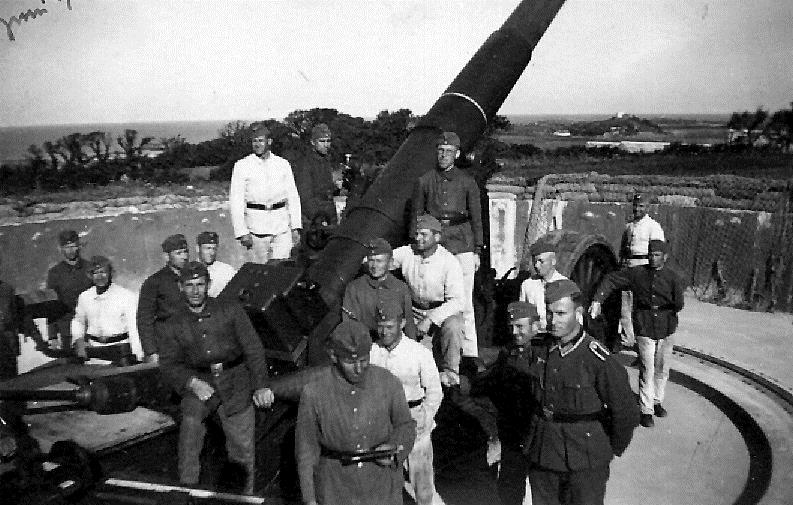
Herman Lauster is seated at centre in his white uniform, amongst his Flak Gun troops.

He told Gilbert one day that, as the situation in Europe rapidly deteriorated, he would go up onto the deck of the watch-post each morning and, looking out to the horizon, he’d pray “Lord, send the Americans!” 

He also related a vision God had given to him of an end to the conflict, in which he saw one of his own German army commanders standing aimlessly atop his observation post, along with 22 of his fellow-soldiers. The officer declared that the war had been a farce and fatally lost.

[Editor’s note: read Epilogue for more on Herman Lauster, at the book’s end]

After D-day the situation turned steadily worse. Being now cut off from the Continent, there were no more rations for the troops, neither was there any further opportunity for civilian trade with the French. From then on we were limited to what could be produced on the Island. Although we were in enemy occupied territory, we were not considered “prisoners of war” and thus not entitled to any assistance from the Red Cross.

A brave man, Captain Fred Noyon changed all that.

Fred Noyon was a retired sea captain who had spent some time as a Channel pilot, working out of St Sampson’s. He had now settled down to the life of a fisherman, a canny man with an intimate knowledge of the waters of the Channel and English coast.  Afraid of very little after his many years of experience at sea, he considered he had probably ‘seen it all’.

One day in mid November he was approached by certain concerned persons, to see if he would be willing to take the risk of going to England in person to present documentary evidence to the Churchill government, which gave a clear and total picture of the dire situation now existing in the Channel Isles. Some few months earlier, two reports had been smuggled out, one in October by uncertain means a second in early November, with an escapee who made it out through France but had not been able to present the papers in person.

(It appeared that the Royal Navy now had a total blockade on the sea-lanes from all ports that would provide any avenue for the Germans to get supplies to the Channel Isles. Aerial reconnaissance photographs taken by RAF flight crews, en route to raids over Europe, indicated  a head-count of cattle…almost all dairy cows, not beef cattle…that all things must have been well as the beasts were not being slaughtered in great numbers. It was a rather simplistic method of intelligence gathering and, tragically, far from the true facts.)

Captain Noyon would be recognised as a plausible and reliable character through whom to pass the information on to the ‘senior service’ (navy) as he had been ‘one of theirs’ (albeit a merchant seaman) almost all his working life.

Noyon gave the matter some consideration and decided that he would give it his best effort, on the basis that:

  1. there were very few others as qualified or experienced as himself
  2. as a widower, with no children in the Island, he had no family whom the Germans could punish after he had gone
  3. he was frustrated with the situation as it was, unable to freely go fishing in his beloved boat, ‘Littlewood’

Besides, he loved a challenge. He agreed to go, along with his mate, Bill Enticott.

The plan was quite simple. He would apply for the usual day fishing license and put to sea out of St Sampson’s, do some fishing along the northeast coast, then turn back south with the stated object of testing his engine pumps whilst sailing into St Peter Port to have repair work on them.

Having loaded all the right gear to match the tale, The German Harbourmaster, when he went to inspect the boat, accepted the story. Unbeknown to the HM, under the nets were an extra stock of eight cans of fuel obtained on the black-market, bartered for an undocumented portion of his fish catch.

The ‘Littlewood’ sailed from St Sampson’s and into the next bay to the north. There Noyon and Enticott laid a very old net (in bad enough repair to abandon) and then carried on slowly northward, appearing to be looking for schools of long-nose fish. Late in the afternoon, passing showers and drizzle set in, hiding them from sight of the shore. Perfect. They changed course out into the Channel. At dusk they raised the vessel’s sail to catch the westerly that had sprung up. Not long before midnight they were challenged by an American sub-chaser. They were taken to Cherbourg…not England as hoped… where they were able, none-the-less, to hand over the documents to high-ranking British authorities, capable of making sure the information got ultimately into the right hands. In addition to the documentation, they were able to give accurate details of defences, gun emplacement locations and force strengths. The foresighted Enticott had, during the time when fishing had been embargoed, volunteered to drive supply trucks for the Germans and used the opportunity to make meticulous notes of where everything and everyone was positioned.

This was the fullest information so far received. Its accuracy and clarity confirmed the previous information received from other sources, at least one of which had passed on through German hands and could have been considered suspect.

On November 5th, contact was authorised with the Red Cross, using the German radio frequency via the local Guernsey transmitter. The following message was sent:

To the Secretary General,                                                                          Guernsey,

International Red Cross,                                                                            5th November, 1944

Geneva 

Conditions rapidly deteriorating here STOP will soon become impossible STOP we urge immediate visit of Red Cross representative STOP

All rations drastically reduced STOP.

  • Bread finishes 15th December.
  • Sugar finishes 6th January.
  • Ration of separated milk will be reduced to one third pint per head by end of year.
  • Soap and cleansers – stocks exhausted.
  • Vegetables generally inadequate to supply civilian population through winter. German consumption heavy…
  • Clothing and footwear stocks almost exhausted.
  • Fuel for gas and electricity finish at end of year.
  • Coal stocks exhausted. Wood fuel quite inadequate.
  • Many essential medical supplies already finished

Victor Carey

       Bailiff of Guernsey

A similar message was sent from the Bailiff of Jersey.

Victor Carey noted in his diary, “…starvation stares us in the face and I can see no way out of it.” The reality was that almost no one in Guernsey was not malnourished and going hungrier by the day. Some got up in the morning, ate what little was available for breakfast and left for work. Returning home at midday they went to bed as there was nothing left to eat and no energy left for work or activity of any kind.

For a minister with a parish as large as Gilbert’s now was, it was imperative that he and Irene stay well. Unknowingly, one of their ‘alternative dietary substitutes’ was also helping to keep them well. From time to time, the “Press” would announce that certain beaches are open for carrageen harvesting and both Gilbert and Irene would join in, as much for the chance to get down to the water’s edge as for the seaweed-moss they were able to collect. Serving suggestions for this bright green algae included: – sun-drying it until crisp to enable them to be finely chopped and used as a green-tea substitute; after washing in fresh water, to be used in a salad; boiled in a small amount of fresh water then drained and served as a cooked vegetable…the water, when left to cool, would set like aspic due to high content of natural gelatine. The amazing fact is that, like many others, Gilbert and Irene ate the carrageen only because it was edible and, despite its rather bland taste, went some way to filling an empty stomach. In reality, it is a medicine all of its own, containing minerals and vitamins conducive to good health. It’s most common commercial use is still in cough and cold medicines.

Other good, healthy food, not normally found on their table in better times, included limpets, chestnuts, turnip, parsnip, stinging nettle, dandelion and more. On one occasion they managed on parsnips alone for over three weeks…causing them both to have recurring dreams of roast lamb and Yorkshire pudding with vegetables and gravy. [The family never had parsnips on their dinner plates in subsequent years].

12. Covert Operations

12. Covert Operations

Whilst the deportees enjoyed listening to radio in their camps in Germany, the population of the Channel Islands sat in ‘communication-darkness’, their radios having been confiscated a few weeks earlier. Undeterred, a few amateur ‘technicians’ got to work, creating crystal sets for themselves. Gilbert was, of course, right up there with the best of them. Naturally, this was kept a personal secret, to avoid being reported and convicted for a crime against the Reich, which attracted a serious penalty.

Even Irene was unaware of Gilbert’s covert activities when he disappeared to the church buildings for hours at a time. Unbeknown to her, and anyone else in the church at that time, he had dismantled portions of the Hammond electric organ, of which the church had taken delivery just prior to the occupation’s commencement, and had removed a great deal of the electric wiring as well as several electrical contacts from the instrument. No one in the congregation would have been any the wiser because the organ was not able to be played, due to the Germans’ imposition of power restrictions, whereby the power was shut off to all but their military facilities, due to fuel shortages. A piano was being used in its place.

After a visit to the rubbish tip, en route to call on one of the church flock who lived in the vicinity, he returned with just the very thing he needed…a small, white ‘Bakelite’ box, 5 cms square by 1.5 cms deep, to hold dentifrice. [‘Dentifrice’ is a solid block of coarse ‘soap’…not unlike sand-soap, only finer…for use as a tooth cleaner. The tooth brush is moistened and the bristles rubbed on the block until it foams. This is used instead of toothpaste as it did not dry out and lasted longer.] These little boxes were standard issue to German soldiers.

Through the lid, six holes were drilled to allow contact points to be fixed. On top of the lid, four screw-contacts were fixed above four of the holes, whilst a tiny brass cup (to hold the crystal) was fitted above the fifth and a small pivot arm with a ‘whisker wire’ above the sixth.

Unfortunately, Gilbert had no crystal but, after racking his brain, he remembered a school science project from which he had learned the chemical method of creating one using sulphur powder. It just so-happened that he knew someone who could supply him with a teaspoon-full of the needed ingredient – none other than the chemist! Upon obtaining it, Gilbert headed for the little kitchen in the old church flat. He put the sulphur powder into a glass tube he had salvaged from the dump, sealed the ends and held the tube over the gas flame, slowly increasing the flame’s intensity until the powder fused into the desired crystalline form. The next job was to carefully file the crystal so as to fit it snugly into the cup.

Up in the attic, Gilbert set to work. Having joined all the organ wire together to form one, very long, endless strand, he began to form it into a circle about 10 feet in diameter. Having laid that circle on the attic floor, he continued to coil the wire, loop after loop, on top of the original circle.

This was apparently an easy method by which to determine the BBC signal’s actual wave-length, a matter of trial and error, as the number of strands and size of the loop are adjusted.  Attaching the end of the loop to the set, he could listen out for the signal by moving the ‘whisker’ to different spots on the crystal.


Gilbert’s Ingenious Crystal Set – note the Wave-length Loop Inside the ‘Bakelite’ Box

But…to actually hear the signal he needed an earphone, of course. Where would one find such a thing?

The answer lay right there in front of him…there it was in his study…the telephone receiver! Dismantling the church’s phone, he removed the little ear-piece from the handset and attached the wires to the screw-contacts on the box-top.

With the wavelength established and signal reception clear, Gilbert set about miniaturising the loop, in exact proportion, to enable it to be installed on the inside of the box.

Success! And a ‘mini’ crystal-set, able to be easily concealed, was created. Already there was talk of surprise inspections of houses for radios or other listening devices by the Nazi ‘SS’ men, so one had to be especially careful, in case they turned up at your door unexpectedly.

Later, having a good supply of the necessary materials, Gilbert went into ‘business’ making these little marvels for trusted friends, instructing them in the art of the dismantling and attaching telephone earpieces.

One of the recipients was a man who kept his set hidden in his doghouse…but no ordinary doghouse! Mr Wilfred Durman lived on a farm where he kept three large Great Danes. They were his prized possessions and, as they were so large, had a doghouse the size of a large garden shed, with a wire-fenced compound surrounding it, to enable then to have space to walk around.

At precisely 5:55pm, each evening, Mr Durman would go out to the doghouse “…to feed the animals in the enclosure…” Whilst they were eating, he would go into the building, shut the door and take out his crystal set to listen to the 6pm BBC news. As dog feed became scarcer, and the dogs became hungrier, he was completely safe in his hideaway, as no self-respecting German soldier was going to come near two fierce canines the size of small ponies, with empty stomachs and bad attitudes.

14. Resourcefulness and Risk

14. Resourcefulness and Risk

Days for us were very busy. Shortages in essential commodities were growing more acute. Even the smallest thing that could be used some time was conserved, not even a twig was left lying on the ground. If a gale blew and trees were damaged in any way, a host of people would arrive with prams, wheelbarrows, handcarts or anything upon which they carry a branch, stick, twig and even the leaves and soon every trace of wood was collected. Winters can be cold in Guernsey and the lack of essential food and clothing called for every effort to be made to subsist during that time. Electricity, coal and wood were now causing anxiety as supplies ran low. The use of gas was restricted to certain hours and its use outside that time ‘verboten’. As the situation worsened, its non-use was enforced by cutting it off at the source twice a day. During the permitted hours, gas-fires were not to be used for room heating. Hot water taps were sealed up and it was more than one dared to break the seals. The use of electric lights between 11pm and 7am was also forbidden, but most people were unaffected as all they wanted to do was find warmth under their blankets and sleep at that hour, so it was not too inconvenient. Later the shortage became so acute that only 4 units of electricity were allowed per household. I became very astute at giving Michael his last bottle and changing his nappy in the dark – it really is amazing what you find you can do when it is imperative.

It was especially during these winter months that the crystal set became most appreciated. Gilbert would take the tiny box from its hiding place, disconnect the ear-piece from the phone and attach it to the terminals and then set the ‘whisker’ onto the BBC. Reception in the house was such that the ear-piece blared out loudly, almost to distortion point. Afraid that a neighbour or, worse, a passing German soldier on patrol, may hear the noise, Gilbert would put the earpiece under two pillows and underneath the warm sheets and blankets he and Irene would enjoy the variety of news, music and comedy of the ‘BBC Home Service’ transmissions…sometimes having to stuff the blankets into their mouths to stop from laughing out-loud at the fun and humour which brightened up their evenings. After all, they would not want the enemy to think they were having too good a time, enough to be laughing so loud, and thus impose even more restrictions on the community!

It gave them another source of good humour with which to face, and cope with, the realities and difficulties of their everyday life. Times were, certainly getting tougher.

It was at this time that, after discussion with some of the men of the church, Gilbert made a ‘hay box’ – a rather primitive aid to cooking. He used a plywood tea-chest and, after obtaining some hay from one of the farmers who attended one of our churches, packed the hay tightly into the box – leaving an indented shape into which two of my saucepans would fit snugly. Then I made a cushion, stuffed with more hay that would compress down tightly on the saucepans when the contents were boiling, and the lid was tightly closed. Gilbert would stand at the ready whilst I would hurriedly drop the peeled and cut vegetables into the pots which were swiftly placed into the space provided in the box. Immediately, the cushion was pressed into place and the wooden lid shut down and that was that…for about 12 hours… when the vegetables would be cooked through! We laugh about it now, but we didn’t always laugh then!!

Later when there was no gas or electricity to heat the water, Gilbert converted a four-litre paint tin into a twig-burner. He made a little platform with four little feet for the burner to stand on. In the side of the tin, he cut several little holes through which we could insert the twigs which I collected whenever I took Michael out in his pram. Once again, we could use the ‘hay-box’ after our twig –burner had brought the water to the boil.  The holes in the burner also provided a small amount of light when used at night.

“Improvisation” was the theme of every day. When it was cold, we wore as many clothes as we could and one winter, Gilbert would spend his mornings at his studies wearing his winter dressing gown over his suit.

In order to fortify the islands to satisfy Herr Hitler’s dream of the ‘unangreifbare Festung’ (impregnable fortress) it was necessary for the Germans to import foreign workers through Organisation Todt (O.T.) to do the work. According to estimated figures, 17,500 O.T. workers…made up of unemployed Frenchmen, Spanish Republicans, Dutchmen, Czechs, Poles, Russian prisoners from the Eastern Front, Belgians, Algerians, Moroccans and other sundry forced-labourers, had arrived in the islands by February 1942. Many more continued to arrive in years to come due to the high attrition rate. No matter what their origins, all were treated with equal cruelty by their overseers and guards. The uniforms that had been issued to them were generally tattered. They wore improvised footwear comprising pieces of cloth, wire or string wrapped around strips of old tires and bound to their bruised and blackened feet. Each carried their own improvised eating receptacle…usually an old jam-tin or pot. They were fed from soup trucks, which would visit their work-sites in the quarries or at fortification construction sites and were frequently so starved they would storm the trucks and fight over the dregs.

Usually they were crammed into abandoned, derelict or badly damaged, furniture-less houses and left to sleep on bare wooden or flagstone floors. Frequently beaten or worked to death at their workplace, their bodies often left atop piles of rock. It is commonly believed that many were even thrown into the cement mixers, to be poured into the walls or foundations of a gun fort or block-house. The greatest concentrations of O.T. workers were located on Alderney, where the fortifications were the heaviest in the islands group. The full truth about the numbers who met their fate there will probably never be known.

The many foreign workers the Germans had brought into the Island were seldom seen but occasionally one or two wandered away from their camps, thin, emaciated and emotionally wrecked. One day Gilbert answered a knock at the front door to find a young man, unshaven, painfully thin and looking very ill. He stood there, a pathetic figure, his eyes deeply sunken with dark rings around them, unable to speak very much English. With his filthy and bruised hands, he opened his tattered overcoat to reveal his only other clothing…brown paper, tied with string. What we could see of his body was skeletal, also bruised. Haltingly he asked Gilbert if he could help him in any way. We both knew of the official order prohibiting civilians from providing food, clothing or shelter to the forced labour workers, but his case had so touched our hearts we did not consider the consequences of our actions. Clothing was now impossible to buy, and Gilbert had only two suits, one suitable for his work, the other not quite so good but still a suitable alternative. As the Apostle Paul put it, “…the love of God constrains us…” and ‘my dear man’ felt compelled to give his second suit to this impoverished young man. So, after also packing up a parcel of underclothes and shirt, he presented it, to the evident joy of the stranger.

The morning passed and then there was another knock at the door…a heavy, strong knock! There stood a Nazi S.S. man. “Didt you giff zis man zese clothes?” he demanded, indicating the young stranger we had seen earlier in the day, cowering behind him. My heart was in my mouth as Gilbert stated firmly, “I did,” wondering just what the outcome would be. The German had apparently been convinced the items had been stolen. He stood there in thought for a moment, opened his mouth as if to speak but paused…closed his mouth…hesitated…then turned instead to the young man, gave him back the parcel and waved him on his way. He stood for a thoughtful moment longer then spun on his heel and headed off down the close, marching briskly past the shuffling foreigner. We looked at each other in silence.

It was if the unseen hand of God had passed between that S.S. man and us, leaving him dumbfounded and quite confused. Truly, we sensed our Heavenly Father’s presence at that moment!

During the next year things dragged by slowly, little of consequence happened. Gilbert was constantly on the go with church activities and visitation of the now-expanded congregation, with so many of other denominations having joined us. With transportation severely limited and his only personal form of mobilisation being his bicycle, making his rounds took so much longer.

On occasion, when Phyllis was free to stay with Michael for a full day, I would cycle along – especially when there were sick folk or problems that required a lady’s attention. Despite the dreary, depressive pace of life, due to occupation circumstances and the negative effect they had on many of the population, we were kept so busy in our ministry that we felt we didn’t have the time to let it get us down. Gilbert frequently commented what a privilege it was to be so caught up in God’s work at this time and how blessed we both felt at having been called to this task.

It is a sad indication of the boredom of life for the community when the ‘highlight’ of each evening, about 6pm, was the arrival of a German reconnaissance aircraft that flew right around the island. The noise of its engines was so loud and distinctive it became known as “Moaning Minnie”, and it became a daily reminder of the presence of our occupying forces.

 It also became the subject of many wise-cracks and in-house jokes, e.g. ‘Why isn’t a Guernsey man intimidated by his wife’s complaining? …because moaning Minnie has made him immune to loud, whining noises!’  

One evening Gilbert had left early for the mid-week Bible study and I was alone in the house with Michael. Overhead, there came the sounds of aeroplane engines and machinegun fire, followed closely by anti-aircraft fire. This wasn’t our “Minnie”, it was too menacing. Quickly I ran up to the bedroom and took Michael downstairs to the kitchen. Standing under the alcove by the gas stove, I rocked him in my arms as the noise continued, singing: “Keep on believing, Jesus is near…Keep on believing, there’s nothing to fear…Keep on believing, this is the way…To faith in the night as well as the day.” Falling asleep in my arms this trusting little child knew no fear and the words of that song gave me that same confidence, realising I was in my loving Heavenly Father’s care. The planes flew off into the distance, peace returned and the experience lives on, remaining real to me as the years have passed.

[This was probably one of many ‘dog-fights’ between RAF Spitfires and Hurricanes and Luftwaffe ME109 and Fockwulf fighter aircraft which took place over the Channel Isles, especially during the ‘Battle of Britain’, with spent bullets and cannon-shells frequently falling on the countryside below. When taking place at quite low altitude, these battles could be frighteningly noisy events].

Gilbert was often away during the day times as more and more requests came for him to call on the aged of the congregation who were finding it increasingly difficult to get to Sunday services. A reduced diet was leaving many of them very weak and frail and with horse-drawn ‘bus’ services being at a premium during the week, the animals were usually rested on the Sabbath.

His usual practise was to take his Communion Case. This little 6x8x3inches black leather-covered box with a hinged top had a moulded interior fitting, into which a small silver goblet and plate, a little box of bread, a miniature bottle of wine, and an even smaller bottle of anointing oil could rest during transportation. This case fitted inside his briefcase alongside his Bible. The briefcase had a wide flap-top which he would open and lay over the cross-bar of his bicycle and then buckle it up so that it hung from the bar, just above and between the pedals. Thus, it was out of the way, yet always within his reach as he went to share Communion, read, or to pass on encouragement from the Scriptures and pray for the sick after anointing them with oil.

He must have covered hundreds – if not thousands – of miles on that bicycle with its ‘custom-made’ tyres. That, along with God’s sustaining power, helped him to remain fit for his ministry…despite the enforced-diet he and all the Islanders were required to endure.

During one of these visitation excursions, he was cycling along the coastal road on the western side of the island. It was a lovely sunny day and the water, out to his left, was a smooth as glass as he looked out across whilst he rode. As he approached a spot where a German observation post had been erected atop one of the many historic Martello Towers that dot the coast a regular intervals (tall, round, thick granite leftovers of 11th century military activities), his attention was drawn to three small black specs low on the horizon. At first, he took them to be three large sea birds but on a second glance realised they were aircraft approaching at high speed. Looking up at the watch post, he could see the soldiers leaning on the rail, apparently unperturbed by the approaching aircraft. Then he saw flashes of light from the wings of the middle one. Instantly he realised this was an Allied attack. Hopping off his bike, he picked it up and dashed to a storm-water ditch beside the road and got down into it. Each of the planes strafed the tower in turn, climbed, banked steeply and turning a full 180 degrees, dove down back to almost sea level and fled back out to seas as fast as they had come. The whole event took less than a minute. They must have flown in below radar height, too low for ‘ack-ack’ fire. The machine-gun on the tower did not return fire at all.

After a short time, satisfied that the aircraft had left and would not return, he lifted himself and his bike from the ditch and pedalled off poste-haste, keeping a watchful eye to seaward.

Leaving Irene or Phyllis alone in the house was concern enough but the Germans had taken to surprise-raids on homes where they suspected clandestine radios or crystal-sets may be hidden. Whilst they had a hiding place behind a loose brick inside a disused chimney in one of the bedrooms and another in the attic, he did not want anyone to have to face a search which may have uncovered the set in his absence. [As it was, there were at least two Military-police raids on the house but on neither occasion was the crystal set in the building.

The German tower built atop a “Martello” tower, which Gilbert witnessed being strafed by an RAF aircraft.

Living in such proximity to General Heine and several other German officers who also had their accommodation in The Close, they were probably considered to be least at risk to the temptation to commit such an offence and no further inspections were made]. Prepared to take full, personal responsibility if found out, Gilbert carried the set with him as he went about his ministerial duties.

A German Coastal Observation tower; rangefinder for the heavy “Mirus Battery” guns.

He had hollowed out part of the padding in the moulded section of his communion box into which his little crystal set would fit snugly. Despite being stopped at checkpoints periodically as he criss-crossed the island, he was seldom searched as he always wore his blue minister’s arm-band. Any officer that did commence a search got no further than opening the briefcase. Upon seeing the Bible and the Communion Box, the search was concluded.

It was on this little crystal set that Gilbert and Irene heard the news in June, 1944 of the Allied landings at Normandy on D-Day.

June 1944 saw hundreds of British aircraft flying high above, crossing the Islands enroute to France. D-Day had come. Once landed, the Allied troops set up a powerful B.E.F. radio station and Gilbert and I were able to pick up their transmissions on our crystal set. What an exciting time as we listened to all the news and action. Of course, we all thought our deliverance was at hand. Little were we to know that our most difficult months lay ahead, and we were in for quite a long wait.

Our German invaders were now “cut off” from the Continent and we had become a ‘Siege within a siege’.

As early as 1942, as the war became more difficult for the Germans who were facing new threats on multiple fronts, many more of the experienced and senior soldiers of the occupying force had been recalled to France, the rank and file were replaced by men who were less driven or fanatical. *

In some cases, the replacements were quite disenchanted with the whole concept of Herr Hitler’s great dream of the ‘Thousand Year Reich’. In fact, amongst the new arrivals were men transferred directly from detention and internment camps, those who had incurred the wrath of ‘the little corporal’ himself, including conscientious objectors, opposition politicians, ministers of religion, and other ‘intellectuals’ who had voiced their own opinions about what was happening to their country under the Nazi regime. They were drafted to non-combatant duties such as civil administration, coastal surveillance, and medical support.

[*Not so with the senior officer replacements amongst whom came many with strong, radical Nazi views and ideals. They were a rather incongruous combination – extremist officers leading largely disinterested troops].

13. Out of the Mouths of Babes

Out of the Mouths of Babes

13. Out of the Mouths of Babes

As early as July 10th, the Germans had instructed that all houses with families living in them were to display a “This house is occupied” sign in the window. As many of the remaining families wanted to keep the dwellings of family or friends who had evacuated out of the Germans’ hands, they sent members of their own family to live in the empty homes and justify having a sign in the window. Eventually, the need outstripped the supply and German officers would visit houses to inspect that all was as it appeared. As time went by they began evicting families to secure more accommodation.

It was a lovely Guernsey-autumn afternoon and my schedule had been changed around. In the afternoon I walked down to the town with the pram, which was quite out of custom for me at that time of day. I don’t remember why it happened but it is probable that news of a restricted commodity was being released on sale at that time had done the rounds, so I would have been keen to make the purchase. Having stood in queues for a couple of hours (we queued for everything we bought) and completed the shopping, I had laboured back up the steep hill, feeling relieved to reach the flat ground of Doyle Road and turn down the slight slope of The Close. Pushing open the gate I left the pram by the front door. Michael was asleep so I took the few groceries inside first.

Now, the amazing thing about this simple act is that I have no recollection of ever leaving the pram at the front door before – I had always taken it to the back door, which was my habit. Besides, it was closer to the kitchen.

I was startled to hear a sharp rap on the door. I thought immediately of Michael in the pram and ran back to see who it could be. The door was ajar but I could see the shadow of someone there and heard a voice. As I opened the door I’m sure my face must have been a study to anyone who might have been an uninvolved spectator! There, to my horror, stood a high-ranking German officer and with him a Guernsey civil-interpreter. My heart sank – I immediately guessed the reason.

At this time of the occupation, housing had become a real problem So many German troops were now in the island that everywhere houses were being commandeered for their use. Usually civilians were given just six hours to vacate the property and find other accommodation…but where? Would it mean going back to that tiny church attic ‘apartment’?

 My mind raced and my heart pounded as I thought of the room upstairs with the contents of the jeweller’s shop. Some had been disposed of by the aunt of the owners to various people anxious to buy but most still remained. What a haul some German soldiers were going to get now! Subconsciously I breathed a brief prayer of I-know-not-exactly-what.

“The officer would like to see over the house,” the interpreter said, and at that very moment a sound met my ears that had never been so welcome. Michael had woken up and let out a loud, prolonged cry. The officer spun around, walked over to the pram and stared down at the little red, puckered face of the blue-eyed, fair-headed baby. Pausing for a few seconds, he turned to the interpreter and spoke to him in German. “The officer wishes to know, is this your baby?” the interpreter asked. Hesitantly I nodded and answered a nervous “Yes.” The officer looked again at the baby, who had now stopped crying, then turned and spoke once more in German. “The officer says he will not turn you out with such a small child,” the Guernseyman said. With that, the officer gave a slight bow, clicked his heels and the two of them turned and walked out through the gate.

I don’t recall if I cried with relief – (I guess I did as, those who knew me will remember, tears are never far from my eyes, either from joy or sorrow). But I do know one thing I did was to acknowledge that this was my Heavenly Father’s care in action. The Psalmist wrote “The Lord shall preserve your going out and you’re coming in…” and how He had done that for us that afternoon! Often I had thought…if I had not gone to town instead of the park that afternoon…had I not left the pram at the front door…if Michael had not cried at that precise moment…how very different and difficult the next two and a half years could have been. I give thanks to The Lord for ever remembrance of  these amazing interventions – trivial to some people, I expect – very vital to me at that time, I can assure you. 

It should be noted that not all of the occupying forces were considered by the Islands’ population to be truly ‘The Enemy’. As the war progressed and the fighting across Europe became more fierce, the elite troops who had arrived in the earliest occupation days were rotated as they were required at the many ‘fronts’ developing across the European theatre. Replacements were frequently less fanatical, less experienced and, consequently, less eager for confrontation with the enemy in battle. The occupation role suited many of them well. As space in barracks ran short, many were billeted with Island families, with whom friendships frequently grew. Often, one would be placed in a house where there were children, reminding him of his own family back home. Photos would be shown, stories told and experiences shared and before long they were part of the family…only to be sadly torn apart when transferred to other postings. Many of the friendships outlasted the war and culminated with the officer’s return to the Island in peacetime, bringing wife and children to meet their husband’s and father’s hosts.

Similar situations arose at administrative levels. One highly ranked secretary in the Guernsey Procurer’s office noted in his diary, “The bread ration is less than 3lb. a week…and there I was talking to a German – and laughing with him too – a man whom I knew to be hating the very thought of the task he was called upon to do.”  He found it impossible to see this man day after day without getting to know something of himself, his background and family and in that situation not allow a friendship to spring up between him and his opposite number.

In reality, there was a great deal of respect between the leaders of the invaders and the invaded. It is said that Dr Symonds, in charge of Guernsey’s medical and health services became a good friend of the Chief German Medical Officer, Dr Lorenz – an adamant ‘anti-Nazi’. The story goes that Symonds would often invite Lorenz to his home where they would sit, talk and curse Hitler together! 

The Guernsey Civilian Harbour Master, Capt. Franklin and the German harbour boss, Kapitanleutnant Obermeyer eventually came to an agreement regarding their shared responsibility for the operation of both St Sampson’s and St Peter Port’s harbours. The two were frequently heard at night in their office, singing sea-shanties and sharing a bottle of the hospitable Obermeyer’s finest liquor. These evenings, reputedly, came to a conclusion with the same toast, “To the war’s end!”

11. When Passing Through the Valley of Weeping


When Passing Through the Valley of Weeping.

September 15th, 1942 was one of those lovely autumn days that give a feeling of warm contentment. Gilbert’s cycle was, by now looking quite a showpiece! The tires had worn out completely and new ones were unprocurable. (With all the greenhouses across the island, in which tomatoes had been grown year-round, miles of hose pipes [used for heating in the winter] were now unused, due to the restrictions on energy for heating. With some ingenuity and resourcefulness, Gilbert had been able to ‘obtain’ enough piping to create two new ‘tires’. He had managed to painstakingly, using a long piece of wire with a hooked end, draw strips of cloth and canvass through the pipes so as to make them solid. They were then cut to length around the rim of each wheel and the ends sewn together at the joins with wire. These new ‘tires’ lasted the duration of the occupation).

 Although somewhat less comfortable on the substitute tyres he (and many other enterprising souls) had ‘manufactured’, he rode far and wide around the island in response to calls for his services.

This particular day he had ridden to the Castel Methodist to speak at an afternoon gathering.

It was a Tuesday, the day of our ‘Bright Hour’, and I was early with all my arrangements. Michael was fed and in his pram, ready for his afternoon walk. Looking at the clock, I found I had some spare time. Earlier in the morning I had heard the paper delivery boy at the gate so I went to look for the paper to see if there were any special ration allowances for the week.

As Phyllis was unavailable that day, my friend Doris arrived, collected Michael and set off happily with the pram for the park. As I closed the door I turned to pick up the paper from the usual place Gilbert put it after reading. It wasn’t there. I looked all over for it, still no paper. By this time something began to tell me it must have been purposely hidden. If so, there could only be one reason – bad news! I intensified my search. Under the cushion of a seldom used chair I found it. Tremblingly, I open to the “Official Notices” page.

NOTICE

15 September, 1942

By order of higher authorities, the following British subjects will be evacuated to Germany:

  • Persons who have permanent residence not in the Channel Isles, for instance, those who have been caught here by the outbreak of war
  • All those men not born on the Channel Isles and between 16 & 70 years of age that belong to the English people, together with their families

Detailed instructions will be given by the Feldkommandantur 515.

Der Feldkommandant,                                              (Gez.) Knackfuss, Oberst.               

Now I knew why Gilbert had hidden the paper! I read and re-read the order. I tried to read into it any other things than it could mean but it was clear – it meant US! I was stunned.

That afternoon I was scheduled to be the speaker for the ‘Bright Hour’. I took up my Bible and speaking notes and re-read my text for the meeting…Philippians 4:11, “I have learned in whatsoever state I am, therewith to be content.”  I asked myself, “Can I really say that?” With fear clutching at my heart, could I honestly say it?

The rows of seats were filled when I arrived, the atmosphere tense. Many others of those in attendance were affected, even as we were, by this turn of events. Tear-stained faces were much in evidence and, trying to be brave, I announced our first hymn, chosen many days before…little knowing how much they would mean that afternoon.

“When the storms of life are raging

Tempests wild on sea and land

I will seek a place of refuge

In the shadow of God’s hand

He will hide me, safely hide me

Where no harm can ere betide

He will hide me, safely hide me

In the hollow of His hand.”

Overcome with emotion, many wept as we sang. This was no soft or imaginary experience, this was real – a ‘NOW’ test. Somehow, I managed to speak without changing my theme, as by faith I claimed whatever was God’s will for us. I would accept it as from His hand…but, Oh how I prayed “If possible, not THIS, Lord.”

As I walked home, I saw Dr Rose nearing the entrance to The Close. He stopped his car and got out. We stood on the corner and discussed at length the new situation and what it might mean. “Chin up,” he said, “they can’t send all of us. So many doctors and other essential people needed to maintain the morale of the population are English. There are bound to be exemptions.” Then he asked about Michael. I told him of my concern that he seemed to have dysentery. He could see I was exhausted and paused to think. “I’ll arrange to have him put into hospital for a few days. Apart from resting you from nursing him, it will give you the time you need to do whatever is essential as far as you and Gilbert are concerned.”  He turned to get back into his car but hesitated and turned back to me, “I suggest you take a note to the Commandant’s office as soon as possible, to see if it’s possible the baby could be left in the Island in the care of someone you can trust, until this is all over.”

I hurried down the cul-de-sac to the house. I hadn’t yet seen Gilbert since this storm has burst upon us. I put the key in the door just as the phone rang. Lifting the receiver, I heard the voice of Mrs Batiste. “I’ve just read the paper, my dear, and I just want you to know I will willingly take care of Michael if you will entrust him to me, whilst you are in Germany.” This dear lady, my own mother’s age, was pouring out her desire to help. How much I will ever treasure and appreciate her loving thoughts.

Gilbert arrived. We talked quickly as I told him of Dr Rose’s arrangements and Mrs Batiste’s suggestion. Hurriedly I wrote the note to the Commandant asking for Michael’s exemption and ran to Grange Lodge – there to find hundreds of people also bearing notes, hoping to be allowed to stay.

After a long wait I found myself standing before the desk of several officials who were processing these requests. Reading my request, the officer in charge looked at me coldly and with an expressionless face said, “Nicht. All families must go together!” My heart sank as I left the building. “What now, Lord?” I questioned.

Meanwhile Dr Rose, as good as his word, came to say arrangements were made with the hospital and, with the assistance of his nurse, took Michael in his car. In his parting words he told me to relax, all would be done to get him right as quickly as possible.

A meeting of ministers of all denominations on the island was called and a deputation representing the ministerial fraternity went to meet the Commandant, requesting exemption for all ministers on the basis that their place in helping maintain the Islanders’ morale was essential. After a lengthy discussion, the Germans consented to allow some to remain but insisted that a certain number should still be deported to maintain the quotas set by Berlin (how we hated the Germans’ obsession with ‘quotas’!). After completion of the list we found that both Arthur Jackson and we were among the number for deportation. It seemed that our three churches would be completely without any pastor of their own and the close-knit relationship that existed between our people and us would now be broken.

Back at home we made plans whilst we sorted out clothing that we could take, knowing it would be a cold winter in Germany. Not having been able to buy wool for baby clothes or even ready-made garments, for ourselves or Michael, in recent days didn’t make it easy. Luggage was very restricted – one small suitcase each – and the boat was to leave on the 21st. There was not much time. The first boats were to leave within 24 hours of the initial declaration.

Gilbert and I were the youngest minister and wife on the island and the only ones with a new baby. Many of the ministers from every denomination were anxious for us, calling us to assure us of their prayers. Early on Thursday morning a Methodist minister rang. During a restless night he had found himself thinking of us and suddenly a thought had sprung to his mind…the Reverend & Mrs Donald Stuart had recently retired from active ministry but still held current ministry credentials and he continued to preach in some of the pulpits vacated by the earlier evacuation. They were also English and would be amongst the deportees anyway. Could it be at all possible that they could take the place of someone on the ministers list and so still keep the numbers correct, thus satisfying the Germans’ statistical requirements (the ‘quotas’ with which they were obsessed)  and yet free up another man to stay. “Meet me by the Town Church and we will try to find the Stuarts. They have been in Jersey for a few days but will likely be coming home on the morning mail boat today,” he said to Gilbert.

By the time they left the Town Church and got to the wharf they found that the boat had arrived early and all the passengers had left. Making their way back up to the town centre, the two men passed a café and, just as they were approaching it, who should walk out of the door but the Stuarts! They had stopped to have a quick cup of ‘ersatz’ coffee before hastening home to start packing. Was it a coincidence? No, it was definitely a ‘God incident’.

The four of them sat back down as the proposition was quickly put to Rev and Mrs Stuart. Without hesitation, their answer was “Yes, of course!” Knowing that he and his wife had to leave anyway, Rev Stuart realised that by going in the official capacity of a minister may well give him opportunities to be a chaplain to the other deportees, with the authorities’ approval. [Already ministers had been issued with armbands bearing a blue cross so that they could be easily identified by both people and authorities.] He relished the idea of extending his pastoral ministry in this desperate situation. After their discussion, they decided to go immediately to the German administration to seek permission for the changeover. The officials listened, wrote copious notes but would not give an immediate answer…it would have to be considered. In true Teutonic form, there would be no hasty decisions from the occupiers, even despite the short deadline.

At home we concluded our preparations as we could not afford to be un-ready, should the request be refused.

Arthur Jackson gathered together his things, leaving various possessions in the charge of church friends, deciding to treat it as an adventure – which it was to become for him…albeit a rather unpleasant one. His cheery disposition during those tense hours of awaiting the outcome of the decision on our future was something of a relief.

Monday 21st dawned – our boat was due to depart for occupied France that evening. During the morning, Gilbert went to the German HQ at ‘Grand Lodge’ to see if a reprieve had been granted for us. By midday I was in our sitting room, which was full to capacity with many of our church people who had gathered together for prayer. Our bags stood packed at the door. Any food I had been able to save for ‘a day yet to come’ I had parcelled and labelled with names for distribution amongst the elderly folk in the congregation.

We were in the midst of prayer when the front door burst open and there stood Gilbert holding aloft our exemption! We were free to stay! Now and our three Elim Churches would have at least one pastor to oversee and minister to them. Arthur was genuinely delighted for us. His concern for Michael in the recent two days since the first declaration had been particularly touching.

What a wonderful answer to prayer! Our people were overjoyed and radiant as they stood with us as  we prayed prayers of thanks then sang together, giving praise to God for His goodness – and once more I knew that the promise of Isaiah 58 : 11 had really proved true  in detail and I rejoiced. Tears of joy stained all our faces.

Amongst numerous activities relating to the deportation, such as the raising of supplies of food for the deportees for the journey (including 1000 hard-boiled eggs gathered up and donated by restaurateur Frank Stroubant), urgent shoe repairs and emergency clothing supplies for the unfortunate travellers, The Guernsey Press, 16 September 1942, reported “at a service at Eldad Elim Church, the Rev. G. S. Dunk announced that the Rev. Donald Stuart had offered to replace him as an deportee, thus leaving one of the Elim Churches’ ministers in the Island. The Rev. A. A. Jackson, of the Delancey Elim Church, is also to leave the Island and the Rev. F Flint has volunteered to leave for the Methodist Church.”

After the war we learned that both Rev & Mrs Donald Stuart had passed away in the Biberach Internment Camp. They had gone to be with The Lord where we know they will have heard “Well done, good and faithful servants.” We have always felt so very, deeply grateful that they took our place, paying the ultimate price and pay them special tribute. We are truly honoured and blessed by their faithfulness.       

Married couples, single women and families were sent to either Biberach or Wurzach Internment Camps in southern Germany. Arthur Jackson went initially to the Laufen Internment Camp, also in the south, along with the single men but was eventually moved to a Prisoner of War camp on the Russian border and made Padre to the American prisoners held there in the bitter cold. He had a dreadful time, having later been marched south with the P.O.W.’s back through Europe, and then being held in Berlin during the heaviest of the Allied bombing. After the war he was repatriated to England… a nervous wreck…but later, happily, following a long period of convalescence, became a Church of England vicar. He took a pastoral role at the Stone Church, Staffordshire.

There has never been a clear explanation as to why the Deportation Order was given in the first place. It puzzled the Occupation Force administration as much as the Island administration as it was a complete breach of the initial German promise as outlined in General Richtofen’s ultimatum that: “In the event of a peaceful surrender the lives, property and liberty of peaceful inhabitants are guaranteed.” Colonel Knackfuss had made an immediate protest to the order, both to the German Commander-in-Chief in France and General Schmidt (Hitler’s Adjutant)…to no avail. The order had come from Herr Hitler himself and that was that. With typical insanity, he had insisted on definite numbers of civilians in specific categories and classifications, for deportation. There is a suggestion that he may have wanted a certain number of Englishmen as ‘pawns’ for some future bargaining, possibly in exchange for interned Germans.

The sadistic and apparently senseless act of tearing people from their homes for deportation and exile in hostile territory caused something akin to panic in some quarters. One man and his wife drank poison in a joint suicide. He died but she was revived after apparently vomiting the mixture back and being found unconscious was rushed to the hospital. Some young girls (of English parentage) escaped deportation by hastily marrying Island men; whilst men and women employed by the Germans were exempted. Other exemptions were granted on the basis of ill-health or essential work (under which category Gilbert and Irene were eventually granted theirs).

Throughout the Islands, younger people volunteered to act as substitutes for elderly or ailing friends, in most cases without success. In Jersey, three young men who had returned home as Conscientious Objectors, after appealing against being called-up for military service whilst working in England, were permitted to go in place of a minister and his family. 

In Guernsey, Baron von Aufsess, Officer in Charge of Military Administration (of who we will read more in a later chapter), had finally to call an end to appeals with the simple statement, “I am sorry, but I must provide the numbers.” – (it was those ‘quotas’ again!!).

The departures took place with an air of stubborn dignity and, on occasion, a spirited expression of rebellion and good cheer. On the wharf some local businessmen arranged for a stall with hot food and soup and offered elaborately wrapped ‘gifts’ of contraband tobacco and cigarettes to the men amongst the deportees, some of whom sported little Union Jacks tucked into their hatbands. Their fellow-Islanders who stood watching them go would break out into intermittent cheers for “England”, “Guernsey” and even “Churchill”.

And so they went, leaving behind their friends anxiously awaiting news of how they were coping. Months later the first letters started coming from the internment camps. Reports of Red Cross parcels and nursing care eased some of the concern for the exiles. Many complained of monotony, lack of exercise and boredom but others had volunteered for work parties outside the camp and found themselves working on farms on the surrounding beauty of Bavaria where friendly farmers fed them well and even allowed them to listen to the BBC on their radios. Mr Topley…a retired British Army officer who had settled in St Peter Port…and his wife wrote to say they were enjoying their ‘Cook’s Tour of Europe at Mr Hitler’s expense’. Mrs Topley observed, “If the Germans have got such a lovely country as this in which to live, why do they want to come bothering other people?”    

10. Great Expectations

10. Great Expectations

Once again my heart was throbbing with a new hope – a baby in June! “What a time to have a baby…” was the cry of some folk, but it wasn’t for me. This was going to be a precious time when I determined to do all I could to keep well in mind, spirit and faith as I looked to the Lord to be with me in a special way.

Baby clothes were so hard to buy by then but, in one shop I discovered a magnificent, lace ‘christening robe’, overlooked and left behind in a storeroom. What a delight to take it home and place it in blue tomato-packing tissue paper to preserve its whiteness, but many more mundane items and things were needed than that, though. Nappies, binders [who today remembers…or would even know what they are?], nightgowns, cardigans, bonnets, etc, etc, but people in the church were so delighted to know their Pastor’s wife was ‘expecting’ [the current “in” term] and soon the ‘Grandmas’ amongst them began looking through baby clothing that their daughters, or daughters-in-law, had left behind at the evacuation. The pile of baby things grew – how acceptable and appreciated each item was. I have often said, “I had the best second-hand-dressed baby in Guernsey.”

It was at this time, I vividly remember, I had a constantly recurring dream. It took place in a beautiful shop where I stood and looked all around at a lavish display of everything a baby could ever need. There were rows and rows of prams hanging from racks on the ceiling. As I gazed at all of the stock so beautifully arranged around me I would ask, “Why have I not seen this shop before?” Immediately, I would wake up…only to dream the same scene the next night, and the next and so on. Oh well! 

June 8th, 1942 and the Germans ordered that all wireless sets must, once again be surrendered. The final date for handing them in was June 17th with a fine of RM30, 000 and penalty of 6 weeks jail for those who failed to obey. No reason was ever offered for this decision but it was suspected that it may have had something to do with an attempted escape from Jersey by three young men three weeks earlier.

This time the loss was felt even more deeply. As things had deteriorated, the BBC radio broadcasts had become a bright light that shone a beam of reality into the darkness of the occupation, but once again we were to return to the sense of total isolation from the world around.

Somehow that loss of contact with the home-land made Gilbert and Irene’s families in London and Hove seem even further away than ever but, in an attempt to keep life in focus, they threw themselves into their preparations for their expected new arrival, due in a few days.

The Emergency Hospital at Castel was about 3 miles from town and that was to be the place of birth for my baby. As public and private transport was now nil (with the exception of a few horse-drawn buses or wagons which made trips into town from rural areas), the St John Ambulance were allowed to call and collect mothers-to-be at the date the baby was due. Alas! Babies do not always oblige!! So it was that the ambulance came on June 13th to hospital where, for a few days, I sat around with several other women waiting and wondering. My doctor, Alistair Rose, came in on his rounds to visit his patients, and asked me how things were going.

Realising that there was no immediate need for me to be there, he suggested that he take me back home and return me in a few days. (Doctors were amongst the few categories of people allowed to run a car so it was my pleasure to be driven home to wait in familiar surroundings.) Was I Glad? …yes indeed! After a week Dr Rose called to see me at home and, saying that he would be “tempting providence” to leave me at home any longer, drove me back to Castel where, in a couple of days…June 23rd…Michael Gilbert Dunk uttered his first cries…to the joy of us both, along with many caring friends.

Somehow the war didn’t matter – the occupation, it seemed, was just ‘a phase’ – my time, my hands, my attention were filled to capacity. My deepest desire was to bring this child up for the Lord.

 Shortages and difficulties had, by now, become challenges – situations to be coped with – in which Gilbert and I were proving again and again the power of prayer and the faithfulness of our God.

“My God shall supply all your need…” had always been a well-proven Bible promise in our household and was again fulfilled in the person of one of the young people from the church who had not been evacuated. As soon as possible after Michael’s birth, I made the effort to continue with my role of Pastor’s wife, speaking at the Bright Hour and assisting with any other essential activities of the church  – which were many and varied under the present conditions – but would have been impossible without some aid.

Very soon after deciding upon this course of action young Phyllis Vaudin arrived at my door one morning, offering to assist with looking after Michael; taking him out in his pram; staying in with him; whatever, whenever I was required to be involved elsewhere.

Phyllis was only 13 years of age and had just left school when the evacuation occurred and was therefore ineligible to evacuate with the other school children. As her parents had not left, she had to stay behind and was now looking for something to keep her occupied.

Soon she was coming to help with bathing, dressing, feeding Michael and generally helping around the house two days a week. What a heaven-sent blessing to me Phyllis was!

Michael was not always well in those early days. He had digestive trouble. There was no baby food to be bought and I was unable to nurse him successfully. The German authorities, anticipating they would one day possess the Islands I suppose, allowed two pints of milk to expectant mothers over 6 months pregnant, which would continue to the child until it was 2 years of age. Of course, no baby needed that amount and so it continued to be a small benefit to the mother and possibly others in the family but, Michael could not digest the famously rich, creamy, Guernsey milk…however much it was diluted of its richness… so it became a real problem and, at times, most upsetting.  Dr Rose kept a close watch on him but was not able to do very much. Constant prayers were on my lips and trust in my heart that all would be well.

Phyllis Vaudin – my Godsend!