When in town, in those first occupation days, one felt as though it was all like a bad dream. Hundreds of grey-green uniformed men were everywhere. Shops were crowded as the soldiers who, finding good stocks of just about everything (at first), spent their ‘Occupation Reich marks’ with great gusto. Always they had to be served first and we watched with some annoyance as all kinds of clothing – ladies’, children’s, baby’s – were bought up and packed into enormous parcels and carried away to be posted to families in Germany. All too soon the shelves were emptied with no replacement stocks, as all communication with, and transport between, England and France (usual suppliers for the islands) had now ceased. To see a burly soldier holding up lingerie and dresses against one of his companions whom he considered to be the same size as the Fraulein for whom they were intended, was really quite hilarious, even though one dare not show it. (It made for a good laugh when shared with friends in private, cheering us up a little as we made the best of a bad situation.).
We were issued with ration books for the necessities, and a few small luxuries, of life but the coupons disappeared so quickly as so many had to be surrendered for a single items Along with rations came the necessity to queue for everything on the list, some of which were available in one place and others in another. Entire days could be spent in queues. It was also obvious that our buying power would soon be nil. Guernsey currency (the islands had – and still has – its own printed and minted Guernsey Pounds, Shillings and Pence) was soon exchanged for the special occupation currency introduced in each country they invaded…‘Occupation Reichsmarks’ …comprising German marks and pfennigs[1]. We found it hard to think of it as real money, somehow. It reminded me of washers and bottle tops.
The newspapers carried updated information relating to rationing and price-fixing of every believable commodity needed for daily living, every day.
Prohibitions on the sale of candles, burning of bonfires after dusk, photography within a mile radius of the airport, the custom of ‘treating’ in restaurants, keeping more than one month’s reserve of food in your cupboard, the private sale of tomatoes and potatoes, etc., etc., were reported upon in each edition, many of which were rescinded or modified within days. Such erratic – usually ‘knee-jerk-reaction’ – declarations, continued throughout the entire occupation, often becoming the source of mirth to the local population and making the German administration look decidedly silly, to say the least! [2]
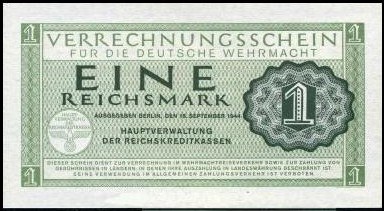
German Occupation Money
Summer days changed to autumn, leaves turned red, orange then russet brown. Days grew colder and shorter. Always we hoped that the war would soon be over – perhaps even by Christmas! Hope is a wonderful stimulant. What a blessing that the future is veiled from us…and that, for the child of God, our trust is in His ability to keep us in the hollow of His hand.
Every now and then, rumour ran rife and excitement ran high as we heard of commando raids on the island when some Guernsey-men who had enlisted in the British forces, were sent by Royal Navy submarines to land on the island for various reasons. They made observations in order to try to ascertain the strength of the occupying force, its defences and the conditions under which the civilian population was now living.
Two elderly ladies, Mrs Le Mesurier and Mrs Michael, were transported to France for sheltering members of the British Forces who undertook one of several undercover commando raids to Guernsey.
British aircraft flew overhead on one occasion, dropping information of eight men who had escaped from Guernsey in a 20 foot boat. They left under cover of darkness, rowing half a mile offshore before starting the boat’s engine. Later the engine stalled but they worked to repair it and arrived in England safely. News such as this was most heartening and gave us fresh conversation to relieve the monotony of the situation. Needless to say, the Germans were not amused by these events and were seen, rather comically, dashing about the countryside picking up any leaflets they could find, threatening punishment for anyone caught with the offending papers. In the newspapers there were also threats of reprisals if further commando raids occurred and deportation to Germany for anyone caught harbouring any military personnel involved in the incursions.
Our radios were a great source of encouragement at this time. To hear the news first-hand from the BBC, along with the familiar programs was a great morale booster, but on November 14th all radios were suddenly confiscated. Local postmen were conscripted, by order of the Commandant’s Office, to collect them. The fine for disobedience of this order was RM 30,000…a real deterrent to everyone…but many took the risk and news received from the BBC was circulated under a blanket of secrecy.
here were also fines imposed for a myriad of petty offences including – illegal milking of a cow [5/-]; not observing curfew hours [£1]; not ensuring blackout screens are light-proof; charging too much for merchandise; sketching, drawing or painting out-doors [5/-]; moving a pig without a permit [10/-]; riding an un-registered bicycle or insisting on riding a bicycle on the left-hand side of the road [2/6] (now that the Germans had changed it to the ‘right’), and so on and on, ad infinitum.
The first fine levied by the Germans was one pound for a gentleman defying the curfew as he ‘weaved’ his way home after dark, apparently.
The subject of bicycle registration had become an obsession with the authorities and provided the troops an opportunity to stop anyone as they rode along at whim to check for valid permits.
A humorous story arose, though, which concerned one of the members who attended the Elim Church who decided that, if he was going to have to have a permit, his would be number 666. He went to the registration office and stood near the door to question each person as they came out to see with what number they had been issued. As people were in no hurry to obey the registration order, the numbers were far too low to have reached the desired goal that day, he went home. The following day was not much better.
The third day he returned and again questioned those exiting the office. Things looked better so he positioned himself near the back of the queue in order to count off the intervening numbers until he could be sure that he would secure his preferred ‘mark of the beast’. It took almost all day to get close to the right number.
Finally, satisfied the numbers were into the 650’s so he joined the queue.
Unfortunately for him, the permits were printed in blocks of 30’s. When they reached 660, it seems the next block was picked up out of sequence and he walked out clutching the number 696!
Greatly upset by his misfortune. He never did speak of it, afterwards, but his story was often repeated amongst his friends and acquaintances and he was the recipient of much ‘leg-pulling’ in later days.
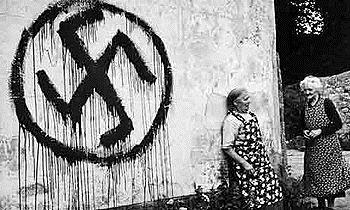
A blood-red swastika, graffiti
It should be noted that the behaviour of the German troops themselves was, and continued in the main to be, almost irreproachable. One of the early fears amongst the population, as they anticipated invasion, was for the womenfolk. There was only one reported rape case in the earliest days, which was most unsavoury. It involved a very drunken soldier and a defenceless, elderly woman. The military authorities conducted a swift and thorough Court of Inquiry resulting in the soldier being convicted, deported to a military base in France and shot.[3]
On more than one occasion, HM Procurer Ambrose Sherwill referred to the situation as “A Model Occupation” and although criticised for an apparent ‘conciliatory tone’ towards the invaders, did in fact tell the truth when he said the Island’s Civilian Administration were…“being treated with every consideration and with the greatest courtesy by the German military authorities…” He went on to say, “The conduct of the German troops is exemplary…I am proud of the way my fellow-islanders have behaved and grateful for the correct and kindly attitude towards them of the German soldiers. We have always been, and remain, intensely loyal subjects of His Majesty; this has been made clear to, and is respected by, the German Commandant and his staff…”
Like most of the Islands’ civilian administrators, Sherwill believed that their survival depended on keeping relations with the Germans on a good footing. That is by no means to say by ‘complete capitulation’, as there were many clashes of wills and wits which had potential for danger…at least one of which resulted in Sherwill being ‘retired’ from his post, then deported and imprisoned in France for complicity in a commando raid which went wrong.
Post-war accusations that the Islanders fraternised with the invaders are completely erroneous. Sherwill’s replacement as HM Procurer, Rev John Leale, summed it up when responding to a challenge that he had caved in to German demands on a certain issue stated, “To tell you the truth, I’m not feeling very heroic [over the particular matter]…but in the long run I have no doubt whatsoever that our rights and interests as British people are best safeguarded by sticking to International Law through thick and thin…we follow the example of those who take partners for life…in espousing the Hague Convention ‘for better, for worse’…”
Christmas Day came and with it a notice from the authorities that they would return all radio sets. The same postmen, who had been instructed to collect them ( with the aid of many willing, extra volunteers), spent Christmas and Boxing Days returning radios. How we appreciated their work and how much we celebrated the unexpected turn of events. The joy of hearing the BBC news again was overwhelming. Naturally, our church activities at this time of the year kept us very busy but our first occupation Christmas turned out to be better than anticipated.
It was about 6 months after the Nazis had arrived and for many people the yearning to hear news of their children and other family members who had evacuated became almost intolerable. A few Red Cross messages had trickled through in October but nothing on a large scale. It wasn’t until January ’41 when formally typed cards, containing no more than 25 words, arrived in quantities sufficient to justify opening an office in town where, when notified, we could go to read and reply to them. The word restriction including the address, it was so difficult to decide how to use the opportunity. Only personal news could be included and how much more than this we longed to convey. They took so long in transit – 4 to 5 months at least – that the news was pretty well stale but we truly appreciated anything which came from those we loved and longed to see.
More and more German troops were arriving and the need for accommodation was becoming pressing. Houses left vacant by the evacuees were being taken over, in addition to soldiers being placed in billets with civilians.
Gilbert and I were now living back in town, having been asked by a friend if we would take charge of her niece’s home. It was a delightfully situated two-storey house standing in a cul-de-sac of eight dwellings – ‘The Close’ – which featured a stone fountain and circular pond in the courtyard, as its centre-piece. We just loved the area, so quiet yet so near to the church and town. The owner was an RAF officer who, along with his wife, little son and mother-in-law, had evacuated leaving the property in the care of the wife’s aunt and uncle. Vacant, it could clearly have been taken over any day by the German Authorities and with that threat; it was obviously a better choice to have civilians occupying it than troops. (There was also the matter of concern for the contents of the family’s jewellery shop which had been stored away in secrecy in one room of the house…and one knew only too well what would happen to those, should they fall into the wrong hands.) So, accepting the gesture of trust, it was our privilege to take responsibility and care for the home and its precious contents for the remainder of the five years during which we lived in it, with the help and friendship of Joan and Ivor Lloyd as our dear neighbours…how much gratitude we owed to them for their kindnesses in so many ways.
We had just moved to The Close when one day there came a knock at the door. Upon opening it, I was handed a requisition for a pillow and mattress for the use of one of the soldiers. Most people were required to surrender bedding of some description. Fortunately there was one of each spare in the house which we could hand over.
Towards the end of 1940 food-stocks had begun to dwindle seriously. The effect upon Guernsey was more severe than Jersey, as Guernsey’s climate and lay of land lent itself more to the growing of tomatoes under glass, whereas Jersey’s land had always been more suitable for crops such as potatoes and some grain types. Experiments in variation were relatively successful but a volume sufficient to feed the swelling population of troops was a problem. Eventually, a shipping service between the occupied French mainland and the islands was established. It was then approved that Guernsey and Jersey could send a purchasing commission to Granville, France, in order to try to negotiate the purchase and supply of the necessities of life.
From Guernsey, the man chosen for the job had the ability to get on well with both Germans and French; was fluent in French and many regional dialects to boot; had a background in dealings with French businessmen and therefore familiar in their business methods; was very energetic; canny and shrewd in dealing with all manner of merchandise. Raymond Falla was already Guernsey’s Chief Agricultural Officer; a tall, dark, imposing and most charming man of the highest calibre. In late August Falla joined Jean-Louis Jouault of Jersey, on a buying trip all over occupied France, tracking down whatever supplies they could lay their hands on. With seven thousand pounds’ worth of RMs in a battered suitcase they conducted business with government, commercial and even black-market sources, with amazing success…all things considered. A quandary arose when it became obvious that the French themselves were short of many of the commodities on the Islands’ shopping list so a certain degree of bribery, hard bargaining and some old-fashioned ‘con-man-ship’ was needed to skilfully and cunningly persuade the suppliers to part with their stocks.
The goods obtained proved, in the end, to be only a stop-gap, prolonging the inevitable but the efforts of these two men added greatly to the morale of the occupied civilians. What’s more, the merchandise was, by and large, of insufficient quality to attract German military personnel to buy them out…the way they had done in the early months. The French-made products were certainly not up to ‘Made in England’ standard of the goods still in stock on the forces’ arrival.
Despite these buying trips to France being repeated over a period of many months, success in securing purchases diminished as supplies on the continent also dried up.
“Shortages” became the subject of every street corner conversation and it was not until years later that it was humorously stated that Guernsey had two commodities of which there was never a shortage: fresh sea-air…and toilet paper!
Due to the huge supplies of tissue paper held in store for the tomato packing and export industry [in a variety of bright colours to identify the grades of fruit], enterprising farmers cut up and packaged the sheets for sale, after the tomato export market died. Guernsey housewives had the rare distinction of being probably the only ones in all German-occupied territories to be able to purchase toilet paper to match their décor. Supplies lasted the duration of the occupation!
When stocks of merchandise in the Islands’ shops finally ran out, many shopkeepers elected to continue trading as ‘swap shops’ or ‘barter markets’ where any sorts of articles could be swapped for others at an agreed value…a pram for a pillow, a frying pan for a pair of warm gloves…a pair of almost new high-heels for two good novels…etc., etc. However, due to restrictions on the movement of certain restricted goods or items [including tobacco, alcohol and certain foodstuffs]; some business was transacted ‘under the counter’.
Food, after the months went by, became scarce and the constant topic of conversation, as one stood in the queues for rationed goods, circled around how everyone was coping. Each week the ‘Star’ and ‘Evening Press’ issued revised orders regarding rations. As the shops ran out of more and more commodities, we realised we would have to make do as best we could. Siege conditions are far from easy when essentials begin to get so short.
Cattle-feed became scarce…hungry cattle do not produce much milk… so milk had to be rationed. Half a pint of skim milk per person was a far cry from the famed ‘rich, full-cream Guernsey milk’ that had always been so abundant and enjoyed so much by all.
Chicken-feed ran short…unfed chickens produce few or no eggs…and so the list went on. It was clear that things weren’t going to get easier as the days continued.
Other restrictions became irksome, too. The use of gas was curtailed, certain hours of use being forbidden. To further enforce this order, the main gas line was shut off twice daily. Those who exceeded their quota within the allowed hours would find themselves deprived of gas supply completely.
Everyone now began to take extreme care of anything and everything they could get hold of, or had already in store. Salt, soap, meat, bread, sugar…and so the list went on…gradually became scarce and we quickly had to learn to substitute or do without. Everyone was gradually becoming nicely ‘slimmed down’ [without the need of diet books to give us the know-how]. My washing no longer had that ‘brighter, whiter look’ as I hung it on the line – but then, neither did Mrs Le Cheminant’s next door – so, not needing to compete it didn’t seem to matter quite so much!
Average weekly rations, at this time, were 4oz butter, 2oz cooking fat, 4oz sugar, and 4oz of flour or oatmeal, macaroni or dried beans. Every now and then we felt like children at a party when a special issue of sardines, tinned tuna fish or even local cheese (kept in storage by the essential commodities committee) were made available as morale–boosters.
Experiments made, out of necessity, revealed that there were many substitutes were available for one thing or another. For instance, when tea became completely unobtainable, I (along with a group of our church ladies) cycled out to L’ancresse Common to pick blackberry leaves in a large bag. I took them home and baked them very slowly in the oven as instructed. The dried leaves came out of the oven considerably less in quantity than the big bagful that went in! I then chopped the leaves finely and put them in a jar for future use. About enough for two pots of tea! Once made, the ‘tea’ wasn’t very appetising…it was green and tasted smoky. All kinds of suggestions were made to improve the final product – “Just add ,baked grated carrot and you won’t notice the difference from real tea”…“Let it stand longer”…“Pour it sooner”… or the ultimate “It’s purely psychological, my dear” …what a joke! However, we persevered and in due course parsnip leaf, rose leaves and petals, carrot tops, and dried dandelions, in variations and mixtures, went on trial as ‘the pause that refreshes’ and – with imagination – we drank and we survived.
More and more the daily newspapers became a life-line to sanity as they entertained, informed and warned readers of all they needed to know for every-day occupation life. They carried reports, hints and suggestions on ‘acceptable alternatives and substitutions’ for some of the accepted norms of life:
“Tobacco substitute…try mixing tobacco 50/50 with dried and chopped vine leaves…”
“Bakers have been instructed to add potato mash at a proportion if one ninth to flour for the bread ration…” (Later fine pollard was added in lieu of potato mash)
“Acorns, currently in plentiful supply in Saumarez Park, are an excellent coffee substitute if roasted, dried and grated…”
“Growers of table grapes have been successfully experimenting with sun-drying the fruit for sultanas to increase storage life…”
“Due to an end of season glut of tomatoes, an expert from France is visiting the Island to instruct growers in methods of sun-drying the fruit for longer preservation…”
“Over-ripe table grapes have been successfully made into vinegar and ‘Sarnia Wine’…”
“Supplement your meat diet with pickled or boiled limpets
Our church services continued, meaning much to those who needed encouragement and the joy of good fellowship. Sometimes German soldiers came in for short visits and we supposed they were possibly there for reasons other than worship – perhaps monitoring Gilbert’s sermons – but it did not seem so as we continued in freedom. The only group to be deprived of gathering were the Salvation Army Corps; closed down by the authorities and their buildings used as troop canteens. Apparently the uniforms and titles used by the Salvationists (Major, Captain, Officer, Soldier, etc) were a problem to the German Authorities… ‘Only one army in the Island at a time’, so to speak! Many Salvationists came and worshiped with us as a result of the closures, in addition to Methodists, Anglicans and Congregationalists, many of whom joined us after cars and motorcycles were confiscated and transport became a problem. Denominational barriers became a thing of the past as our shared troubles and trials broke down such differences. The motto ‘All one in Christ Jesus’ became a reality. How precious such experiences can be!
………………………………………………………….
[1] (On July 9th, when first introduced, the Reichs mark [RM] was fixed at a rate of RM8.00 to the pound…by September 2nd the rate altered to RM2.00 to the pound!!)
[2] (After the war, it was explained by former Occupation Troop members, that many of the orders were sent directly from the German High Command in Berlin to the French HQ in Paris, under whose jurisdiction the Channel Isles fell. The majority of these orders were intended for mainland France. However, as is often the case when promotion-seeking egos become involved in any organisation, bureaucratic little, lower-ranking officers forwarded them to the Commandant’s office, en Toto, where other little bureaucrats printed and released them directly to the press, prior to being read by their superiors. The frequent contradictions and withdrawals that followed their issuance made most of the orders a joke.)
[3] [There was only one other publicly reported incidence of rape in the entire occupation of the islands…which did not actually involve enlisted men but rather some conscripted German civilian harbour officials…in Jersey. It would be unlikely that any army in the world, occupying enemy territory, would be able to boast a record equal to this.]
 enemy on the Island - WWII