On Thursday June 27th, 1940, we were on the crowded High Street when a plane flew over, very low and at great speed. As folk looked up, expecting it to be an RAF aircraft, they were struck with horror as they recognised Luftwaffe markings.
New questions arose: “How long now? What next?” Thursday passed, no more planes sighted over St Peter Port, although several high altitude reconnaissance flights passed over the north and east of the island. Fears were temporarily allayed.
Friday 28th June, 1940 – a day never to be forgotten by so many – dawned fine and calm.
The morning paper, ‘Guernsey Star’, gave notice of a speech to be made in Smith St, from the balcony of the ‘Press’ building, late in the afternoon and so it was that a vast crowd gathered as His Majesty’s Procurer, Major Ambrose Sherwill, spoke through a loudspeaker to the assembly. Gilbert and I found ourselves standing next to two of our church members, Mr and Mrs George Langmead, for what was basically a ‘pep’ talk designed to encourage, calm and give the population a general ‘chins-up’. Amongst other things, we were urged to be resourceful, grow all the food we could and…if the Germans did come at all… it might not be all that bad.
Certainly he did not (indeed, could not) tell us anything about the uncertainties of the future.
The speech over, the crowd slowly dispersed, the low hum of conversation rose and fell like the murmuring of the sea. The four of us climbed the hill at a leisurely pace, reached the church and sat on the low wall near the entrance to talk over what we had heard. It was almost 7pm, twilight on a typical warm Guernsey summer evening, upon which the darkness would not settle until almost nine.
Suddenly it happened!
First the low drone of aircraft coming in across the sea from the east…almost indistinguishable. As they approached the harbour the planes fanned out, roared up into the sky, then dived over the docks and township, their engines screaming.
War had come! Machine guns rattled, bombs whistled, concussion blasts shook the air.
We dashed into the church to take cover, scrambling under the heavy pews for extra protection.
The continuing explosions were intense. The smell of cordite filled the air.
About ten interminable minutes later…with a sense of nerve-rattling uncertainty, dread and the knowledge that there were no guns to defend us and nothing we could do…we emerged, still shaking, to see the pall of dust and smoke rising above the township. The drone of Luftwaffe engines had faded away into the distance and other nervous citizens, like us, emerged from the temporary shelter they had sought in doorways or behind walls.
Lorries had been lined up on the wharf ready to send boxes of tomatoes to England on the few cargo ships which had continued to run after the evacuation was completed. The mail boat, ‘Isle of Sark’, which also operated a regular service to mainland, was in port. Cattle, pigs and other livestock from Alderney had just been unloaded, waiting to be trucked to farms at the northern end of the island.
As the bombs rained down and machine-gun bullets hammered into the trucks, petrol tanks burst into flame, spreading sheets of fire across the dock. Tragically, some drivers – who had dived under the vehicles for shelter – burned to death. The Alderney livestock broke loose and stampeded amongst the piles of smashed tomato-crates, many of them breaking legs. Shrapnel showered waterfront buildings, shattering windows and wounding or killing occupants and bystanders. Blood from humans and animals, laced with tomato flesh and juice collected in thick, surreal pools on the White Rock. Elsewhere on the island other aircraft had machine-gunned buildings and vehicles, firing on farm workers in a field. One even returned and strafed an ambulance carrying wounded to hospital, killing one of the wounded patients and severely wounding an attendant (Mr Joseph Way, who later died of his injuries). The Guernsey lifeboat, despite its obvious identification, was also strafed whilst operating offshore, killing one crew member. Since the island was demilitarised there was no defence, other than from the ‘Isle of Sark’, recently fitted with light anti-aircraft guns, which managed to return several rounds of fire. In Jersey, St Hellier harbour was subject to a less fierce (but no less frightening) attack, when it was bombed at the same hour. Civilians were fired upon as they ran for cover. The final toll, released the next morning was reported as: 29 deaths in Guernsey, 9 in Jersey with many more badly wounded.
St John Ambulance volunteer, Donald Board…who was later to become a member of the Eldad Elim church, with a memorable role in the choir…was despatched poste-haste to assist with the crippled ambulance and render first aid to the driver. [When interviewed, his recollections of the devastation at the scene were still quite graphic to his mind, even in the new millennium, 65 years later.]
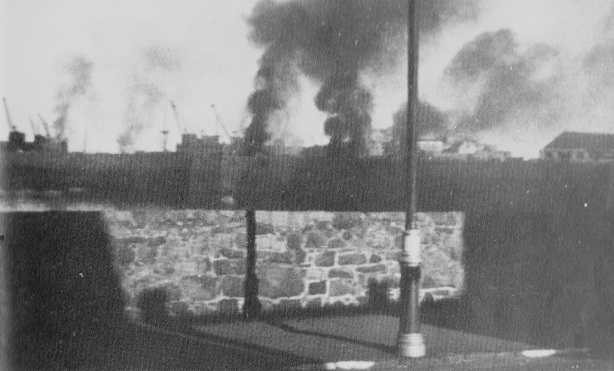
Aftermath of the Harbour Bombing
Ironically, the ‘Guernsey Press’ that evening (which had hit the streets at 5pm), had reported that certain British ‘military experts’ had declared, “There need be no fear of the Germans taking any advantage of the British decision to demilitarise the Channel Islands…” Many people, including some of the injured and dead, would have held that newspaper in their hands whilst listening to the Procurer’s speech.
[The islanders, in shock at the bombing, were furious at the unprovoked attack. There were outbursts of bitterness – which the Germans were later to counter when they refuted the accusations. They described their actions as ‘legitimate acts of war’, claiming to have mistaken the line of tomato-lorries as military vehicles carrying loads of munitions. Nonetheless, the machine-gunning of the lifeboat, ambulance and citizens was totally indefensible. The population knew they were demilitarised and fully expected the Germans to know the same.
The Germans countered that they had absolutely no intelligence reports relating to the Islands’ military or non-military status, having no informants ‘on the ground’. They claimed to have been proceeding with an already proposed plan which was given its final approval on Thursday June 20th …eight days before the attack…assuming the Islands to be defended.
The question still remained…what of the reconnaissance flight the previous day, clearly indicating no evidence of military occupation or anti-aircraft activity and yet they had continued with their ‘blitzkrieg’ – lightning raid – just the same?
They insisted, nonetheless, they had not received any communication advising details of demilitarisation.
On the other side of the ledger, as it was later revealed, the British Government was somehow trying to get “the best of both worlds” by demilitarising the islands but remaining silent on the issue, hoping the enemy would be too preoccupied to notice. It was a case of “trying to be too smart by half”, as the saying goes.
Also unaware of the British position and horrified at the attack, Ambrose Sherwill made an urgent telephone call to London immediately after the raid, in response to which the BBC announced news of the demilitarisation on the 9 p.m. news. Reuters News Agency also released a communiqué. The latter was apparently the means by which the German forces finally heard ‘officially’ of the situation in the Isles…at least that it what they later claimed.
Naturally, once all the facts were later known, many Islanders expressed added bitterness at London’s heartless abandonment of them. The event became cynically known in Guernsey as “The Battle of Tomatoes”]
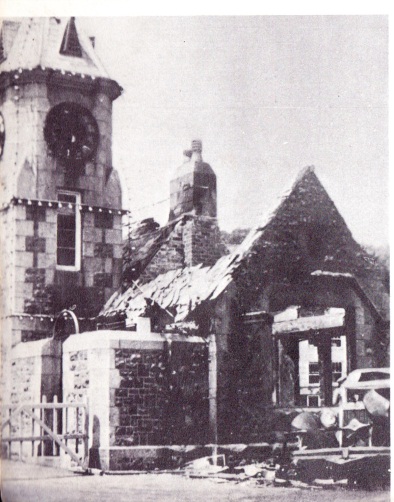
Bomb damage to St Peter Port Clock-
Tower, at the White Rock weighbridge
Bidding the Langmeads a hasty farewell, as they left hurriedly for their home, we made our way up to the flat. Quickly Gilbert contacted Arthur Jackson (Pastor of the De Lancey Elim Church) and together they went down to The White Rock to see the damage and offer any help they could provide.
The sight of the burnt-out lorries was horrifying, especially more so when they learned that some people who were farewelling friends on the ‘Isle Of Sark’, had sought shelter with the lorry drivers beneath the vehicles. People they talked with…many who just wandered aimlessly around the docks area in shock…were terrified that the raiders would return, perhaps after nightfall.
Hearts all over the Island were heavy and sad.
Our new church secretary and his wife lived out in the beautiful parish of Castel, towards the centre of the island. Their property, with its greenhouses and flower gardens, bordered the magnificent Saumarez Park. Their immediate concern was for us, staying in the town so close to the harbour…particularly in the flat above a large building which may be a target…so they phoned us, insisting that we go to stay with them for the time being. As Pastor Jackson lived adjacent to St Sampson’s Harbour…another potential target area, further up the east coast of the Island…they suggested he also join us.
(Arthur and his wife, small daughter and baby boy had arrived in Guernsey not long after Gilbert & Irene’s own arrival. When the evacuation was announced, he sent his wife and children to England, staying himself “for a little while” until he felt it was right for him to leave. His situation was now decided for him by circumstances beyond his control and the folk in his congregation were glad to have him with them.
The Pastor of the third Elim Church at Vazon, on the west coast, was Rev John Woodhead. After much prayer, John had taken his wife and two daughters on one of the boats back to England, intending to return alone and continue his ministry. He was due on the next, return-sailing of the mail-boat “Isle of Sark” however, due to the actions that followed in the next two days, was prevented from so doing.
So there was the Elim work with three churches and now only two Pastors. The ‘future plan’ that had been recently set out for the introduction of lay-preachers to assist in these growing assemblies, was now an imperative.
The situation being as it had now become, it made sense to have both Pastors living in close proximity. To have cooperation at this time, when things were becoming uncertain, was vitally important and it was obvious that each needed the other, in a location where the night curfew would not affect their ability to meet, plan and pray together).
By Saturday night all three of us were installed in ‘Manor View’ with Mr and Mrs Peter LeTissier and their son Ronald. After the traumatic shock of the previous evening, and now finding myself amidst a lovely stand of tall pine trees and surrounded by beautiful gardens, the fresh air made me feel very sleepy. The countryside was so lovely. Hydrangeas, at their very best, formed thick hedges around the charming old homestead. The new bungalow was delightful and we made a happy family all together. In such a delightful spot it was too easy to ignore or forget the dark clouds gathering on our horizon.
Sunday morning, June 30th found us in a morning service filled to capacity. Many people who rarely attended church were in the congregation that morning. Other denominations reported the same. The atmosphere was tense but assurance and calm became very evident as we sang hymns, read God’s Word and shared Communion together. Then, as we prepared to conclude the service, the air-raid siren sounded a warning! Folk looked at each other fearfully as Gilbert suggested that, as best possible, we should move over near the thick granite walls.
Some stood pressed to the wall whilst others sat on the pews or squatted on the floor and children curled up under the pews. We sang hymns and choruses as we waited. No sound of aircraft overhead. After a while it was obvious that some felt they would take the risk and make their ways home. With a prayer for protection, Gilbert gave the benediction. Everyone left silently.
Nothing happened…the ‘all-clear’ never sounded!
Not long after noon, a single German plane touched down at the airport. Head of the Guernsey Police, Inspector Schulper, had been given a sealed letter from the States addressed to “The Officer Commanding, German Forces, Guernsey”…to be handed to the first enemy personnel ashore whenever, wherever, however they arrived. The letter stated that the island had “no armed forces of any description”.
Upon receiving news of this arrival he made his way, poste-haste, to the airport – only to find it deserted. One observer had seen the aircraft land and taxi to the tarmac. Leaving the engine running, a lone pilot had cautiously approached the terminal building and, finding it empty, walked inside, revolver in hand. Just then three British fighter planes passed low, overhead. This apparently startled the pilot, who dashed out of the building (leaving his revolver on the counter), scrambled into his plane and took off in great haste. Whether or not he made it back to his base is unknown.
A short while later (after some tricky manoeuvring, required to scare 50 Alderney cattle to one end of the runway), four German Transport planes arrived. Inspector Schulper made his way, once more, to the airport and handed his letter to Captain Liebe-Pieteritz who earned to distinction of being the first German officer to receive the surrender of British soil.
On hearing the aircraft overhead, Major Sherwill rang the Home Office in London, from his own office, to say “Goodbye”…until the war’s end.
Also hearing the low-flying aircraft were Gilbert and Peter Le Tissier who were sitting at Manor View, enjoying a late Sunday lunch with their wives. Looking up and recognising them to be German transport planes, both of them had the same sudden, awful thought. In a cupboard upstairs at the Eldad church there were thousands of leaflets refuting Adolf Hitler’s claim to world supremacy. Quickly they dashed there and loaded their cars to capacity before speeding off, each to one of the other two churches to collect any copies which had been left there. They then made their way quickly to a place where they knew there was a furnace in which they could rapidly dispose of these documents. The contents of the literature would certainly have been viewed as subversive by the German Forces if discovered. The entire afternoon was spent setting fire to the bundles of propaganda, many of which were so tightly wrapped that they refused to burn quickly. With the aid of some petrol the job was finally finished. They returned to Manor View, reeking of smoke…‘mission accomplished’.
The German landing party, meanwhile, asked to be driven to a location suitable for the establishment of a headquarters. The Inspector called for several police cars as well as commandeering a taxi to take them to the Royal Hotel. After requisitioning the hotel, a Luftwaffe Officer [probably Capt. Liebe-Pieteritz], in the company of a Guernsey Policeman, visited Major Sherwill at Havelet House requesting him to accompany them to their newly established HQ at the Royal. The Bailiff, Victor Carey was also collected and brought to the hotel as the first, rather frightening but almost comical, [1]signs of foreign authority became apparent.
We went to the evening church service under the freedom of British Rule and came home under the Nazi Regime.
I had gone with the Le Tissiers to Eldad, whilst Gilbert had driven out to our Vazon church to fill the empty pulpit. Again, there were well-attended services in churches everywhere. People were in need of hope and comfort. This wasn’t a dream, it was real!
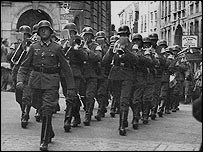
German Forces March on British Soil
St Peter Port’s High Street
On the way home, Gilbert had passed German troops everywhere, especially in the area near the airport, where more aircraft had landed. As he slowed to pass one point where several officers were talking to a squad of men, he was chilled to see the heel clicking, stiff-armed salute of the soldiers and hear them shout “Heil Hitler!”
Monday July 1st. The swastika flew from the Royal Hotel. For many, the knowledge that we had indeed been occupied had yet to dawn upon them, being tucked away in their quiet little rural cottages and homesteads, but the phone-lines were soon running hot as a special free copy of the ‘Star’ was delivered to homes or distributed on the streets. Soon the truth struck home.
That morning, in bold print, the front page of the ‘Star’ (and later, the evening’s ‘Press’) bore the first German Orders to be issued on British soil, under huge banner headlines:
ORDERS OF THE COMMANDANT OF THE GERMAN FORCES
IN OCCUPATION OF
THE ISLAND OF GUERNSEY
- All inhabitants must be indoors by 11pm and must not leave their homes before 6am
- We will respect the population in Guernsey, but, SHOULD ANYONE ATTEMPT TO CAUSE THE LEAST TROUBLE SERIOUS MEASURES WILL BE TAKEN AND THE TOWN WILL BE BOMBED!
- All orders given by the military authority are to be strictly obeyed
- All spirits must be locked up immediately and no spirits may be supplied, obtained or consumed henceforth. This prohibition does not apply to stocks in private houses
- No person shall enter the aerodrome
- All rifles, airguns, pistols, revolvers, daggers, sporting guns and all other weapons whatsoever, except souvenirs, must, together with all ammunition, be delivered to the Royal Hotel by 12 noon today, July 1
- All British sailors, airmen and soldiers on leave in the island must report to the police station
- No boat or vessel of any description, including any fishing boat, shall leave the harbours without an order from the military authority
- The sale of motor spirit is prohibited, except in exceptional circumstances. The use of cars is forbidden
- The black-out regulations already in force must be observed as before
- Banks and shops will open as usual
(Included in the same issue were the funeral notices for victims of Friday’s air-raid, carefully worded in a manner so as to not give offence to the Germans).
Order number 9 was to be particularly noted for us. Poor little Austin 7! Soon it was put up on blocks and we were never to ride in it again! [2]
As we were now living about 3 miles from the church and all bus services were to cease, we were back to the need of transport. Choices were confined to walking or riding bicycles. But…where would one get a bicycle? Overnight they had become premium items.
Even so, Gilbert managed to get a second-hand bike for himself. He then found one for me…almost brand new. It had been bought on a hire-purchase arrangement by someone who had since evacuated and the shop had reclaimed it but, for a small amount, we could pay the debt out. The only problem was…I had never ridden a cycle in my life! Out of sheer necessity, it was now my turn to learn…and FAST! After a wobbly start I was off and away. I loved it! The wind in my face, the joyful exhilaration and the exercise – everything had its compensation and, for me, no less than this new experience.
We rode everywhere. Regulations prohibited riding two abreast – common sense in a place with so many narrow lanes as part of its roadway network – so in single file, bicycle after bicycle was to be seen moving around the island, as if in ‘caravans’. It was a great way to mix and meet with new people, especially when a steep hill was encountered and all had to dismount and walk up together.
……………………………………………………………….
[1] (The escorting soldiers on motorbikes, driving ahead of the vehicles at high speed, had surprised and terrorized on- coming drivers who met them coming down the narrow streets…on the ‘wrong’ side of the road…!)
[2] [Eventually it was requisitioned by the Germans and sent off to France for enemy use there.]
 enemy on the Island - WWII